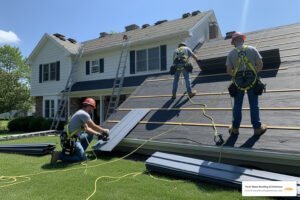
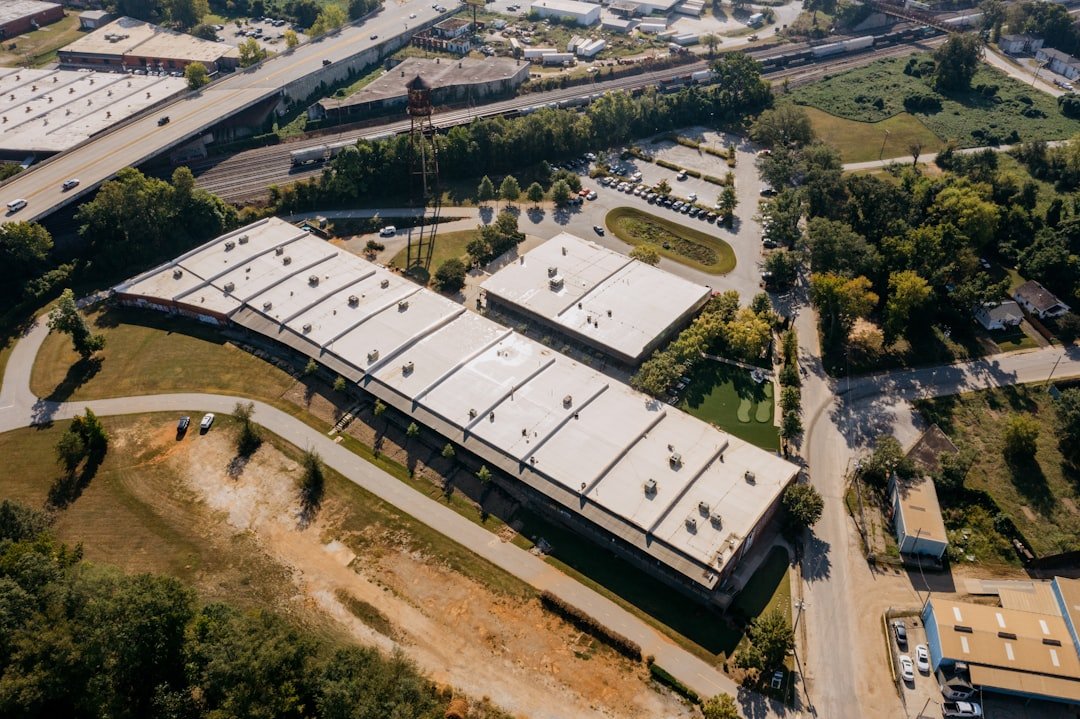
Why Finding the Right Local Commercial Roofing Company Matters in 2026
A local commercial roofing company is the single most important partner a property owner can choose to protect a commercial real estate investment in 2026. The U.S. commercial roofing market exceeds $15 billion in annual value, and more than 60% of commercial building owners rank roof problems among their top three maintenance concerns. At First State Roofing & Exteriors, we’ve seen firsthand how the right contractor transforms a building’s long-term performance — and how the wrong one accelerates costly failures.
Quick answer: What should you look for in a local commercial roofing company?
- Local expertise — Knowledge of regional climate, building codes, and permit requirements
- Proven track record — Verified reviews, completed projects, and industry certifications
- Full-service capabilities — Inspections, installation, repair, maintenance, and emergency response
- Transparent pricing — Written estimates with clear cost breakdowns
- Strong warranties — Coverage on both materials and workmanship
- Rapid availability — Fast response times, especially after storm damage
Approximately 75% of commercial roof failures stem from improper installation or neglected maintenance — not the materials themselves. That statistic means who installs and maintains your roof matters far more than most property owners realize. A local contractor who understands your region’s weather patterns, building codes, and inspection processes can add a decade or more of reliable performance to your roof system.
This guide breaks down what separates great commercial roofing contractors from average ones, the core services and materials you should understand, and exactly what to evaluate before signing any contract.
I’m Richard McCain, Owner and President of First State Roofing & Exteriors Co., and I’ve spent more than 20 years overseeing commercial and residential exterior projects across Kent and Sussex County, DE. Everything in this guide reflects real-world project experience — not industry theory.
Why Choose a Local Commercial Roofing Company Over National Chains?
Choosing a commercial roofer often comes down to a decision between a large national network and a dedicated local contractor. National chains invest heavily in marketing, but they frequently subcontract labor to regional crews — leading to inconsistent quality, fragmented communication, and delayed response times.
A trusted local commercial roofing company delivers measurable structural advantages:
- True Accountability: Local contractors live and work in the same communities they serve. In Kent and Sussex County, DE, our reputation is tied directly to the quality of every completed project.
- Climate-Specific Expertise: A contractor based in Dover or Milford understands how Mid-Atlantic humidity, intense summer UV exposure, winter freeze-thaw cycles, and coastal wind loads impact flat and low-slope roofing systems — knowledge that directly affects material selection and installation methods.
- Direct Communication: Property owners work directly with business owners and project managers rather than an anonymous call center.
When evaluating your options, finding a team that combines local roots with elite technical standards is essential. You can begin narrowing your choices by uncovering elite commercial roofing companies nearby who understand your specific building requirements.
Regulatory Compliance and Local Building Codes
One of the most undervalued benefits of partnering with a local contractor is their working familiarity with regional building codes and municipal regulations. In Kent and Sussex County, DE, building departments in Kent County, Sussex County, and municipalities like Dover and Milford enforce specific structural and energy standards that vary by jurisdiction.
Commercial installations must meet strict wind uplift ratings — often requiring FM Global or UL-rated assemblies — and energy efficiency mandates such as minimum R-30 polyiso insulation for flat roof assemblies under the 2021 International Energy Conservation Code (IECC) as adopted locally. A local commercial roofer maintains direct relationships with code officials, ensuring permits are secured efficiently and every project phase passes municipal inspections without costly rework.
For property owners in the Seaford area, our Seaford DE commercial roofing team provides specialized knowledge of Sussex County permitting requirements. You can also consult the definitive list of local commercial roofing experts to find a partner who guarantees full code compliance.
Rapid Emergency Response
When severe weather strikes, time is the most critical variable. A minor membrane puncture or a clogged drainage system can escalate into a catastrophic interior leak within hours, damaging inventory, disrupting operations, and creating mold hazards that trigger OSHA violations.
A local company can mobilize emergency repair teams within hours. Proximity allows crews to arrive with the necessary equipment for immediate mitigation — emergency tarping, temporary membrane patching, and localized water extraction — while a national firm may take days to dispatch an approved subcontractor.
If your facility suffers sudden storm damage, explore the top commercial roof repair companies near me to identify a rapid-response partner before a crisis occurs.
Core Services Offered by Commercial Roofing Contractors
Commercial roofing is a specialized trade requiring heavy equipment, advanced safety protocols, and deep material expertise. A professional commercial contractor manages a complex building envelope engineered to protect physical assets, maintain interior climate control, and meet stringent code requirements.
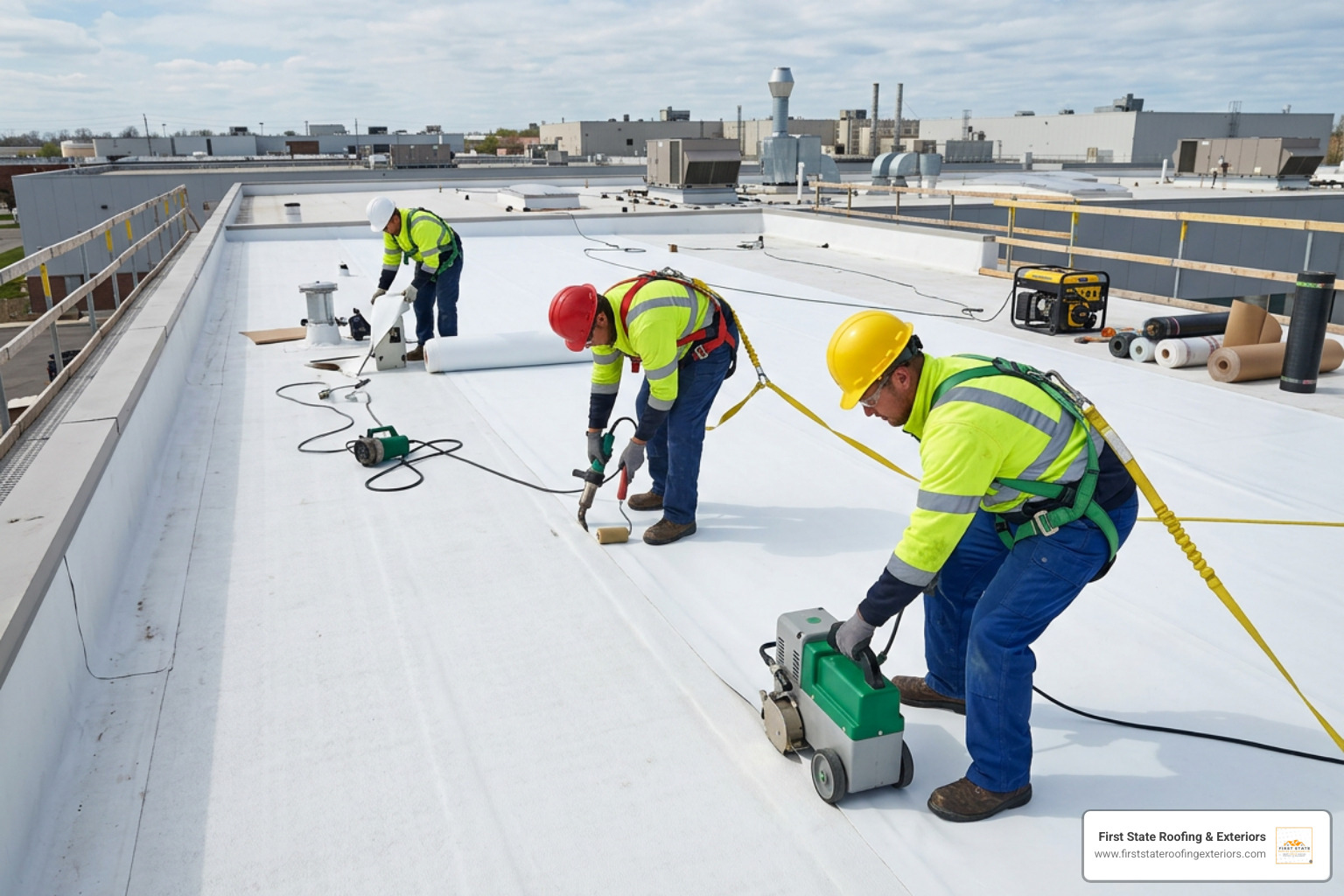
To keep your facility secure and dry, a full-service contractor provides end-to-end commercial solutions. You can view our complete range of capabilities on our commercial exterior services page.
Comprehensive Inspections
A professional commercial roof inspection is a diagnostic process that goes far beyond a visual walkthrough. It identifies hidden vulnerabilities before they manifest as active leaks or structural damage.
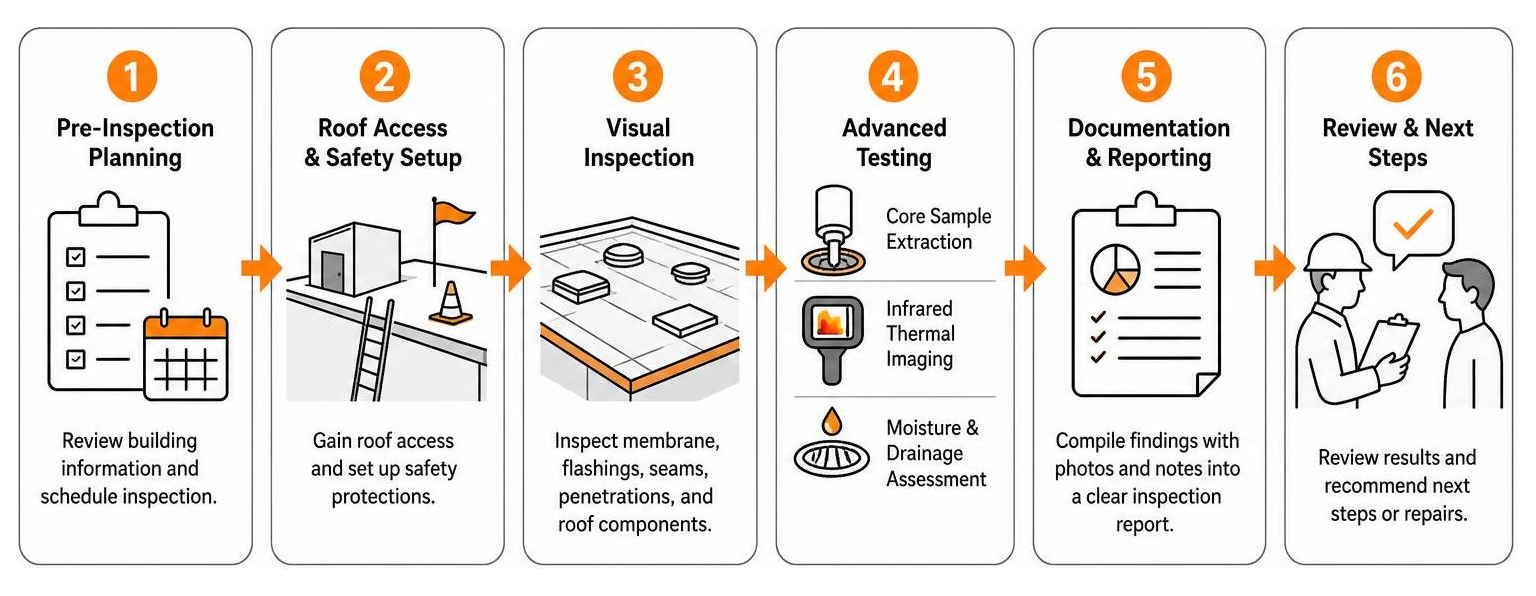
During an inspection, a qualified commercial technician will perform:
- Core Sample Extraction: Cutting a small cylindrical cross-section of the roof down to the deck to analyze insulation layers, detect hidden moisture saturation, and determine the exact composition of older roof systems.
- Infrared Thermal Imaging: Using specialized thermal cameras to detect temperature differentials across the roof surface. Wet insulation retains heat longer than dry insulation, so infrared scans pinpoint subsurface moisture with precision — often identifying problems invisible to the naked eye.
- Drainage and Perimeter Analysis: Evaluating commercial gutters, scuppers, interior drains, and parapet walls to confirm water is shedding efficiently. Standing water that remains for more than 48 hours accelerates membrane degradation and adds structural load.
For more detail on what to expect during a professional diagnostic assessment, check out our local commercial roofing complete guide.
Commercial Roof Replacement and Retrofitting
When a commercial system reaches the end of its useful life, property owners face a critical decision between a complete tear-off and a roof overlay (retrofit).
A complete tear-off involves stripping the existing system down to the structural deck, repairing any rotted wood or damaged metal decking, and installing an entirely new insulation and membrane assembly. While more labor-intensive, this method eliminates trapped moisture and provides a clean substrate for maximum adhesion and warranty coverage.
A retrofit (overlay) involves installing a new single-ply membrane directly over the existing roof. This approach reduces labor time by 30–40% and diverts thousands of pounds of material from landfills. However, it is only viable if the existing roof structure is dry and structurally sound. Building codes typically limit commercial structures to a maximum of two roofing layers.
For property owners considering a full system replacement, our commercial roof replacement service page outlines the process from initial assessment through final inspection. You can also read our detailed guide on commercial roof replacement costs and systems explained to weigh the financial and structural trade-offs.
Common Commercial Roofing Systems and Materials
Selecting the right material for a commercial property depends on the building’s structural design, local weather exposures, chemical exposure risks, foot traffic requirements, and long-term budget constraints.
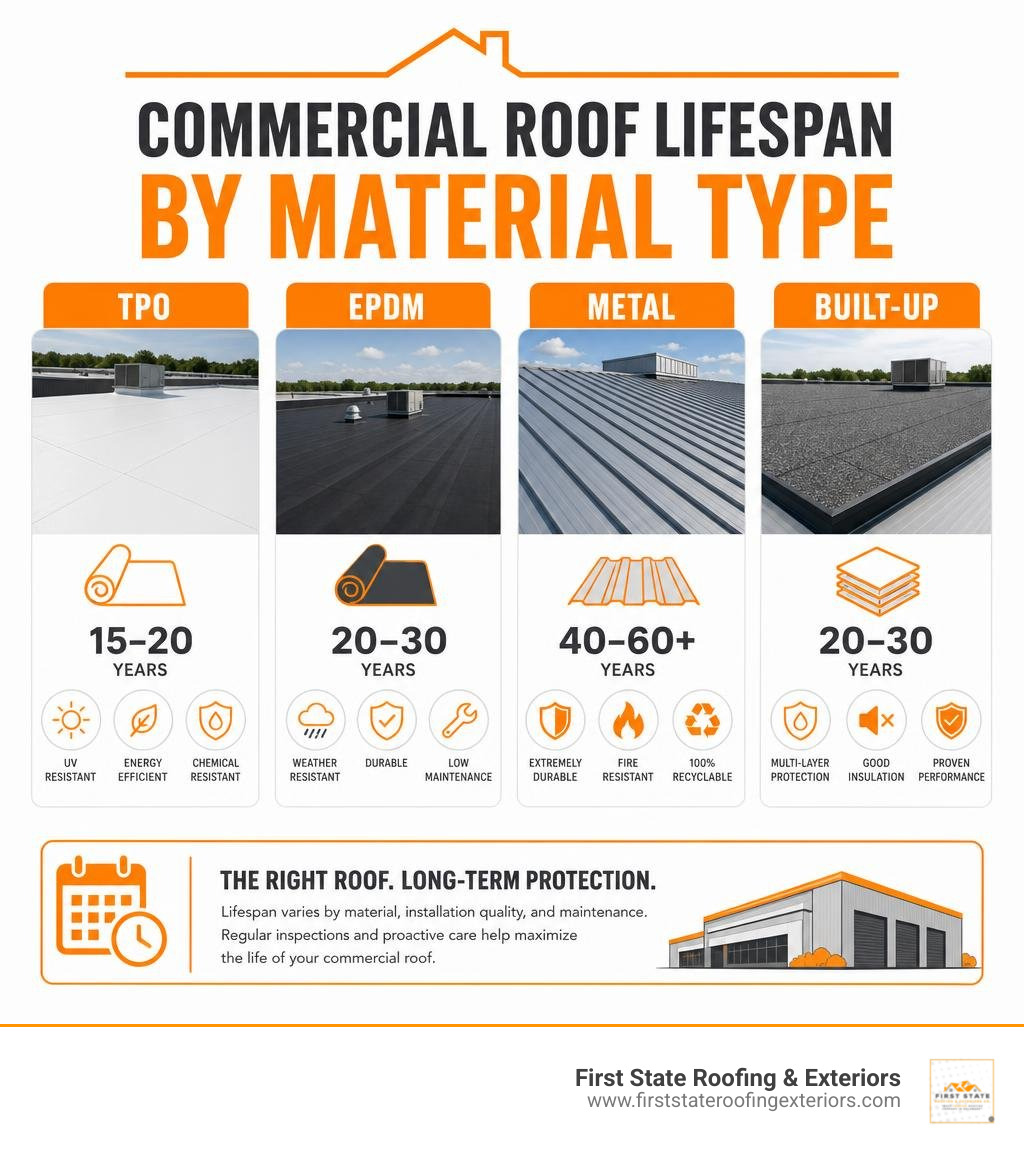
The following comparative matrix summarizes the most widely specified commercial roofing systems in 2026:
| Material Type | Average Lifespan | Estimated Cost per Sq. Ft. (Installed) | Wind Resistance Rating | Energy Efficiency (Reflectivity) | Best Suited For |
|---|---|---|---|---|---|
| TPO (Thermoplastic Polyolefin) | 20–30 Years | $8.00 – $12.00 | Excellent | Exceptional (Cool Roof) | Retail, Offices, Warehouses |
| EPDM (Synthetic Rubber) | 25–35 Years | $7.50 – $11.00 | Very Good | Fair (Unless Coated White) | Industrial Facilities, Cold Climates |
| PVC (Polyvinyl Chloride) | 20–30 Years | $9.00 – $14.00 | Exceptional | Exceptional (Cool Roof) | Restaurants, Food Processing |
| Standing Seam Metal | 50+ Years | $12.00 – $20.00 | Outstanding | Good (With Cool Coatings) | Steep-Slope, High-End Commercial |
| Modified Bitumen | 15–20 Years | $8.50 – $13.00 | Good | Fair | High-Traffic Flat Roofs |
Membrane selection is a long-term capital decision. For an in-depth breakdown of these materials and their manufacturing standards, consider exploring commercial roof materials and manufacturers.
Single-Ply Membranes: TPO, PVC, and EPDM
Single-ply membranes are the industry standard for flat and low-slope commercial properties, accounting for an estimated 40% of all commercial re-roofing projects in the United States.
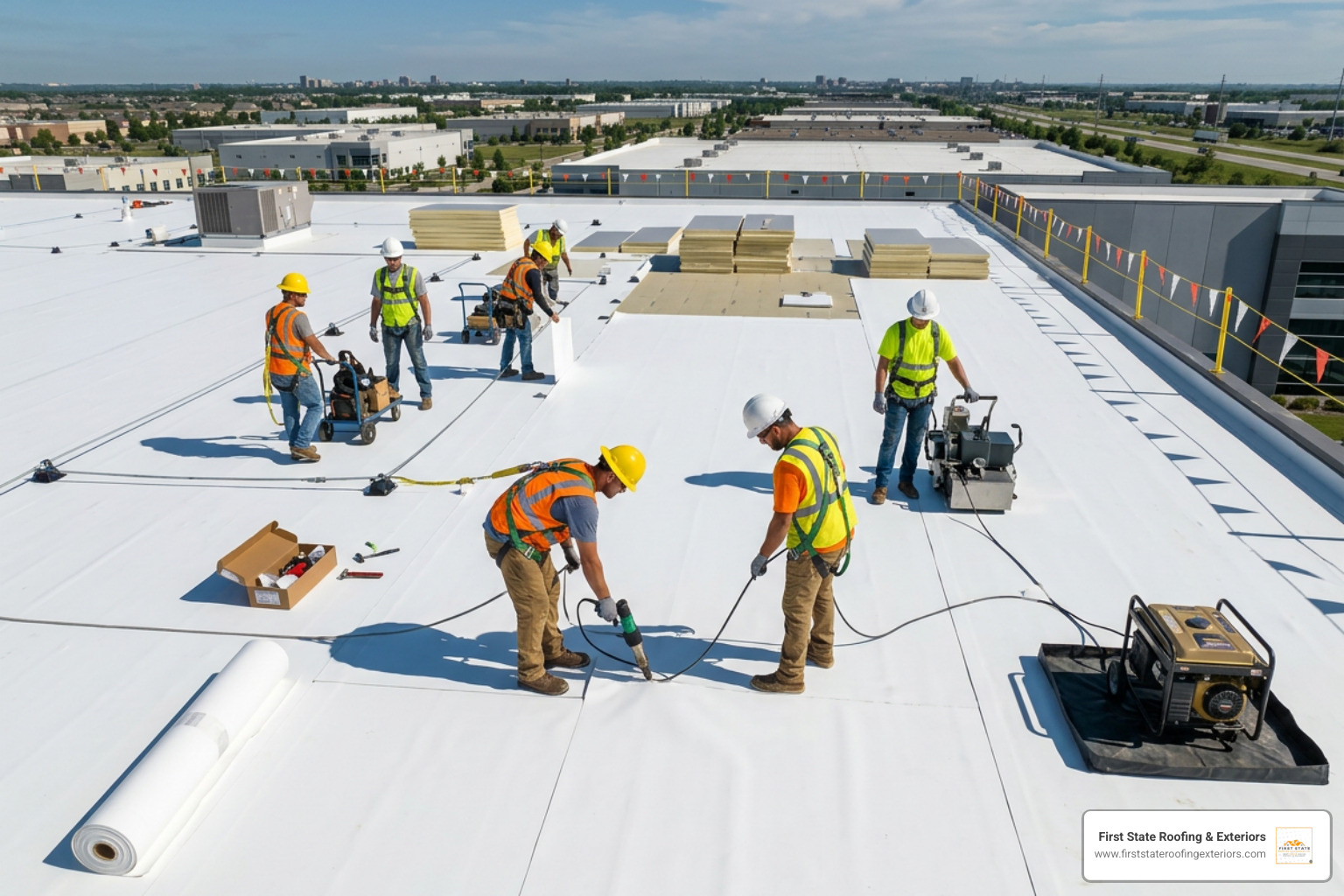
- TPO (Thermoplastic Polyolefin): TPO is a highly reflective single-ply membrane featuring heat-welded seams. Hot-air welding physically fuses the seam material together, creating a monolithic bond that is up to four times stronger than adhesive or taped seams. TPO delivers exceptional resistance to UV radiation, ozone, and algae growth.
- PVC (Polyvinyl Chloride): PVC membranes are uniquely resistant to chemicals, grease, and animal fats — making PVC the premier choice for restaurants, food processing plants, and manufacturing facilities with active rooftop exhaust systems. PVC also offers superior fire resistance with a Class A rating.
- EPDM (Ethylene Propylene Diene Terpolymer): EPDM is a synthetic rubber membrane known for extreme flexibility. It remains pliable in temperatures as low as -60°F, allowing it to absorb thermal expansion and contraction cycles without cracking — a critical advantage in the Mid-Atlantic region’s variable climate.
For technical specifications and industry-approved installation guidelines, consult the National Roofing Contractors Association (NRCA).
Commercial Metal and Asphalt Systems
For properties with steep-slope designs or high-traffic flat roofs, metal and asphalt-based systems remain proven, reliable choices.
- Architectural Metal Roofing: Standing seam metal roofs feature concealed fasteners that eliminate exposed penetration points, preventing water entry. With proper maintenance, metal roofs routinely exceed 50 years of service. They carry Class A fire ratings and meet the highest wind resistance standards, including Miami-Dade NOA approvals.
- Modified Bitumen (Mod-Bit): Mod-bit systems consist of multiple layers of asphalt modified with SBS (styrene-butadiene-styrene) rubber or APP (atactic polypropylene) polymers for enhanced strength and flexibility. These multi-ply systems are exceptionally tough, making them ideal for roofs with heavy foot traffic from HVAC maintenance crews or rooftop equipment servicing.
For detailed engineering bulletins and performance data on asphalt-based commercial systems, refer to the Asphalt Roofing Manufacturers Association (ARMA).
Maximizing Energy Efficiency and Sustainability
In 2026, a commercial roof is no longer viewed simply as a shield against rain — it is a powerful tool for reducing operational costs. Energy-efficient commercial roofing systems can reduce a building’s cooling costs by up to 30% annually, providing a rapid return on investment.
The primary driver of these savings is the Cool Roof concept. Highly reflective white TPO and PVC membranes reflect up to 85% of solar heat back into the atmosphere, rather than absorbing it into the building’s interior. This significantly lowers the temperature of the roof surface, reducing the load on your rooftop HVAC units and extending their operational lifespans.
Additionally, many property owners are utilizing roof restorations — applying high-solids silicone or acrylic roof coatings over existing membranes — to extend the life of their roofs by 15 or more years while instantly upgrading their thermal reflectivity.
To learn more about how modern energy codes and sustainable materials are integrated into a commercial project, read our comprehensive commercial flat roof replacement guide.
Frequently Asked Questions about Commercial Roofing
How much does a commercial roof replacement cost in 2026?
The average cost of a commercial roof replacement in 2026 ranges from $8.00 to $14.00 per square foot installed, depending on the membrane material, insulation requirements, and structural complexity.
A standard 10,000-square-foot flat roof replacement using a 60-mil TPO membrane with code-compliant polyiso insulation typically costs between $80,000 and $120,000. Primary cost drivers include:
- Tear-off labor: Removing multiple existing layers increases disposal fees and labor hours significantly.
- Insulation thickness: Meeting modern energy codes — such as R-30 minimum insulation requirements under the IECC — directly impacts material costs.
- Penetrations: Roofs with numerous HVAC units, skylights, and vents require extensive custom flashing work, adding 10–20% to total labor costs.
For a detailed breakdown of pricing trends and budgeting strategies, check out our guide on commercial roof replacement cost in 2025 and beyond.
How often should a commercial roof be inspected?
Commercial roofs should be inspected at least twice per year — in the spring and autumn — and immediately following any severe weather event such as hail, high winds exceeding 60 mph, or heavy snowfall.
Bi-annual inspections are critical for identifying minor issues before they escalate. During these assessments, technicians clear debris from drainage systems, check for membrane punctures, inspect flashing at joints and penetrations, and verify that seams remain fully sealed. Neglecting documented inspections can void manufacturer warranties, which typically require proof of preventative maintenance at specified intervals.
To understand how routine maintenance protects your bottom line, read more about commercial roof and gutter repair.
What is the average lifespan of a commercial flat roof?
The average lifespan of a commercial flat roof is 20 to 30 years, determined primarily by the membrane material, installation quality, and adherence to a preventative maintenance schedule.
A single-ply TPO or PVC roof can deliver 25+ years of reliable service when properly installed and maintained. However, improper installation or poor drainage design can reduce that lifespan by 50% or more. Standing water (ponding) that remains on a roof surface for more than 48 hours degrades membranes through accelerated UV exposure and places significant structural stress on the building deck. Partnering with an experienced local contractor ensures your system is designed with proper slope — a minimum of ¼ inch per foot — and adequate drainage to maximize its service life.
To estimate long-term capital expenses and plan for future upgrades, use our regional cost guidelines to calculate flat roof replacement cost.
Conclusion
Your commercial roof is the first line of defense protecting your business, employees, and inventory. Partnering with a dedicated local commercial roofing company ensures your property receives specialized care, regional expertise, and the rapid response times required for reliable year-round performance.
First State Roofing & Exteriors is Kent and Sussex County, DE’s trusted commercial roofing expert, delivering unmatched integrity, transparency, and 24/7 emergency availability to property owners throughout the state.
We provide completely free, professional estimates for commercial property owners who need clear guidance before making a roofing decision. Call (302) 222-4065 today to schedule your free inspection and get an honest assessment of your roof’s condition — no obligation, no pressure.