Most Kent County homeowners don’t think about their roof until something goes wrong. But if your cooling bills climb every summer and your upstairs stays stuffy no matter what the thermostat says, your roof is already affecting your daily life — you just haven’t connected the two yet. A conventional dark asphalt roof can reach surface temperatures above 150°F on a hot Delaware afternoon. That heat doesn’t stay outside. It pushes straight into your attic and radiates down into your living space. Cool roofing materials work differently — and the results are measurable. Here’s what you need to know.
What Are Cool Roofing Materials?
Cool roofing materials are products specifically engineered to reflect more sunlight and release absorbed heat more efficiently than standard roofing. Two properties define them: solar reflectance and thermal emittance. Solar reflectance measures how much sunlight a surface bounces back instead of absorbing. Thermal emittance measures how quickly the material sheds whatever heat it does absorb. The higher both numbers, the cooler the roof runs.
The Cool Roof Rating Council — an independent organization — tests and rates roofing products on both metrics, and ENERGY STAR uses those ratings to certify qualifying products. So when a contractor tells you a product is a “cool roof,” there’s a way to verify that claim. It’s not just a marketing label.
In practice, a cool roof surface stays roughly 50°F cooler than a conventional dark roof on the same summer afternoon. That gap directly reduces how hard your AC works — and for a single-story home, that can translate to up to 15% less cooling energy use over the course of a summer.
Metal Roofing vs. Asphalt Shingles for Energy Efficiency
This is one of the most common questions we hear, and it’s worth answering honestly. Asphalt shingles are the default choice for most residential roofing projects — they’re familiar, widely available, and relatively affordable upfront. But in Kent County’s climate, they come with a real drawback: they don’t last as long as they do elsewhere.
Because of Kent County’s hot, humid summers, coastal storm exposure, and year-round moisture load, asphalt shingles typically last only 15 to 22 years here — compared to 20 to 30 years in less demanding climates. That shorter lifespan means you’re replacing your roof more often, and each replacement is a cost you absorb again from scratch.
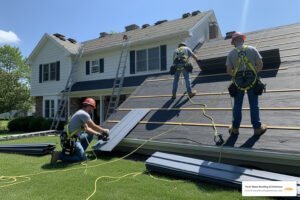
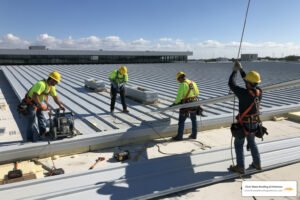
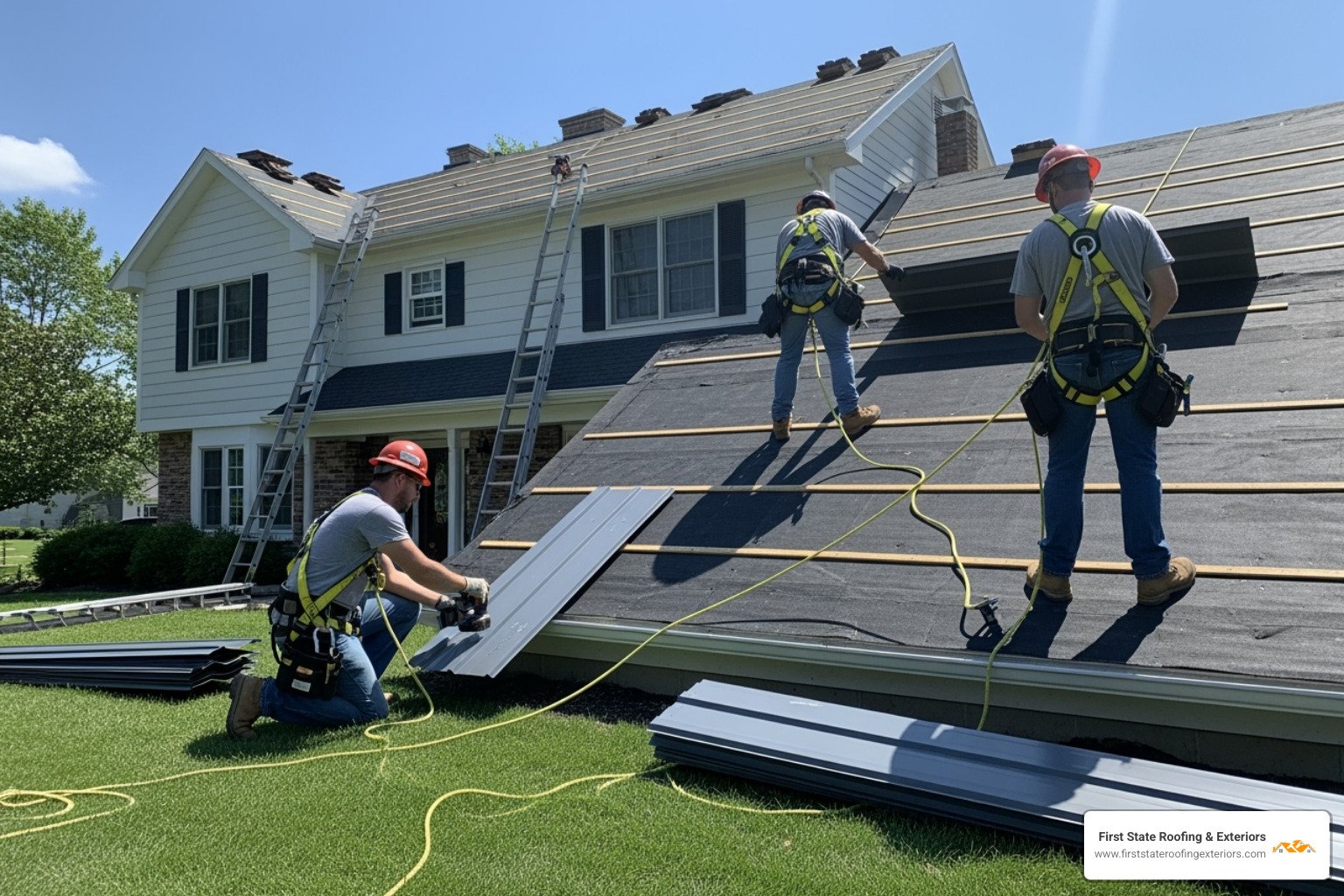
Metal roofing behaves differently in heat. It has low thermal mass, meaning it doesn’t store heat the way asphalt does. Combined with the air gap that forms between the metal panels and the roof deck during installation, metal roofing creates a natural thermal break that keeps attic temperatures significantly lower. That’s before you factor in reflective coatings, which push the performance even further.
The lifespan comparison is significant. A properly installed metal roof in Kent County can last 40 to 60 years or more — more than double what you’d expect from asphalt in this climate. The upfront cost is higher, but when you account for how many times you’d replace an asphalt roof over that same period, the math often shifts. You’re not paying more for a metal roof so much as you’re paying once instead of twice or three times.
From an energy standpoint, cool metal roofing can reduce cooling costs by 7% to 15% annually, according to the Green Building Alliance. That’s not a dramatic number in any single year, but compounded over 40 years of ownership, it adds up to real money. And it does that while also reducing the thermal stress on the roof itself — which is part of why metal roofs last as long as they do.
For Kent County homeowners who are already cycling through asphalt roofs every 15 to 20 years, metal roofing is worth a serious look the next time a replacement comes up.
What Is a Galvalume Roof and Is It Worth It in Delaware?
Galvalume is a specific type of steel used in metal roofing — and it’s worth understanding what makes it different from standard galvanized metal, especially if you’re in a humid, coastal-adjacent area like Kent County.
Standard galvanized steel is coated with zinc to resist corrosion. Galvalume steel uses a coating that combines aluminum, zinc, and silicon. That aluminum content is what sets it apart. Aluminum forms a tighter, more stable barrier against moisture and oxidation than zinc alone, which means Galvalume holds up significantly better in humid environments over time. In moderate climates with high moisture exposure — which describes Delaware fairly well — Galvalume roofing can last 50 years or more, with many installations exceeding 60 years under the right conditions.
For Kent County specifically, this matters. The county sits far enough inland that it’s not directly coastal, but Delaware’s weather is heavily shaped by Atlantic systems — nor’easters in the fall and spring, tropical moisture in late summer, and consistent year-round rainfall that averages around 45 inches annually. That’s a lot of moisture cycling through a roofing system every year. A material that handles humidity better isn’t just a nice upgrade; it’s a practical choice for the local climate.
Galvalume is also lightweight, which reduces structural load on the home, and it pairs well with reflective coatings that push its solar reflectance into cool roof territory. If you’re evaluating metal roofing options and wondering whether the Galvalume distinction matters — in Kent County, it does. It’s not a premium you’re paying for a brand name. It’s a material that’s genuinely better suited to the conditions your roof will face here.
We install Galvalume and other metal roofing systems across Kent County, and we’re happy to walk you through the specifics for your home’s situation.
Roof Restoration as a Path to Cool Roofing Performance
Not every homeowner is in a position to do a full roof replacement right now — and not every roof needs one. If your roof is still structurally sound but aging, roof restoration with a reflective coating is a legitimate way to gain cool roofing benefits without starting from scratch.
Roof restoration involves applying an engineered reflective coating to an existing roof surface. Done correctly with a CRRC-rated product, it increases solar reflectance and thermal emittance — the same two properties that define a cool roof — and can meaningfully extend the life of the underlying roof system. It’s not paint. It’s a performance upgrade.
The cost is a fraction of a full replacement, with most homeowners paying between $542 and $2,514 for materials and professional application, averaging around $1,466 for a typical home. For a roof that has useful life remaining, that’s a compelling option.
Does a Cool Roof Coating Actually Work, or Is It Just Marketing?
It’s a fair question, and the skepticism is healthy. The roofing industry has its share of products that promise more than they deliver. But CRRC-rated and ENERGY STAR-qualified cool roof coatings are independently tested — not just labeled by the manufacturer. The Cool Roof Rating Council publishes a searchable directory of rated products that shows actual solar reflectance and thermal emittance values, including how those values hold up after three years of weathering. That aging data matters because a coating that performs well when new but degrades quickly isn’t worth much.
When a coating is applied to an eligible existing roof — one that’s still in serviceable condition without widespread damage or moisture intrusion — it can genuinely extend the roof’s life by years while delivering measurable energy performance. The reflectance improvement reduces UV and infrared radiation wear on the underlying material, which is one of the primary mechanisms behind asphalt shingle degradation in the first place.
For Kent County homeowners, this is worth knowing because Delaware’s climate is particularly hard on roofing materials. If your roof was installed 10 or 12 years ago and is showing early signs of aging but isn’t failing, restoration is a real option — not just a delay tactic. You’re buying time while also improving performance, rather than spending money on an emergency replacement when the roof finally gives out.
The honest caveat: restoration isn’t appropriate for every roof. A contractor worth trusting will assess the substrate first and tell you if the roof isn’t a good candidate. If there’s active moisture intrusion or widespread shingle failure, a coating won’t fix that. But for a roof that’s aging but intact, it’s a legitimate and cost-effective path to cool roofing performance.
Storm Damage in Kent County and the Upgrade Window Most Homeowners Miss
Delaware gets hit. Nor’easters roll through in the fall and spring. Tropical systems track up the coast in late summer. In August 2020, Hurricane Isaias produced an EF2 tornado in Dover — the longest-tracked tornado in Delaware state history — and caused significant roofing damage across Kent County. These aren’t rare events. They’re part of living in this part of the Mid-Atlantic.
When storm damage forces a roof replacement, most homeowners default to replacing like-for-like. They were happy enough with asphalt before, the insurance claim covers the replacement cost, and it feels like the simplest path. That’s understandable. But it’s also a missed opportunity, because the replacement moment is when upgrading to a cool roofing material is most financially accessible.
If your insurance claim is covering the cost of a new roof, the incremental difference between standard asphalt and a more durable, energy-efficient material is often far more manageable than it would be in a non-claim scenario. You’re already spending the money on installation. The question is just what material goes on top.
We work directly with insurance providers and help our customers navigate the claims process from inspection through completion. That means you’re not managing the paperwork and the contractor coordination at the same time — we handle it together. If a storm has already pushed you toward a replacement decision, that’s exactly the moment to have a conversation about what material makes the most sense for the next 40 years, not just the next 15.
We’ve been doing this work in Kent County for over 22 years, and we’re authorized installers of GAF, Owens Corning, TAMKO, CertainTeed, and Atlas Pro materials. That breadth of manufacturer relationships means we can match the right product to your home’s specific needs — roof pitch, aesthetic preference, budget, and performance goals — rather than steering you toward whatever a single manufacturer offers.
Is a Cool Roof the Right Choice for Your Kent County Home?
The short answer: for most homeowners in this area, yes — in one form or another. Whether that means a full metal or Galvalume replacement, a cool shingle upgrade at the next replacement cycle, or a reflective coating on a roof that still has life in it, there’s a path that fits most situations and most budgets.
Kent County’s climate makes the case on its own. Hot, humid summers, consistent storm exposure, and 45 inches of annual rainfall are hard on conventional roofing materials — and easy on your energy bill when you have a roof that’s actually working with the weather instead of absorbing it.
If you’re not sure where your current roof stands or which option makes sense for your home, the best starting point is a free estimate. First State Roofing & Exteriors Co. serves Dover, Milford, Smyrna, Harrington, Felton, Greenwood, and the surrounding communities across Kent County — and we’re happy to give you a straight answer about what your roof actually needs.