What Does Commercial Flat Roof Replacement Cost in 2026?
Commercial flat roof replacement cost is one of the biggest budgeting questions for any property owner or facility manager. Here’s a direct answer before we dive deeper:
| Roof Size | Estimated Cost Range |
|---|---|
| 1,500 sq ft | $10,000 – $22,500 |
| 10,000 sq ft | $45,000 – $150,000 |
| 50,000 sq ft | $200,000 – $750,000 |
| 100,000 sq ft | $450,000 – $1,500,000 |
National average cost per square foot: $4 to $15, with most projects falling between $6 and $9/sq ft.
Costs vary based on material choice, roof condition, location, and complexity. A simple TPO overlay on a clean deck costs far less than a full tear-off with insulation upgrades and custom HVAC flashing.
If your building is in Kent and Sussex County, DE, our commercial roofing experts at First State Roofing & Exteriors can give you an accurate, no-obligation estimate — call us at (302) 222-4065 to schedule a free inspection.
Planning a commercial roof replacement means more than just picking a material. You need to budget for tear-off, insulation, drainage, permits, and labor — all of which can significantly shift your final number. A roof that looks straightforward from the ground often reveals hidden costs once work begins. As one roofing contractor noted after a recent project in Queens, NY: a 3,500 sq ft warehouse quoted at $42,000 ended up at $51,500 once three layers of old roofing and HVAC complications were uncovered.
That’s exactly why getting a thorough inspection before committing to a price matters so much.
I’m Richard McCain, Owner and President of First State Roofing & Exteriors, with over 20 years of hands-on experience managing commercial flat roof replacement cost decisions for property owners across Kent and Sussex County, DE. In this guide, I’ll walk you through everything you need to budget accurately and make a confident decision.
Common commercial flat roof replacement cost vocab:
Understanding Your Commercial Flat Roof Replacement Cost
When it comes to commercial properties, no two flat roofs are identical. However, understanding the baseline figures is the first step in mapping out your capital expenditure. Nationally, a commercial flat roof replacement typically averages between $6,000 and $22,500 for smaller spaces (like a 1,500-square-foot retail storefront), while larger industrial warehouses can easily cross into six-figure territory.
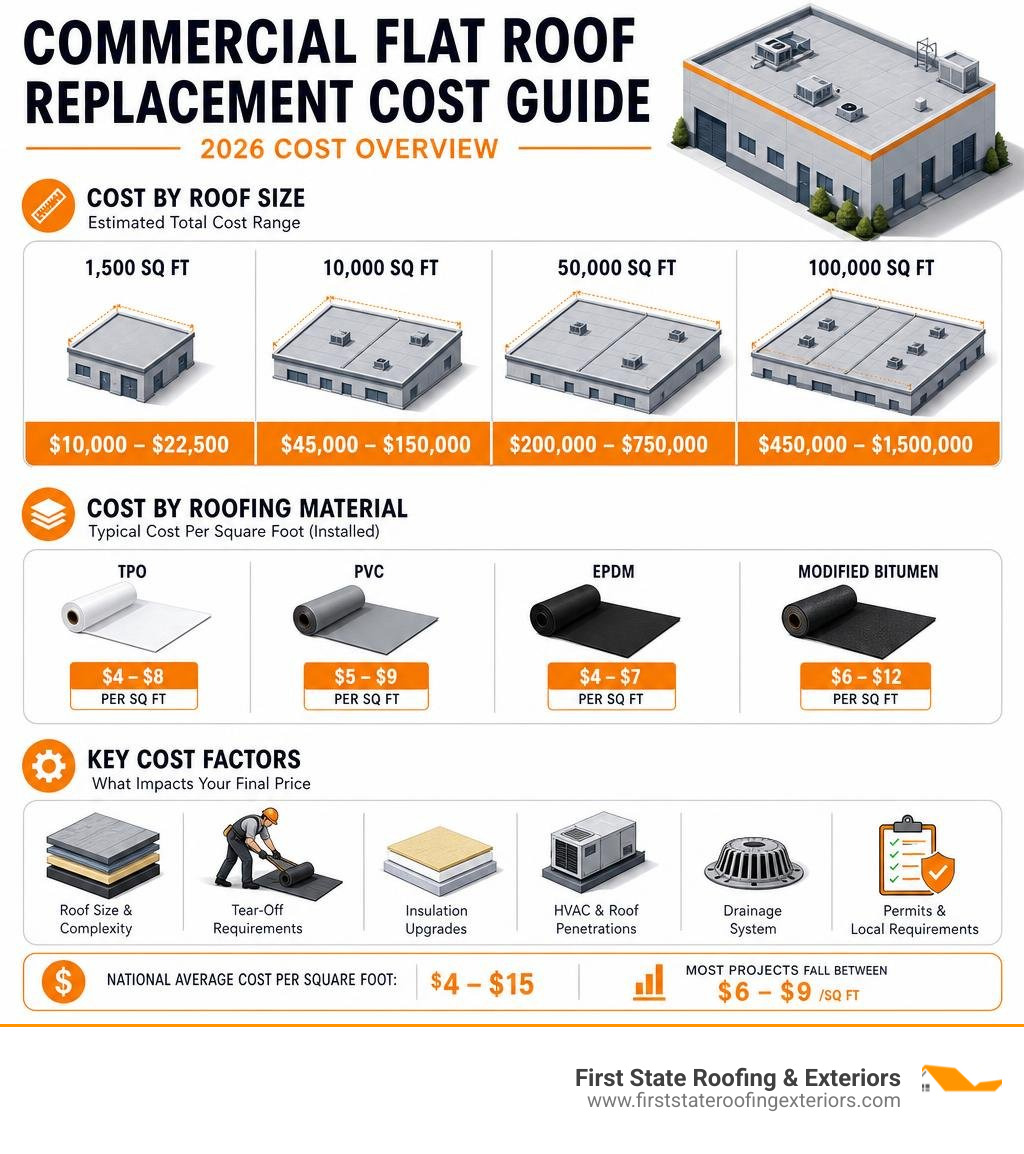
To help you visualize how these numbers scale, we have mapped out the commercial roof replacement costs and systems explained below. This shows how size and structural demands dictate the overall pricing spectrum.
Average Commercial Flat Roof Replacement Cost Per Square Foot
The average commercial flat roof replacement cost per square foot ranges from $4 to $15, with most mid-sized commercial properties landing in the $6 to $9 per square foot sweet spot.
This per-square-foot cost is heavily influenced by the condition of the underlying substrate and the specific membrane you choose. For a detailed national cost analysis, Angi’s Flat Roof Replacement Cost Guide highlights that labor and preparation work typically make up 40% to 60% of these total square-foot rates.
Total Commercial Flat Roof Replacement Cost by Building Size
As your roof’s footprint grows, economies of scale begin to work in your favor. While a 1,500 sq ft roof might cost closer to the higher end of the per-square-foot spectrum due to minimum setup fees and localized labor mobilization, a massive warehouse benefits from bulk material discounts.
- 10,000 Square Feet: Expect a total cost of $45,000 to $150,000. At this scale, single-ply membranes like TPO or EPDM are highly cost-effective because rolls can be laid out quickly with fewer seams per square.
- 100,000 Square Feet: Expect a total cost of $450,000 to $1,500,000. On these large-scale industrial projects, material volume discounts are substantial, but logistics (like crane rentals, material staging, and safety monitoring) play a larger role in the final budget.
Key Factors That Influence Commercial Flat Roof Replacement Costs
Calculating your budget isn’t as simple as multiplying your square footage by a flat rate. There are several physical and environmental variables that our teams evaluate during a professional on-site inspection.
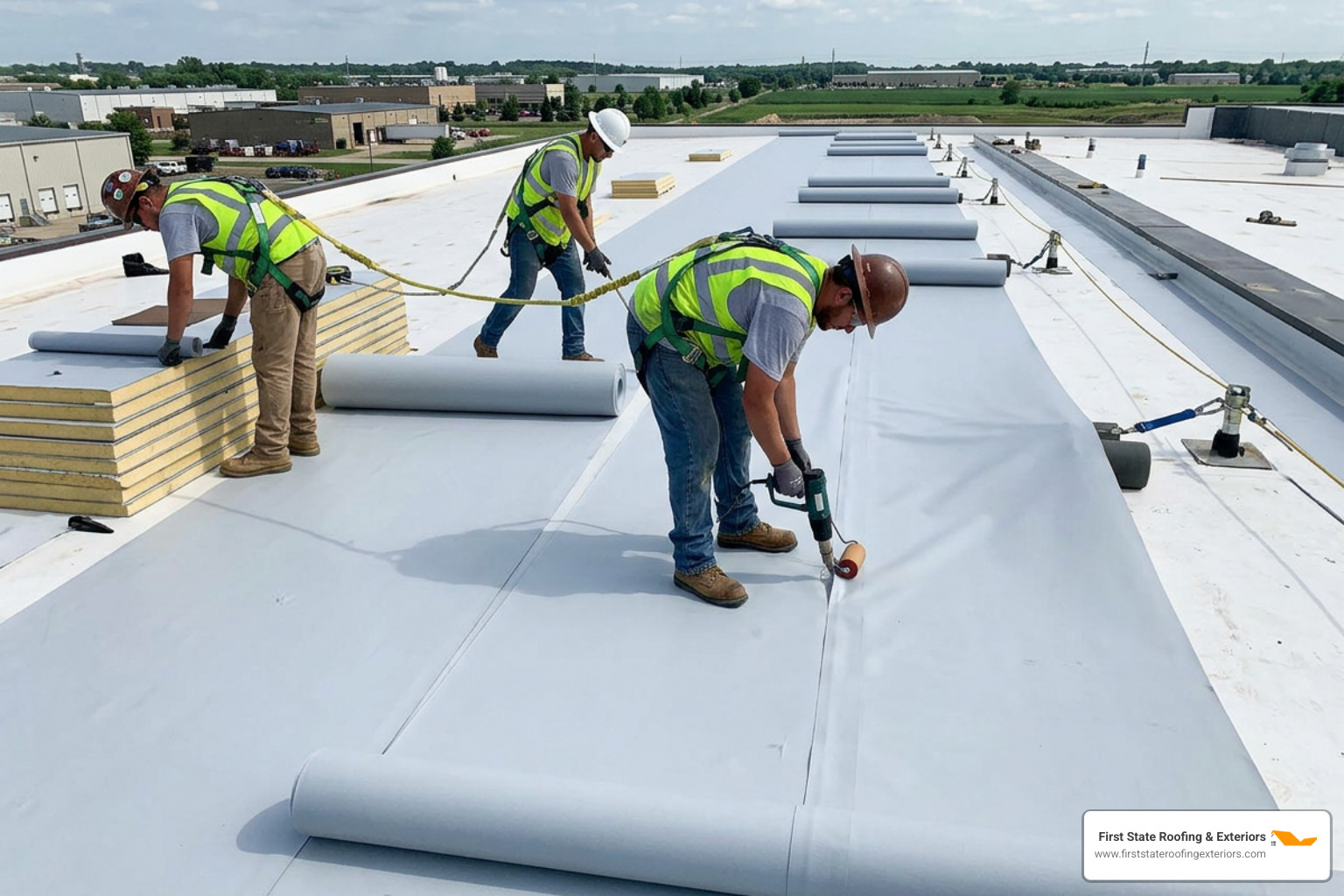
Every commercial building presents unique structural challenges. For a comprehensive look at how these variables alter pricing, you can review the HomeGuide Flat Roof Replacement Cost Analysis.
Roof Complexity and Penetrations
A wide-open flat roof with nothing on it but clean parapet walls is a roofer’s dream. However, most commercial roofs are crowded with HVAC units, skylights, exhaust vents, plumbing pipes, and drainage systems.
Each of these penetrations requires custom flashing, boots, and detailed sealing to remain watertight. If your roof has multiple HVAC systems, expect to pay between $200 and $500 per unit for specialized flashing labor. For a deeper dive into maintaining and repairing these complex commercial roof components, read our Office Roof Repair Guide 2025.
Geographic Location and Local Building Codes
Your physical address dictates your labor costs and material requirements. In Kent and Sussex County, DE, we experience hot, humid summers and cold, coastal winters. This temperature swing causes flat roofs to expand and contract constantly. Furthermore, coastal high-wind zones mean local building codes require robust fastening patterns to prevent wind uplift.
If you are planning a project in the Kent County area, our Dover commercial roofing guide details how local municipal permits, zoning laws, and coastal weather patterns affect your installation.
Comparing Commercial Flat Roofing Materials: Cost vs. Lifespan
Selecting the right material is a balancing act between your immediate capital budget and the long-term cost of ownership. Different materials offer vastly different lifespans, maintenance requirements, and energy-saving properties.
For an in-depth breakdown of brands and system configurations, check out our guide on Beyond The Shingles Exploring Commercial Roof Materials And Manufacturers.
| Material | Cost Per Sq. Ft. | Expected Lifespan | Key Benefit |
|---|---|---|---|
| TPO | $6.50 – $8.50 | 20 – 30 Years | Highly reflective, energy-efficient |
| EPDM | $7.00 – $10.00 | 25 – 35 Years | Extremely durable, handles thermal shock |
| PVC | $8.00 – $11.00 | 20 – 30 Years | Highly resistant to chemicals and grease |
| Modified Bitumen | $4.00 – $8.00 | 15 – 20 Years | Great for heavy foot traffic |
| BUR (Built-Up) | $5.00 – $10.00 | 20 – 30+ Years | Time-tested, multi-layer redundancy |
TPO (Thermoplastic Polyolefin)
TPO is currently the most popular choice for commercial flat roofs in Kent and Sussex County, DE. Priced between $6.50 and $8.50 per square foot, it offers fantastic value. TPO is a white, highly reflective single-ply membrane that bounces solar radiation away from your building, lowering your summer cooling costs by 15% to 30%. Its seams are heat-welded with specialized hot-air tools, creating a physical bond that is up to four times stronger than taped seams.
EPDM (Ethylene Propylene Diene Monomer)
Often called “rubber roofing,” EPDM is a synthetic rubber membrane costing $7.00 to $10.00 per square foot. It is incredibly resilient against hail, UV exposure, and extreme temperature fluctuations. While traditionally black (which absorbs heat), white EPDM options are available for those seeking better energy efficiency. EPDM is highly flexible, making it ideal for older buildings that may still be settling.
PVC (Polyvinyl Chloride)
If you own a restaurant, food processing plant, or manufacturing facility, PVC is your best option. Priced between $8.00 and $11.00 per square foot, PVC is highly resistant to animal fats, grease, chemicals, and acids that vent out of commercial kitchens. Like TPO, PVC features heat-welded seams for maximum leak protection, and its white surface provides excellent solar reflectivity.
Modified Bitumen and Built-Up Roofing (BUR)
Modified Bitumen ($4.00 to $8.00/sq ft) and Built-Up Roofing ($5.00 to $10.00/sq ft) are traditional, multi-layered asphalt systems. They are exceptionally tough and can withstand heavy foot traffic, making them perfect for roofs that house heavy mechanical equipment requiring frequent servicing. However, they are heavier than single-ply membranes and more labor-intensive to install.
Tear-Off vs. Overlay: Choosing the Right Replacement Method
One of the first decisions we must make when assessing your roof is whether to perform a complete “tear-off” or an “overlay” (also known as a recover).
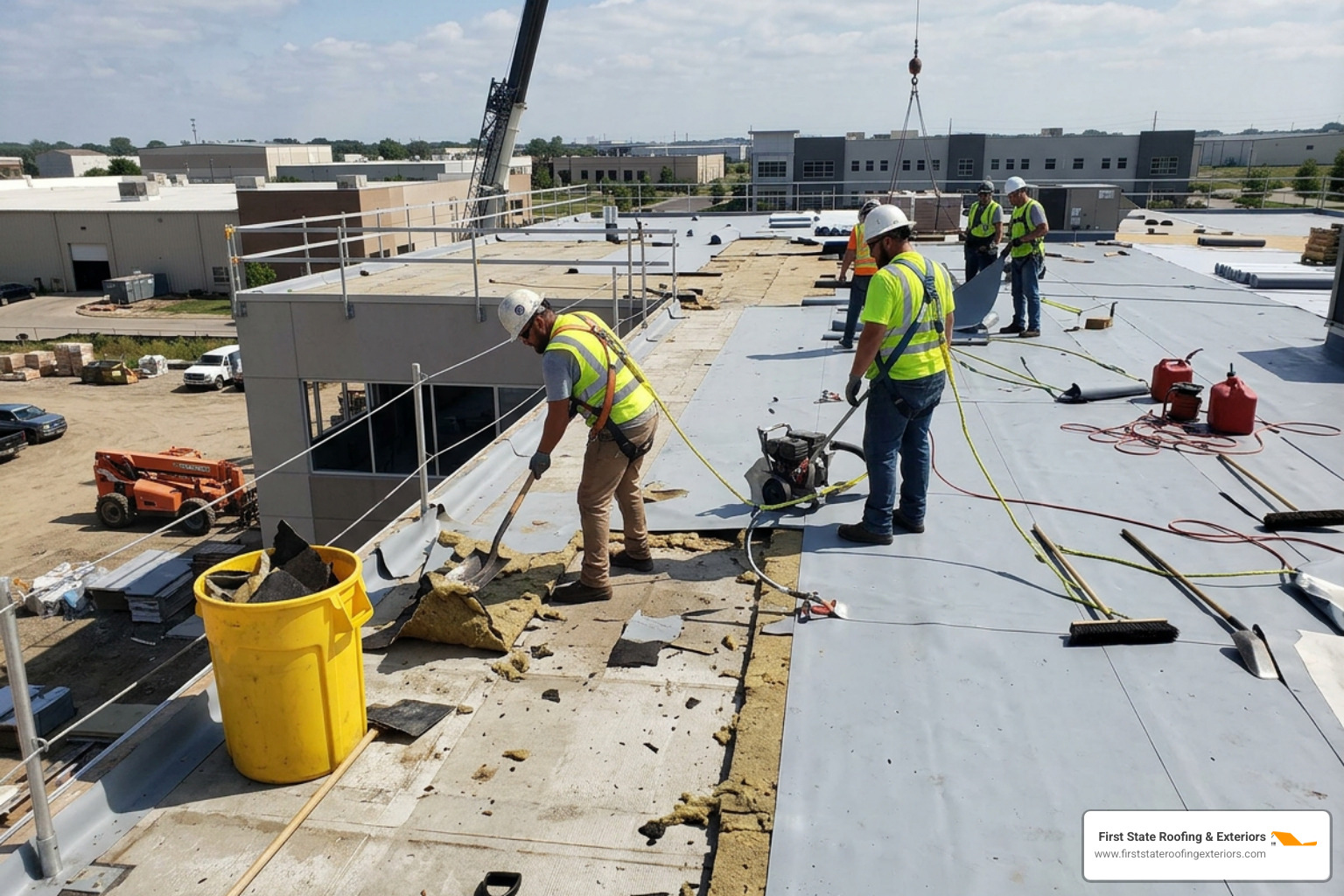
Before making a decision, we suggest reading our comprehensive from tear-off to top-off guide to understand the structural implications of both methods.
The Complete Tear-Off Method
A complete tear-off involves stripping the old roofing system down to the bare wood or metal deck.
- The Pros: It allows us to inspect the structural deck for hidden rot, water damage, or rust. This is the only way to guarantee a 100% clean, dry foundation for your new roof, ensuring manufacturer warranties are fully validated.
- The Cons: It is more labor-intensive and requires disposal fees for the old materials, which typically adds $1.00 to $3.00 per square foot to the project cost.
The Overlay (Recover) Method
An overlay involves preparing the existing membrane and installing the new single-ply system directly over it.
- The Pros: You save significantly on labor and disposal costs because the old roof stays in place.
- The Cons: You cannot inspect the underlying deck for structural integrity. Additionally, international building codes (IBC) and local Kent and Sussex County, DE codes strictly prohibit installing a third roof layer. If your building already has two layers, a complete tear-off is legally required.
Additional and Hidden Costs in Commercial Flat Roof Replacement
When budgeting for your commercial flat roof replacement cost, it is easy to focus solely on the membrane and labor. However, several supporting elements can add to the final invoice.
To avoid unexpected financial surprises mid-project, read our detailed breakdown of Commercial Roof Replacement Cost What To Expect In 2025 And Beyond.
- Insulation Upgrades (Polyiso): Modern building codes require specific R-value ratings for commercial properties. Upgrading your roof’s insulation using Polyisocyanurate (Polyiso) boards typically costs $1.50 to $2.50 per square foot, but it pays for itself over time through lower heating and cooling bills.
- Tapered Insulation for Drainage: Flat roofs aren’t actually flat; they require a minimum slope of 1/4-inch per foot to channel water toward drains. If your roof has pooling water, we must install tapered insulation to create artificial slopes, which can add $2,500 to $5,000 to the drainage budget.
- Permits and Disposal Fees: Commercial building permits in Kent and Sussex County, DE typically range from $250 to $800 depending on the project scope. Disposal and dumpster fees for a standard tear-off generally run between $1,200 and $2,500.
Frequently Asked Questions About Commercial Flat Roof Replacement
When is it time to replace a commercial flat roof instead of repairing it?
You should replace your commercial flat roof if it has reached 15 to 25 years of age, has widespread water saturation in the insulation, or if your annual repair costs exceed 30% to 50% of the cost of a full replacement. Isolated leaks can be patched, but systemic failures require a new system.
How can I save money on my commercial flat roof replacement?
- Off-Peak Scheduling: Plan your replacement during the late fall or early winter when roofing demand slows down to secure better labor rates.
- Regular Maintenance: Keep your drains clear of debris. Preventing standing water extends the life of your current membrane, allowing you to delay replacement until you are financially ready.
- Tax Incentives: Ask your CPA about Section 179 tax deductions, which allow some commercial property owners to deduct the full cost of roof replacements in the year of installation.
How long does a commercial flat roof replacement project take?
Most commercial flat roof replacements take between 3 to 7 days to complete. A standard 2,000 sq ft roof usually takes 4 to 5 days. Timelines depend heavily on weather conditions, the number of penetrations, and whether a complete tear-off is required.
Conclusion
Replacing your commercial flat roof is a significant capital investment, but it is also one of the best ways to protect your business assets, improve energy efficiency, and secure peace of mind for the next 20 to 30 years.
At First State Roofing & Exteriors, we are your local Kent and Sussex County, DE experts. We serve business owners in Dover, Milford, and across the state with transparency, integrity, and 24/7 availability. We specialize in installing high-quality, durable commercial roofing systems tailored to our coastal climate.
Ready to get an accurate estimate for your property? We provide completely free, no-obligation commercial roof inspections and detailed estimates.
Explore our professional commercial roof replacement services to schedule your free inspection today!