You’re not a roofing expert. You shouldn’t have to be. But when you’re facing a damaged roof — whether it happened gradually or overnight during a storm — you suddenly need to make a high-stakes decision about someone you’ve never met, doing work you can’t fully evaluate, on the most important structure protecting your home.
That’s an uncomfortable position to be in. The good news is that a handful of direct questions will tell you almost everything you need to know. A contractor who welcomes them is someone worth talking to. One who deflects, rushes you, or gets vague? That’s your answer too.
Why These Questions Matter More in Kent County, DE
Kent County gets hit. That’s not pessimism — it’s geography. With roughly 45 inches of annual rainfall and a direct path for Atlantic storms, the area sees real weather damage on a regular basis. In August 2020, an EF2 tornado spun off Hurricane Isaias and tore through Dover, ripping roofing off a middle school and damaging homes across the county.
Events like that don’t just damage roofs — they bring in out-of-state contractors by the truckload. Storm chasers — contractors who follow severe weather from market to market — are a documented, recurring problem in Kent County and Sussex County. They knock on doors, claim your roof is damaged, collect a deposit, and either do substandard work or disappear before the job is finished.
The questions below are your defense against that. They’re designed to separate contractors rooted in Kent County from transient operators who see storm damage as an opportunity to extract money and move on.
Are You Registered as a Contractor in Delaware?
Delaware doesn’t issue a traditional roofing license the way some states do. Instead, contractors are required to obtain a Construction Contractor Registration Certificate through the Delaware Department of Labor. This registration requires workers’ compensation insurance, an OSHA-compliant safety plan, and disclosure of any prior labor law violations or fraud. You can verify a contractor’s registration at Delaware.gov — and if they can’t tell you their registration number or get uncomfortable when you ask, that’s a red flag.
Here’s why this matters beyond paperwork: if a roofer is injured on your property and the contractor doesn’t carry workers’ compensation, you could be held financially liable. A legitimate contractor will hand you proof of general liability insurance and workers’ comp without hesitation. If you have to ask twice, or they offer to “email it later,” keep looking.
Storm chasers rarely bother with proper Delaware registration because they’re not planning to stay. They operate under the assumption that by the time anything goes wrong, they’ll be three states away. Asking this question upfront — and actually verifying the answer — immediately separates the professionals from the opportunists.
Do You Subcontract the Work, or Is Your Own Crew Doing It?
This question makes some contractors uncomfortable, and that discomfort is informative. Many roofing companies — especially those that operate regionally or follow storm damage — hire day-labor subcontractors to handle the actual installation. That means the people on your roof may have no direct relationship with the company you hired, no accountability to their standards, and no reason to care about your callback six months later.
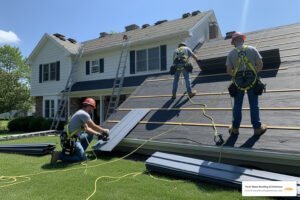
When we work on a roof, it’s our crew doing it — no outsourcing, no subcontractors. We manage the entire project from start to finish. That means if something isn’t right, you know exactly who to call and there’s no finger-pointing between us and a third-party crew.
Ask a contractor point-blank: “Will your employees be doing this work, or will you be bringing in subcontractors?” A confident, clear answer of “our own crew” is what you want. Anything hedged — “we work with trusted partners,” “we use certified subs,” “it depends on availability” — tells you the accountability chain is murkier than it should be for a project of this size. Roofing isn’t a small purchase. The average replacement runs well into the five figures. You deserve to know exactly who’s doing the work.
Questions That Separate Good Roofers From Great Ones
Registration and crew transparency are the baseline. They tell you whether a contractor is operating legitimately. But there’s a second tier of questions that goes further — separating contractors who meet the minimum from those who consistently deliver work worth paying for.
These questions dig into credentials, warranties, and what happens after the job is done. The answers reveal how seriously a contractor takes their own work — and whether they’ll still be around to back it up.
What Manufacturer Certifications Do You Hold?
Most homeowners assume all roofing contractors have access to the same materials and warranties. They don’t. Manufacturer certifications — particularly at the elite tier — unlock warranty options that uncertified contractors literally cannot offer. GAF Master Elite status, for example, is held by approximately 2 to 3 percent of roofing contractors in the United States. It requires documented training, a track record of quality workmanship, and ongoing compliance with GAF’s standards.
Contractors who hold Master Elite certification can offer enhanced warranty tiers, including lifetime labor guarantees, that a non-certified contractor has no ability to provide regardless of how good their sales pitch is. We hold GAF Master Elite certification — and we’re also authorized installers of Owens Corning, TAMKO, CertainTeed, and Atlas Pro materials. That breadth of authorization means you’re not limited to whatever a single manufacturer offers. You get access to premium warranty options across multiple product lines, and we’ve been vetted by the manufacturers themselves.
When you ask a roofer about certifications, you’re asking whether the warranty you’ll receive is the real thing — backed by a manufacturer who will still exist in 20 years — or a piece of paper from a company that may not. The average roofing company in the U.S. lasts about four years. A manufacturer-backed warranty from a certified installer doesn’t disappear if the contractor does.
Can You Help With My Insurance Claim?
After a storm rolls through Kent County — and they do roll through — the insurance claim process is often where homeowners feel most lost. Your insurer sends an adjuster. The adjuster works for the insurance company. If you don’t have someone in your corner who understands roofing damage and how claims work, you may end up with a settlement that doesn’t cover what actually needs to be done.
A good roofing contractor should be able to work directly with your insurance provider to document the damage accurately and advocate for a fair assessment. We do this as a standard part of how we work with storm-damaged roofs — not as an add-on, but because it’s part of doing the job right. If a contractor you’re interviewing has never worked with an insurer, doesn’t understand the claims process, or tells you to just handle it yourself, that’s a gap that will cost you time and potentially money.
Ask specifically: “Have you worked with insurance claims before, and can you help me through that process?” A contractor who’s done this regularly will answer with specifics — how they document damage, how they communicate with adjusters, what the timeline typically looks like. One who hasn’t will give you a vague answer or redirect you.
In a county where storm damage is a genuine annual reality, this isn’t an edge case question. It’s a core competency you should expect from any contractor you seriously consider. And if financing is a concern — which it is for a significant number of homeowners facing unexpected repair costs — ask about that too. We offer flexible financing options precisely because a necessary repair shouldn’t have to wait.
How to Choose a Roofer in Kent County, DE You Won’t Regret
The right contractor doesn’t just answer these questions — they answer them without hesitation, with documentation to back it up, and without making you feel like you’re being difficult for asking. That confidence isn’t arrogance. It’s what 22-plus years of doing this work in the same community looks like.
Kent County homeowners deserve a contractor who’s rooted here, registered here, and accountable here — not one who showed up after the last storm and will be gone before the next one.
If you’re in the process of vetting roofers and want a straight conversation with a team that welcomes every question on this list, reach out to First State Roofing & Exteriors Co. for a free estimate. We’ll show you exactly what our answers look like.