Is Your Garage Roof a Hidden Hazard? What Kent and Sussex County, DE Homeowners Need to Know
Garage roof asbestos replacement is one of the most urgent home safety issues facing owners of pre-2000 properties — and one of the most misunderstood. If you suspect your outbuilding contains hazardous materials, partnering with a trusted Kent and Sussex County, DE home exterior expert is the safest way to protect your family and restore your property’s value.
Here is a quick summary of what you need to know:
- Identify it — Garages built before 2000 with grey, corrugated cement sheets likely contain asbestos.
- Don’t disturb it — Cracked or damaged sheets can release harmful airborne fibres.
- Hire a licensed professional — DIY removal is dangerous and can carry legal consequences.
- Replace with a modern material — Steel, EPDM rubber, or GRP fibreglass are all safe, durable alternatives.
- Get documentation — A proper job includes a waste disposal certificate and removal records.
If your garage was built before 2000, asbestos cement was the standard roofing material across the US and UK. It was cheap, fire-resistant, and durable — until it wasn’t. Over time, weathering, cracking, and physical damage cause those sheets to become friable, meaning they can shed microscopic fibres into the air around your home. As the Kent and Sussex County, DE Department of Natural Resources and Environmental Control (DNREC) makes clear, asbestos exposure is a serious health hazard with no safe level of inhalation.
The good news? Replacement is faster, safer, and more affordable than most homeowners expect. As a professional contractor, I’ve seen how a one-day professional job can eliminate years of risk and give a garage a new lease on life.
I’m Richard McCain, Owner and President of First State Roofing & Exteriors, with over 20 years of hands-on experience in roofing and exterior solutions across Kent and Sussex County, DE — including countless projects involving garage roof asbestos replacement and the installation of modern, code-compliant alternatives. In this guide, I’ll walk you through everything you need to know to handle this safely and confidently.
Garage roof asbestos replacement definitions:
Identifying Asbestos in Your Garage Roof

Before you start planning a replacement, you need to know exactly what you are dealing with. Asbestos was a highly popular construction material from the 1930s until its complete ban in 1999. Because of its incredible fire resistance and low cost, it found its way into millions of residential garages.
If your garage was built or renovated during this sixty-year window, there is a very high probability that the roof contains asbestos. Identifying it early prevents accidental disturbance during routine maintenance. You can use our handy checklist for when you need a new roof to assess your overall roof health, but asbestos requires a few specialized diagnostic steps.
Visual Indicators of Asbestos Cement Sheets
While you cannot confirm the presence of asbestos with 100% certainty just by looking at it, several classic visual indicators point to its presence:
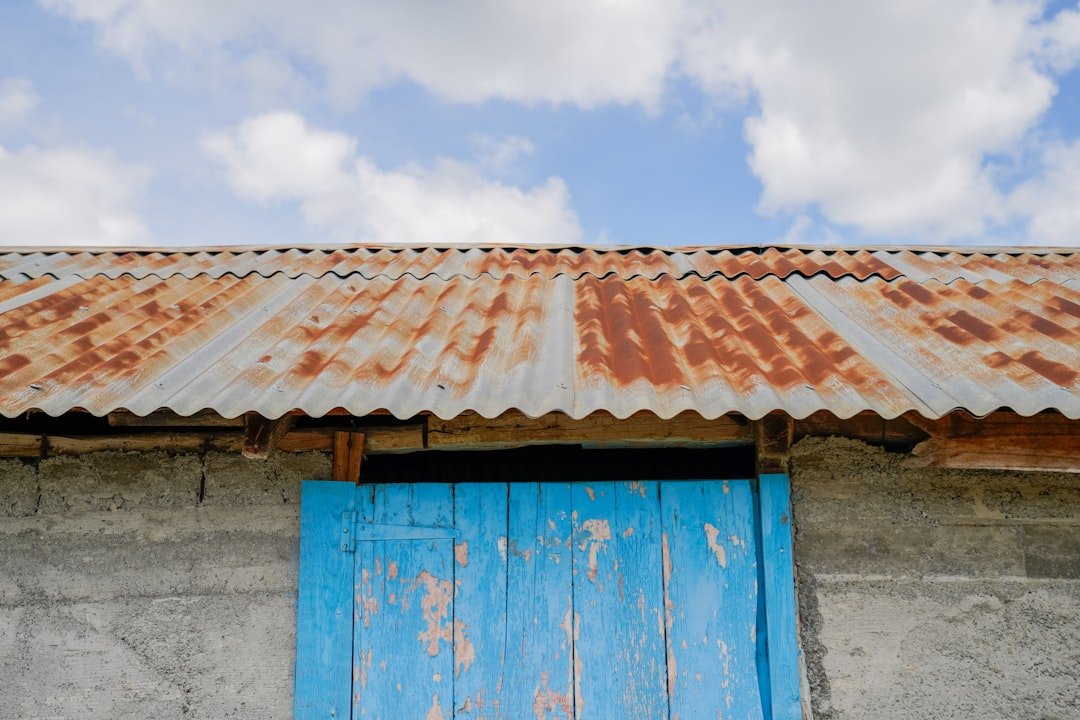
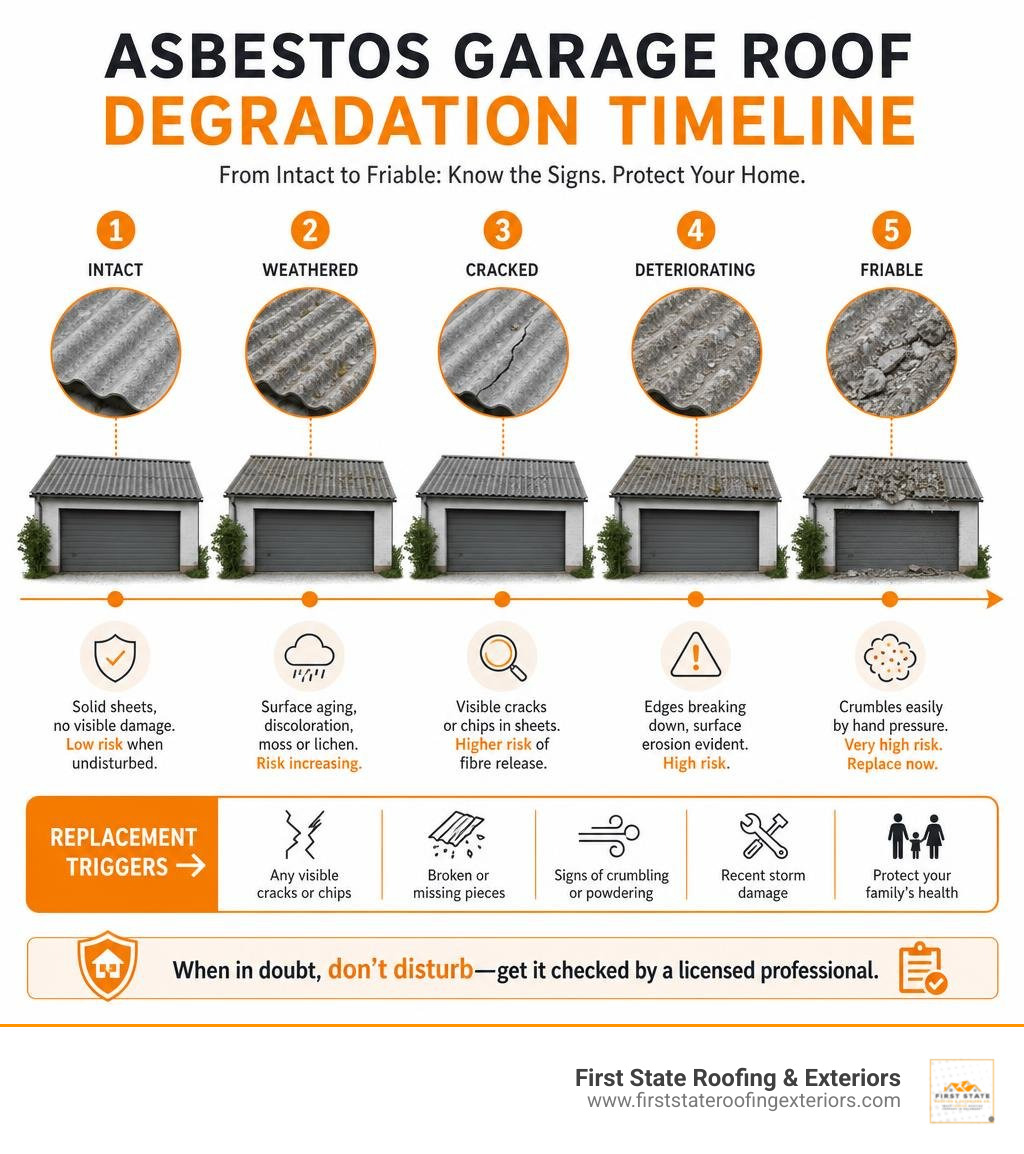
- Grey Corrugated Sheets: Most asbestos garage roofs consist of large, wavy, corrugated panels that are light grey or blue-grey. Over decades of exposure to Kent and Sussex County, DE weather, these panels often darken, accumulate heavy moss growth, or develop white water stains.
- Dimpled Surface Patterns: Asbestos cement sheets often feature a distinct texture on the underside, resembling a pattern of small dimples, craters, or a woven grid.
- Weathered and Flaking Edges: Look at the edges of the panels. If they are soft, crumbling, flaking, or showing exposed fibrous strands, this is a major warning sign.
- Old Fasteners: Many older asbestos roofs are secured with heavy metal bolts or nails driven through aluminium runners. If these fasteners are heavily rusted and the surrounding material is cracking, the roof is structurally compromised.
Professional Testing and Asbestos Surveys
If you suspect your roof contains asbestos, the gold standard is to have it professionally tested. Never scrape, drill, or cut a sample yourself, as this releases the very fibres you are trying to avoid.
A professional asbestos survey involves a certified technician visiting your home, sealing off the target area, and carefully extracting a tiny, controlled sample. This sample is then sent to a certified laboratory for polarized light microscopy analysis.
An asbestos survey for a residential garage typically costs around $245 to $350. In many cases, if you work with an experienced contractor, clear photos of the roof structure are enough to confirm the material type and obtain an accurate quote without requiring a full physical survey first.
The Health Risks of Damaged Asbestos Roofing
Why all the fuss about a few old roof panels? The health hazards associated with asbestos are entirely linked to the inhalation of microscopic mineral fibres.
When asbestos cement is intact, stable, and undisturbed, it poses a very low risk to your family. However, as the material ages, it undergoes a process called weathering. Decades of hot Kent and Sussex County, DE summers, freezing winters, and heavy rain break down the cement binding agent, turning a stable roof into a fragile liability.
How Fiber Release Occurs
Asbestos fibres do not decompose or wear out. Instead, they lie in wait within the cement matrix. Fiber release typically occurs due to:
- Cracking and Fracturing: Walking on an old asbestos roof, dropping tools, or tree branches falling on the panels will fracture the sheets, instantly releasing millions of microscopic fibres.
- Abrasive Cleaning: Never use a pressure washer, wire brush, or stiff broom to clean moss off a suspected asbestos roof. This acts as a giant fiber-dispersion mechanism.
- Water Leaks and Erosion: Acidic rainwater slowly dissolves the cement binder, allowing loose fibres to wash into your gutters, dry out, and become airborne in your yard.
Long-Term Health Implications
Once inhaled, these tiny, needle-like fibres travel deep into the lungs and the pleural lining. Because of their physical structure, the body cannot break them down or expel them. Over a period of 15 to 50 years, these trapped fibres cause chronic inflammation and cellular damage, leading to severe diseases:
- Mesothelioma: A rare and aggressive cancer of the lining of the lungs and abdomen, almost exclusively caused by asbestos exposure.
- Asbestosis: A progressive, irreversible scarring of the lung tissue that causes severe shortness of breath and permanent lung damage.
- Lung Cancer: Highly linked to asbestos inhalation, with the risk multiplying exponentially for individuals who smoke.
To keep your family safe, any damaged, flaking, or leaking asbestos roof must be addressed immediately rather than left to degrade further.
The Legal and Safe Process for Garage Roof Asbestos Replacement
Removing and disposing of asbestos is highly regulated in the state of Kent and Sussex County, DE. The Kent and Sussex County, DE Department of Natural Resources and Environmental Control (DNREC) enforces strict guidelines to ensure that hazardous materials do not contaminate residential neighborhoods or local landfills.
The entire process must prioritize containment and dust suppression. Much like replacing asbestos siding shingles, replacing a garage roof requires specialized training, safety gear, and legal disposal pathways.
Safe Removal Protocols and Containment
A compliant, professional removal process follows a strict sequence of safety protocols:
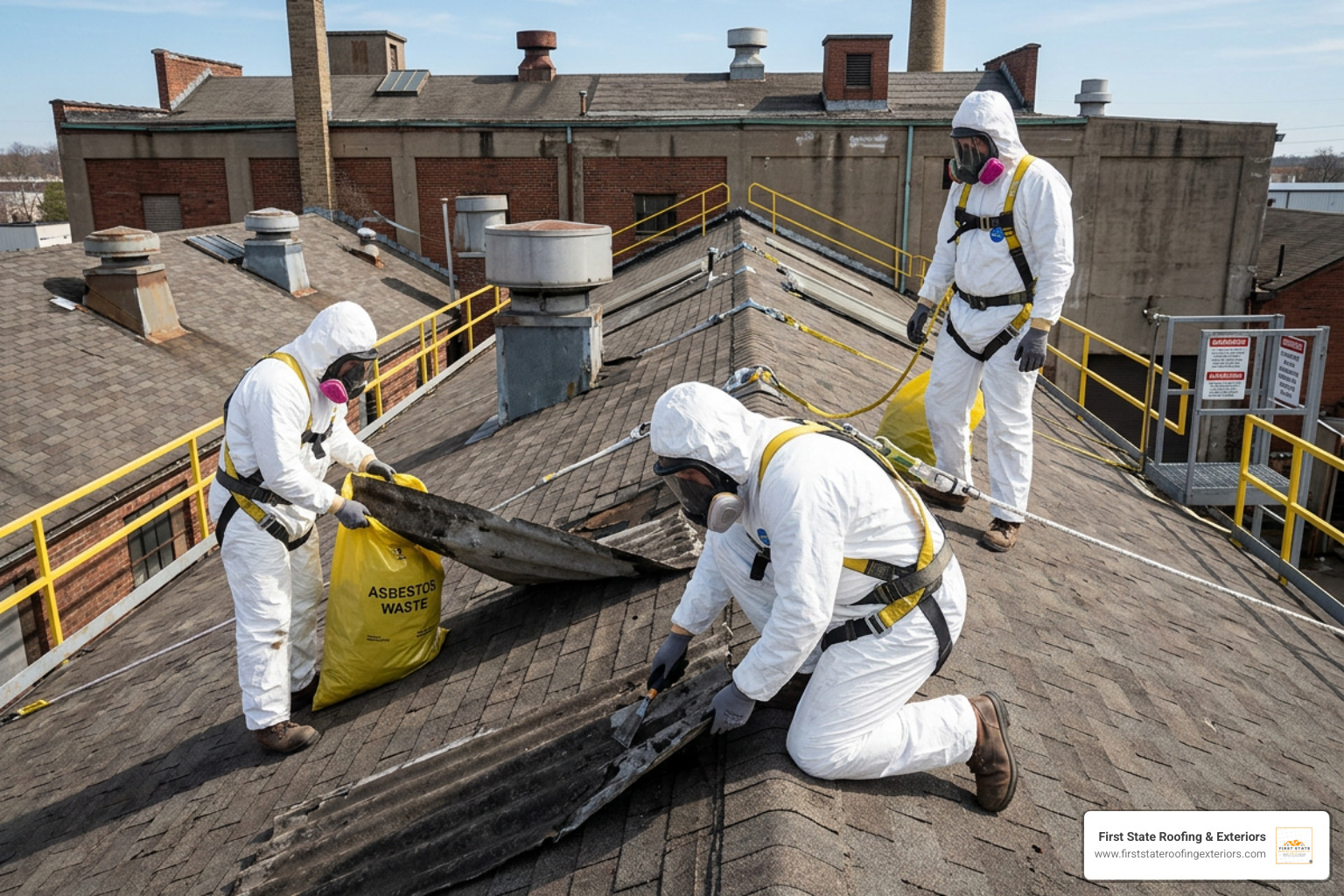
- Dust Suppression: Before a single bolt is turned, the roof sheets are sprayed with a specialized fiber-binding liquid or water mixed with a wetting agent. This keeps the material damp and prevents dry dust from lifting into the air.
- Whole Sheet Removal: Technicians do not break or smash the panels. Instead, they carefully unscrew or cut the fasteners and lift the sheets down intact.
- Personal Protective Equipment (PPE): Workers wear disposable Type 5/6 hazardous material coveralls, single-use gloves, and fitted respirators equipped with HEPA filters.
- Ground Protection: Heavy-duty plastic sheeting is laid on the ground around the garage to catch any accidental debris or run-off water.
Compliant Disposal and Waste Regulations
You cannot simply toss asbestos sheets into your weekly trash bin or take them to a standard local dump. Doing so is highly illegal and carries severe fines.
All asbestos waste must be double-wrapped in heavy 1000-gauge polythene sheeting, sealed with duct tape, and clearly labeled with hazardous material warnings. It must be transported by a licensed hazardous waste carrier directly to an approved hazardous waste landfill. Once disposed of, you must receive a official Waste Shipment Record (or hazardous waste consignment note) proving the material was legally and safely discarded.
Modern Non-Asbestos Replacement Materials
Once the old, hazardous roof is safely gone, you have the exciting opportunity to choose a modern, beautiful, and completely safe replacement material. Today’s roofing systems are vastly superior in durability, thermal performance, and aesthetics.
When planning your upgrade, consult our complete guide to roof replacement to see how different materials impact your home’s structure. Here are the top non-asbestos materials used for modern garage roofs:
Corrugated Steel and Metal Panels
For sloped or pitched garage roofs, corrugated steel is the modern gold standard.
- Lifespan: 35 to 40+ years.
- Durability: Extremely strong, completely non-combustible, and resistant to wind, hail, and moss.
- Key Feature: Often coated with a protective plastisol layer available in multiple colors to match your home. Many systems include an anti-condensation backing (like DRIPSTOP) to prevent drips and dampness inside the garage.
EPDM Rubber and GRP Fibreglass
If your garage has a flat or very low-slope roof, single-ply membranes are the ideal choice.
- EPDM Rubber: This synthetic rubber membrane is laid in a single, seamless sheet. It is incredibly flexible, stretches up to 300% to accommodate structural movement, has five times greater UV resistance than old felt systems, and boasts a lifespan of up to 50 years.
- GRP Fibreglass: A liquid-applied resin combined with glass fiber matting that cures into a single, rock-hard, jointless laminate. It is highly impact-resistant and lasts 25 to 30 years.
Cost and Timeline Expectations
Budgeting for a garage roof asbestos replacement requires looking at two distinct phases: the safe removal/disposal of the old material, and the installation of the new roof.
To help you plan, we have compiled a comparison of the most common replacement materials:
| Material Type | Average Cost (per sq. ft. installed) | Expected Lifespan | Best Suited For |
|---|---|---|---|
| Corrugated Steel | $4.50 – $8.00 | 40+ Years | Pitched / Sloped Roofs |
| EPDM Rubber | $6.00 – $10.00 | 50 Years | Flat Roofs |
| GRP Fibreglass | $9.00 – $14.00 | 25–30 Years | Flat Roofs |
| Fibre Cement (Non-Asbestos) | $5.00 – $9.00 | 30+ Years | Heavy-duty Pitched Roofs |
For a deeper dive into overall roofing costs in our region, check out our roof replacement cost guide and our 2026 price guide.
Average Costs of Garage Roof Asbestos Replacement
On average, professional asbestos removal for a standard single garage starts at around $950 to $1,500, while a double garage ranges from $1,800 to $3,000, depending on the number of sheets and accessibility.
When you combine safe removal, hazardous waste disposal fees, and the installation of a high-quality new steel or EPDM roof, the total project cost typically ranges between $2,500 and $5,500. While this is a significant upfront investment, it completely eliminates a major health liability and instantly boosts your home’s market value.
Project Timelines and What to Expect
One of the biggest concerns homeowners have is how long their property will be a construction zone. The good news is that professional teams work incredibly fast:
- Single Garage: Usually completed in one working day. This includes wetting and removing the old sheets, inspecting the underlying timber frame, and installing the new weatherproof roof.
- Double Garage: Typically takes one to two days, depending on structural complexity or the need for timber repairs.
Planning Permission and Building Regulations
Do you need municipal approval to replace your garage roof? In most parts of Kent and Sussex County, DE, replacing an existing roof with a similar profile falls under “permitted development” or minor repairs, meaning you do not need extensive planning permission. However, there are important local nuances to keep in mind.
Permitted Development Rights for Garage Roofs
In general, you do not need planning permission if:
- The overall height of the garage roof is not being increased significantly.
- The structural footprint of the building remains exactly the same.
- Your property is not located in a designated historic preservation district (such as certain historic zones in Dover or Lewes) where material changes are strictly regulated.
Local Kent and Sussex County, DE Building Codes
While planning permission might not be required, you must still comply with local building codes. If you are changing the material from lightweight asbestos cement to heavier modern tile or thick fibre cement, you must ensure the existing wood rafters can handle the increased dead load.
Wind resistance is another critical factor in our coastal region. For example, when working under Seaford, DE roofing regulations, all new installations must be rated to withstand regional wind loads and storm conditions. A professional local roofer will handle all permit applications and ensure your new roof is fully code-compliant.
Frequently Asked Questions about Garage Roof Asbestos Replacement
Can I perform a DIY garage roof asbestos replacement?
While it is technically legal for a homeowner to remove asbestos from their own property in some jurisdictions, it is highly discouraged. Without professional-grade negative pressure respirators, decontamination setups, and specialized wetting equipment, you are almost guaranteed to inhale harmful fibres. Furthermore, transporting hazardous asbestos waste in a personal vehicle without proper licensing is illegal in Kent and Sussex County, DE and can result in massive fines at local disposal facilities.
How do I know if my garage roof contains asbestos?
If your garage was built before 2000 and features corrugated grey sheets, there is a very high probability it contains asbestos. The only way to know for certain is to have a certified professional extract a small sample and analyze it under a microscope in a certified laboratory.
Does removing an asbestos roof increase property value?
Yes, significantly. Modern home buyers are highly sensitive to environmental hazards. If a home inspector flags an asbestos garage roof during a pre-purchase survey, it often leads to buyers demanding steep price drops or backing out of the sale entirely. Replacing the roof beforehand removes this hurdle, enhances your home’s curb appeal, and provides peace of mind to future buyers.
Conclusion
Replacing an old, deteriorating asbestos garage roof is one of the smartest investments you can make for your home’s health, safety, and long-term value. By removing a dangerous environmental hazard and replacing it with a modern, watertight, and durable material like steel or EPDM rubber, you protect your family and your property for decades to come.
At First State Roofing & Exteriors, we bring family-owned local expertise, absolute integrity, and complete transparency to every project. We are dedicated to protecting Kent and Sussex County, DE homes with safe, compliant, and beautiful roofing solutions.
Don’t let an old roof compromise your home’s safety. We offer completely free estimates and honest advice. Call us at (302) 222-4065 for a free inspection. Explore our professional roof replacement services and schedule your free inspection with our expert team today!