If you’ve got a cedar shake roof, or you’re considering one, you already know the appeal. It looks like a million dollars. It has character. It feels like a premium choice. But if you live in Kent County, you also know what Delaware weather can do to a roof over time—and cedar shake and this climate do not always get along.
This isn’t a knock on the material. It’s just an honest look at what actually happens when you factor in 45 inches of annual rainfall, humid summers, and a storm season that shows up every year without fail. Composite roofing has come a long way, and it deserves a real comparison—not a sales pitch.
What Cedar Shake Actually Costs Kent County Homeowners Over Time
The sticker price of cedar shake installation is only part of the story. The part most homeowners don’t fully account for is what happens after the roof goes on—the cleaning cycles, the preservative treatments, the individual shake replacements when splitting or curling starts showing up after a wet winter.
In a drier climate, cedar shake holds up well. In central Delaware, where humidity is a year-round condition and no month is truly dry, the maintenance timeline compresses. That’s not speculation—it’s what organic materials do when exposed to persistent moisture, freeze-thaw cycling, and the kind of summer heat that Kent County regularly delivers.
Cedar Shake Shingles and Delaware’s Humidity: A Difficult Combination
Dover follows a humid subtropical climate—which sounds technical, but what it means practically is that moisture is always present. The county averages 45 inches of rain per year, which is nearly 20% above the national average. There’s no dry season to give cedar shake a break. Every month brings meaningful precipitation, and that sustained moisture exposure is exactly what accelerates cedar’s known failure modes: mold growth, moss accumulation, splitting, and rot.
Cedar shake shingles are an organic material. They’re wood. And wood absorbs moisture. Over time, that absorption causes the shakes to swell, contract, check, and eventually crack. Once the surface integrity breaks down, water gets underneath—and that’s when you start seeing leaks, damaged decking, and repair bills that make homeowners wonder why they didn’t ask more questions before the original installation.
The freeze-thaw piece compounds this. Kent County averages about 15 inches of snow per year. That might not sound like much, but it’s enough to create repeated freeze-thaw cycles through winter. Water that’s already worked its way into micro-cracks in cedar shake expands when it freezes. That expansion widens the cracks. The next thaw lets more water in. It’s a gradual process, but it’s relentless—and it’s one that composite roofing is simply immune to, because there’s no organic material to absorb moisture in the first place.
For homeowners in Dover, Harrington, Milford, or Smyrna who are looking at a cedar shake roof that’s 15 or 20 years old, this pattern is often already in motion. The roof may still look acceptable from the street, but the structural story underneath is frequently more advanced than the surface suggests.
Cedar Shingles and Insurance: What Kent County Homeowners Are Hearing at Renewal
This is the part of the cedar shake conversation that catches homeowners off guard. Insurance companies across the country have been quietly tightening their underwriting guidelines around wood shake roofs—and that trend is showing up in Kent County renewal letters.
The core issue is risk. Wood is flammable, even when treated, and fire resistance treatments degrade over time. Beyond fire, insurers cite rot, warping, cracking, mold, and insect vulnerability as compounding liability factors. The result is that some insurers are refusing to write new policies on homes with cedar shake roofs, while others are surcharging existing policyholders at renewal. For homeowners near the Delaware coast—where insurance costs are already elevated due to storm exposure—a cedar shake roof can become a serious financial complication.
This isn’t a fringe scenario. It’s a documented, growing pattern. And it’s one of the reasons homeowners who initially planned to repair their cedar shake roof end up deciding on a full replacement instead—because the insurance math changes the calculation entirely.
Composite roofing changes that math back in your favor. Many composite shingles carry a Class 4 impact resistance rating—the highest available under UL Standard 2218. That rating means the shingle can withstand a 2-inch steel ball dropped twice from 20 feet without cracking. Insurance providers recognize Class 4 ratings and frequently offer premium discounts in the range of 10 to 35 percent for homes that carry them. For a Kent County homeowner paying elevated premiums due to coastal proximity or storm history, that discount can meaningfully offset the cost of the roof upgrade over time.
Premium composite shingles also carry Class A fire ratings—the highest available—which directly addresses the fire-risk concern that’s driving insurers away from cedar shake. Switching materials doesn’t just solve the aesthetic question. It can change your insurability profile entirely.
How Composite Roofing Performs in Kent County’s Climate
Composite roofing—sometimes called synthetic shake—is made from engineered polymers and recycled materials, molded to replicate the look of natural cedar shake, slate, or tile. The key difference is what it’s not made of: anything organic. There’s no wood fiber, no asphalt-soaked mat, no material that absorbs moisture or reacts to temperature the way cedar does.
That distinction matters a lot in a climate like Kent County’s. The failure modes that shorten cedar shake’s lifespan in Delaware—moisture absorption, mold, freeze-thaw cracking—simply don’t apply to composite. The material doesn’t absorb water. It doesn’t rot. Moss and algae have nothing to anchor to. And because it’s engineered rather than grown, the performance is consistent across the entire surface rather than dependent on the quality of individual shakes.
How Long Does Composite Roofing Last Compared to Cedar Shake?
This is usually the first question homeowners ask, and the answer is fairly direct. Quality composite shingles carry a life expectancy of 40 to 50 years. Premium products are available with 50-year limited lifetime warranties from the manufacturer. Cedar shake, under ideal conditions with proper maintenance, can reach 30 to 50 years—but “ideal conditions” is doing a lot of work in that sentence. In a humid, high-rainfall climate like Delaware’s, the practical lifespan of cedar shake is shorter, and the maintenance required to reach even the lower end of that range is significant.
What that means for a homeowner in Felton or Greenwood who’s replacing a 20-year-old cedar shake roof is that composite is likely the last roof they’ll ever need to put on that house. Cedar shake, without rigorous maintenance, may not be. That’s not a trivial difference when you’re talking about a major home improvement investment.
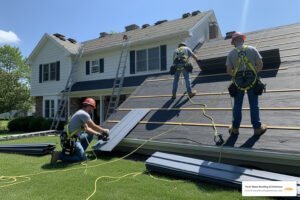
The warranty depth also matters. Composite shingles from manufacturers like GAF, Owens Corning, and CertainTeed come with extended warranty coverage that goes beyond the material itself—including workmanship coverage when installed by a certified contractor. Standard cedar shake warranties are typically limited to the material and are far shorter in duration. The installer certification piece is important here: those extended warranties are only accessible through contractors who hold the relevant manufacturer certifications. An uncertified installer can put the same shingle on your roof and you’ll still walk away with a shorter, less comprehensive warranty.
As a GAF Master Elite certified contractor—a designation held by roughly 2 to 3 percent of roofing contractors in North America—we’re able to offer warranty tiers that most local contractors simply can’t access, including the GAF Golden Pledge, which covers both materials and labor under manufacturer backing.
Does Composite Roofing Actually Look Like Real Cedar Shake?
This is the objection that comes up most often from homeowners who love the look of cedar and are reluctant to give it up. It’s a fair concern—and the honest answer is that it depends entirely on which composite product you’re looking at.
Budget composite shingles can look flat or uniform in a way that real cedar shake doesn’t. Premium composite products are a different story. They’re molded directly from natural cedar shakes, which means the texture, the color variation, the shadow lines, and the dimensional depth are captured from actual wood. At ground level—which is how virtually everyone will ever see your roof—premium composite shake is visually indistinguishable from the real thing.
The difference is that it stays that way. Real cedar shake weathers, grays, and develops the kind of patina that some homeowners love and others don’t. Composite shingles are engineered for color stability, with UV-resistant construction designed to hold their appearance over decades without the moss, streaking, or uneven weathering that cedar develops in humid conditions like those across Kent County.
For homeowners in Smyrna or Camden who want the aesthetic character of a cedar shake roof on a home they’re planning to sell in the next decade, composite also makes sense from a resale standpoint. A 40-year-old cedar shake roof in variable condition is a negotiating liability. A composite roof with decades of warranty remaining is a selling point. Buyers and their inspectors know the difference—and so do appraisers.
The coastal second-home angle is worth naming directly. If you own property near Lewes or Bethany Beach as well as a primary home in Kent County, the case for composite is even stronger at the beach. Salt air, elevated humidity, and storm exposure accelerate every weakness cedar shake has. The look you’re after doesn’t require you to accept the maintenance burden and insurance complications that come with real wood in a coastal environment.
Choosing the Right Roof for Your Kent County Home: What to Do Next
The composite versus cedar decision comes down to one honest question: what does this roof actually need to do, in this climate, over the next 40 years? For most Kent County homeowners, the answer points clearly toward composite—not because cedar isn’t a beautiful material, but because Delaware’s rainfall, humidity, and storm exposure work against it in ways that compound quietly until they become expensive.
If you’re already dealing with a cedar shake roof that’s showing its age, or you’re planning a replacement and want to understand your options before committing, the most useful next step is a straightforward conversation with someone who’s actually installed both materials in this market.
First State Roofing & Exteriors Co. has been doing exactly that for over 22 years, across Dover, Smyrna, Milford, Harrington, and the surrounding communities. We offer free estimates, work directly with insurance providers when storm damage is part of the picture, and can walk you through the warranty options that are actually available to you—not just the ones that sound good on a product sheet.