You noticed something — a water stain on the ceiling, a panel that looks slightly off, or maybe just a drip you can’t explain. You know your metal roof is supposed to last for decades, so you’re not sure whether to panic or ignore it. The honest answer is: you probably don’t need to panic, but you shouldn’t ignore it either. Most metal roof problems start small and stay small — as long as someone actually looks at them. Here’s what to check, what it usually means, and how repairs get done when you do need a professional.
Metal Roof Inspection Checklist: What to Look at Before You Call Anyone
Before you pick up the phone, it helps to do a basic visual check yourself — from the ground and, if safe, from the attic. You’re not trying to diagnose everything. You’re just gathering enough information to have an informed conversation with a contractor and avoid being told you need more than you actually do.
Start inside. Go into your attic after a rain and look for water stains, damp insulation, or any daylight coming through the decking. The tricky part about metal roof leaks is that water travels — it follows the decking and rafters before it drips, so the wet spot on your ceiling is often several feet away from the actual leak source. The attic gives you a better starting point than the ceiling does.
What to Check on the Roof’s Surface (Without Getting Yourself Into Trouble)
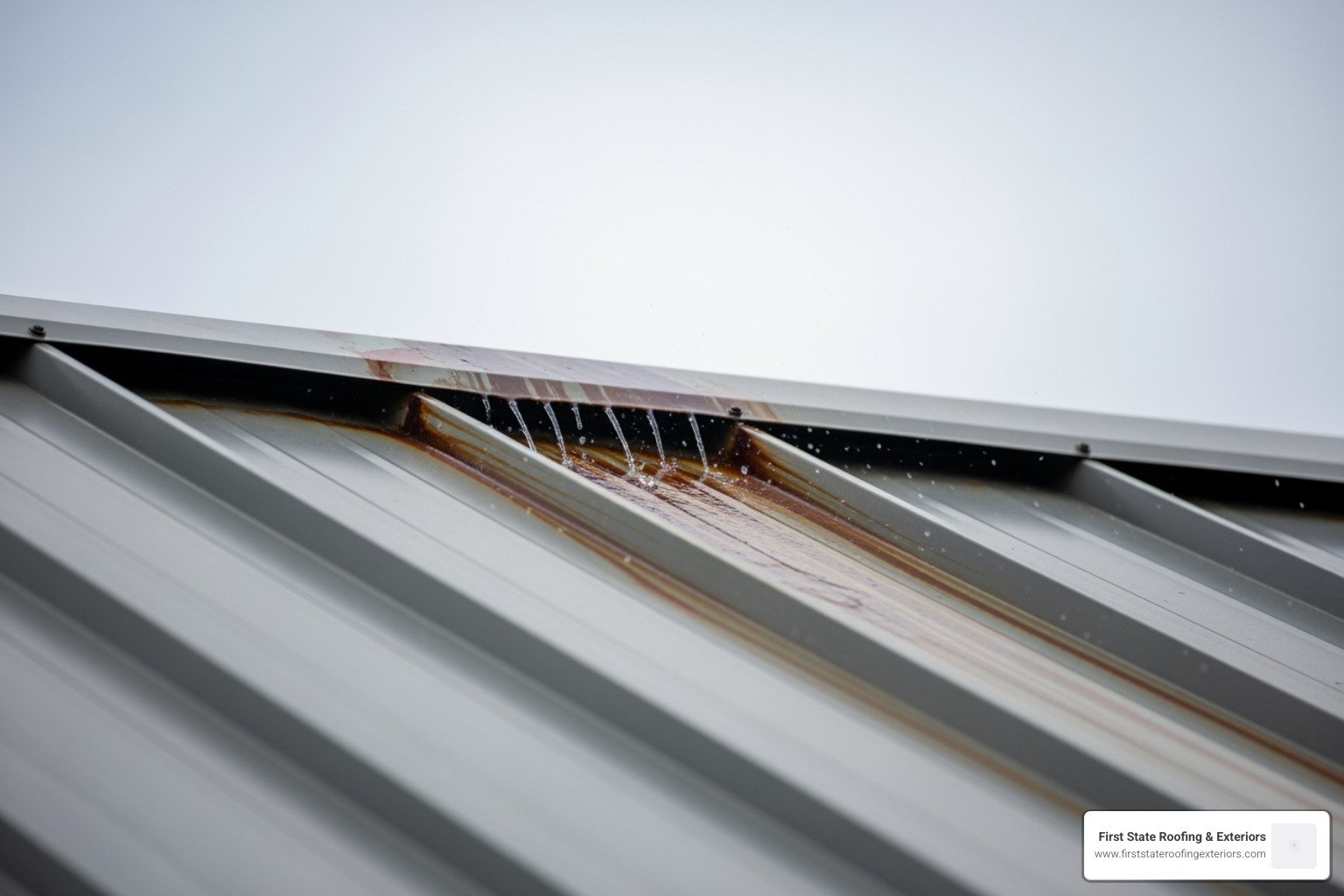
From the ground or a safe vantage point, you’re looking at a handful of specific things. Fasteners are the first place to start. On exposed-fastener metal roofs — the kind with visible screws across the panels — those screws have rubber washers underneath them that compress and seal against the metal. Over time, thermal expansion causes the panels to move, and that movement slowly backs the screws out. A screw that’s backed out even a quarter inch is no longer sealing properly. You can often spot this from the ground if you know what you’re looking for: a slightly raised screw head, or a rust streak running down from the fastener location.
Next, look at the seams and overlaps between panels. These are the areas where water has the best chance of getting underneath. Sealants along seams degrade from UV exposure and temperature cycling — Kent County’s summers are hot enough and winters cold enough that this process happens faster than most people expect. A seam that looks fine from a distance might be cracked or pulling away on closer inspection.
Flashing is another common failure point, and it’s worth understanding why. Flashing is the metal trim that seals transitions — where the roof meets a chimney, a skylight, a vent pipe, or a wall. These are the points where two different materials or planes meet, and they require a flexible seal that can handle movement. When that seal fails, water gets in — and because it enters at a transition point, it often travels a long way before you see it inside.
Finally, look at the panels themselves for dents, scratches through the coating, or any visible rust. A scratch that exposes bare metal isn’t an emergency, but it will rust over time, especially in areas of Kent County that get salt-laden air moving in from the coast. A small rust spot treated early is a $150–$300 fix. Left alone, it can spread into the panel and become a much larger problem.
Don’t forget the gutters. Granules in the gutter mean an asphalt roof is shedding. Metal shavings or rust-colored debris in the gutter from a metal roof mean something is corroding somewhere above.
Metal Roofs That Look Like Cedar Shakes: Inspection and Repair Specifics
If your metal roof has a textured, wood-grain appearance — the kind that mimics cedar shake shingles — the inspection process is mostly the same, but there are a few things worth knowing about how these roofs differ from standard flat-panel systems.
Metal shake profiles are stamped from steel or aluminum with a cedar grain texture pressed into the surface. They’re designed to interlock with each other, and most use concealed fasteners rather than exposed screws — meaning the fasteners are hidden under the overlapping edge of the next panel up. That’s actually a good thing from a leak-prevention standpoint, because there are no exposed screw holes to back out and fail. But it also means that if a panel is damaged, replacing it requires someone who understands how the interlocking system works. You can’t just lift a panel and slide a new one in without knowing the specific profile.
The coating on metal shake profiles is also worth paying attention to. Premium products use a PVDF (polyvinylidene fluoride) finish that resists UV degradation, mold, and mildew — which matters in Kent County’s humid climate. If the coating is scratched or worn through in spots, those areas are vulnerable to rust. Some manufacturers use a galvanized steel substrate with a multi-layer finish system on top; others use aluminum, which is naturally rust-resistant and often a better choice for properties closer to the coast where salt air is a real factor.
One thing that trips people up with metal shake roofs: oil canning. If you look at your metal panels and notice a slight waviness or ripple in the surface, that’s oil canning — a cosmetic characteristic caused by stress during manufacturing or installation. It is not a structural problem, it does not cause leaks, and it does not need to be repaired. If someone tells you your panels need to be replaced because of oil canning, get a second opinion. The panels themselves are fine.
The bigger repair considerations for metal shake roofs are damaged or dented panels (usually from hail or falling debris), failed sealant at penetration points, and — on older installations — fasteners that have corroded through the panel. Any of these are fixable without replacing the whole roof, as long as you’re working with someone who has experience with the specific profile.
Flat Roof Repair Options: What Works and What Doesn’t
A lot of homes and commercial buildings in Kent County have at least one flat or low-slope section — a garage roof, a rear addition, a sunroom, or in the case of many commercial properties along the Route 13 corridor from Dover down through Milford and Harrington, an entire building footprint. Flat roofs behave very differently from sloped metal roofs, and the repair approach is different too.
The most important thing to know about flat roof maintenance is the 48-hour rule: if water is pooling on your flat roof for more than 48 hours after a rain, that’s a problem. Standing water accelerates membrane breakdown through thermal cycling and biological growth, and it puts weight stress on the decking underneath. Kent County averages about 45 inches of rain a year — that’s a lot of opportunities for ponding to happen if the roof isn’t draining properly.
Flat Roof Repair Options: Patch, Coat, or Replace?
When a flat roof develops a problem, you generally have three paths forward, and the right one depends on the age of the membrane, the extent of the damage, and what system is already in place.
A membrane patch repair is the most straightforward option for localized damage — a puncture, a seam separation, or a small area of delamination. For TPO (thermoplastic polyolefin) membranes, patches are heat-welded to the existing surface, creating a bond that’s actually stronger than the surrounding material when done correctly. For EPDM (ethylene propylene diene monomer) membranes — the black rubber roofing common on older commercial buildings — patches are applied with compatible adhesive and seam tape. The key word is compatible: using the wrong adhesive or sealant on either system will cause the patch to fail faster than the original damage would have.
A liquid-applied coating system is an option for roofs that are showing widespread surface wear but don’t have significant structural damage to the decking underneath. These coatings are rolled or sprayed over the existing membrane and cure into a seamless, waterproof layer. They can extend the life of a flat roof meaningfully, and they’re significantly less expensive than full replacement. The catch is that they’re not appropriate for every situation — if the membrane has extensive delamination, active leaks in multiple locations, or the decking is compromised, coating over the problem just delays the inevitable.
Full membrane replacement is the right call when the system is old enough that repairs are no longer cost-effective, when damage is widespread, or when the existing membrane has failed in ways that a patch or coating can’t address. For commercial properties in Kent County — particularly those along the Route 13 corridor or near Dover Air Force Base — this is often a TPO or EPDM replacement, and it requires a contractor certified in those systems, not just a general roofer comfortable with shingles.
How to Patch a Flat Roof: What the Process Actually Looks Like
If you’re trying to understand what a professional flat roof patch repair involves — either because you want to know what you’re paying for or because you’re considering a small DIY fix — here’s how it actually works.
The first step is finding the real source of the leak, which is harder than it sounds on a flat roof. Water enters at one point and travels along the membrane or decking before showing up inside. A professional will typically do a visual inspection of the entire surface, looking for blisters (air pockets under the membrane), open seams, punctures, and areas where the membrane has pulled away from the flashing at edges or penetrations. On larger commercial roofs, infrared scanning can identify wet insulation beneath the membrane that isn’t visible on the surface.
Once the source is identified, the damaged area is cleaned thoroughly. Any debris, dirt, or standing water has to be removed — adhesives and heat-weld equipment don’t bond properly to contaminated surfaces. For a TPO patch, the repair area is cut clean, a patch piece is cut several inches larger than the damage on all sides, and the patch is heat-welded using a hot-air welder. The seams are then probed to confirm the weld is solid. For EPDM, the process uses primer, bonding adhesive, and seam tape, with cure time required before the repair is exposed to moisture.
The edges of any patch — where the new material meets the existing membrane — are the most vulnerable point. A proper repair seals those edges completely, with no lifting or gaps. This is where DIY repairs most commonly fail: the patch looks fine in the middle but the edges aren’t fully bonded, and water finds its way underneath within a season or two.
One thing worth knowing: flat roof repairs on commercial-grade membrane systems require specific training and equipment. TPO heat welding in particular requires a calibrated welder and someone who knows the right temperature and speed settings for the specific membrane thickness. It’s not the kind of repair where improvisation works in your favor. If your building has a TPO or EPDM roof and you’re dealing with a leak, the repair needs to be done by someone certified in that system — not just someone with a tube of roof sealant and good intentions.
When to Stop Watching and Start Calling
Metal roofs — whether standing seam, corrugated panels, or a cedar shake profile — are genuinely built to last. Most of the problems they develop are fixable without replacing the whole roof, and catching them early makes a real difference in what the repair costs and how much disruption you deal with.
The same goes for flat roof sections. A small leak addressed promptly is a patch repair. The same leak ignored through another Delaware winter is a decking problem.
If you’ve done a visual check and something doesn’t look right, or if you’ve got an active leak you can’t trace, the next step is a professional inspection. We at First State Roofing & Exteriors Co. serve Kent County, DE and the surrounding area, handle both residential and commercial roofing, and offer free estimates — so getting a straight answer on what you’re dealing with doesn’t have to cost you anything upfront.