
Hear from Our Customers
A properly installed flat roof stops being something you think about. No water stains appearing on ceilings after a hard rain. No anxiety every time a nor’easter rolls up the Delaware Bay. No wondering whether pooling water has been sitting long enough to cause damage — because your drainage is doing its job.
For homeowners along Lewes Beach or in communities like Henlopen Acres, that peace of mind is tied directly to protecting a property that carries real financial weight. Average home values in Lewes run well into the mid-to-high six figures. A flat roof failure that goes unaddressed doesn’t stay a roofing problem — it becomes a structural problem, a mold problem, and eventually an insurance problem.
If you own a vacation rental or second home in Lewes and you’re not always on-site, the right flat roof system with proper drainage means you’re not getting a call mid-July about water coming through the ceiling. That’s a real outcome. That’s what this is actually about.
We’ve been working across Kent and Sussex counties for over 22 years. That’s two decades of understanding how Delaware’s climate actually behaves, including what it does to flat roof membranes on properties that sit near the Delaware Bay.
Lewes isn’t an inland job. The salt air alone changes how we think about material selection and flashing details. Contractors who primarily work in Dover or Smyrna and occasionally take a job down US-9 toward Lewes aren’t working with the same knowledge base as a team that has consistently served coastal Sussex County properties. We’re licensed, insured, BBB Accredited, and carry a 5.0 Google rating from 63-plus verified reviews — because the work has to speak for itself in a market where reputation travels fast.
There’s no subcontracting here. The crew that shows up is the crew that does the work, start to finish.
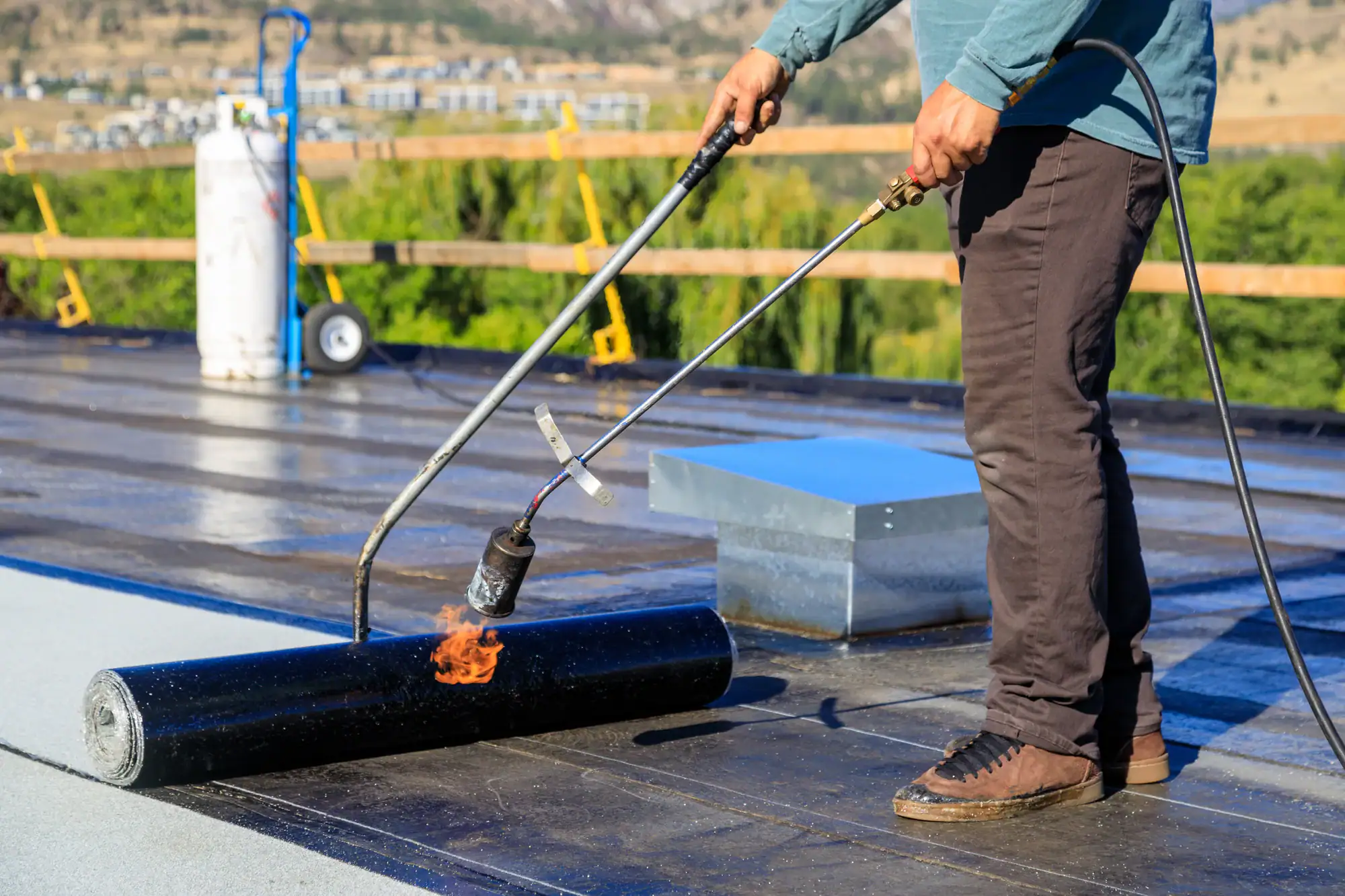
It starts with a free estimate. Someone from our team comes out, looks at the roof, and gives you an honest assessment of what you’re actually dealing with — whether that’s a repair, a full membrane replacement, or something in between. You get a clear, written estimate before any decision is made.
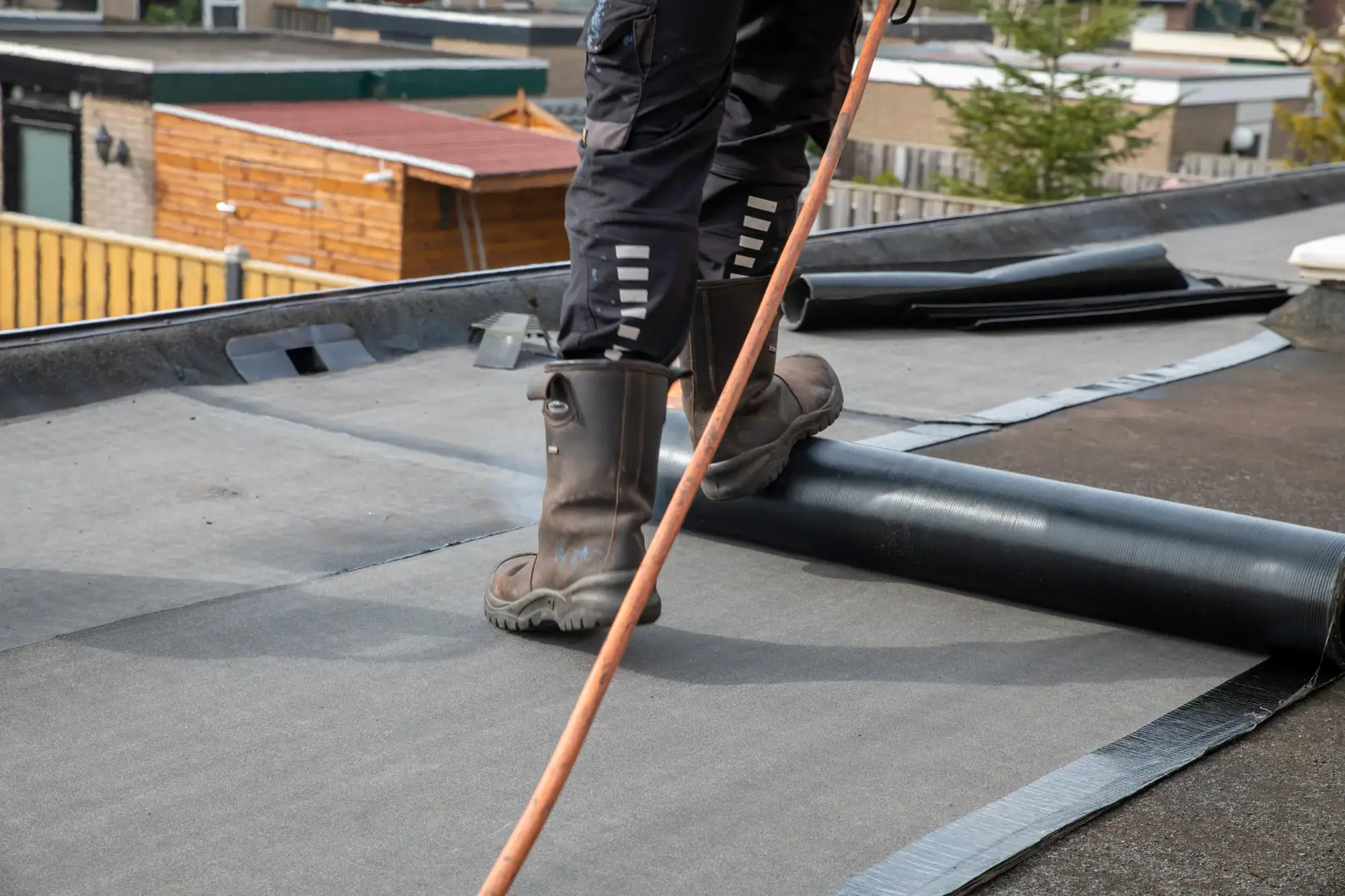
If you’re moving forward with a replacement, we begin with a full tear-off of the existing membrane so the deck can be properly inspected. This step matters more than most homeowners realize. In Lewes, where coastal humidity and rainfall are consistently higher than inland Delaware, deck damage from moisture infiltration is common — and covering a compromised deck with a new membrane just delays a bigger problem. Once the deck is confirmed solid or repaired where needed, we install insulation, and then the membrane goes down.
Whether that’s TPO, EPDM rubber roofing, modified bitumen, or PVC depends on your building, your budget, and what makes the most sense for your property’s coastal exposure. Because Lewes falls under the City’s 2021 ICC Code requirements, all roofing work requires a proper permit. We handle that process — you don’t have to navigate the City of Lewes building department on your own. When the job is done, the site is cleaned up completely.

Ready to get started?
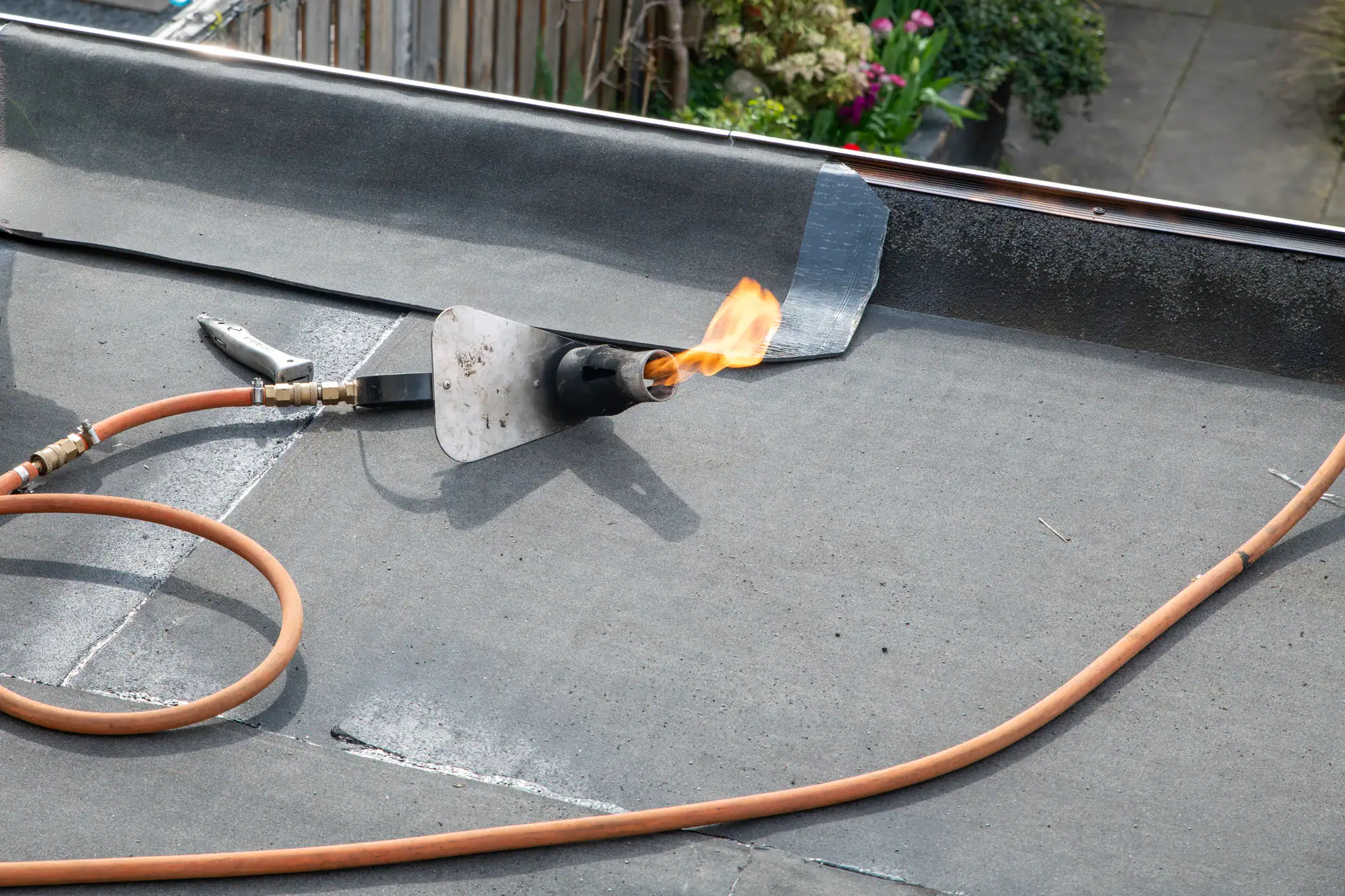
Not every flat roof material performs the same way in a coastal environment. TPO roofing membrane reflects up to 84% of solar load, which makes a real difference for commercial properties and larger homes in Lewes trying to keep cooling costs manageable through a humid Delaware summer. Its heat-welded seams also hold up well under the wind uplift that nor’easters generate along the bay.
For properties where flexibility through freeze-thaw cycles is the priority — and Lewes gets more of those coastal freeze-thaw swings than inland Delaware — EPDM rubber roofing material has a proven track record, with lifespans reaching 20 to 30 years when installed correctly and maintained. Modified bitumen is still a solid option for lower-slope sections of older buildings, including some of the commercial structures along Savannah Road and Second Street in historic downtown Lewes. PVC roofing membrane is worth considering for commercial applications where chemical resistance or long-term warranty terms are a priority.
Beyond the membrane itself, roof waterproofing details like perimeter flashing, penetration seals, and drain design are what separate a flat roof that lasts from one that fails early. In a city that sits between the Delaware Bay, the Lewes and Rehoboth Canal, and Canary Creek, drainage isn’t an afterthought — it’s a core part of the installation. We also assist with storm damage insurance claims, which matters in a community that faces more frequent and severe coastal storms. If you’ve had a nor’easter come through and you’re not sure what your roof sustained, that’s a conversation worth having before you file.

The honest answer is that it depends on the building, but coastal exposure does narrow the field. TPO and EPDM are the two most commonly recommended membrane systems for properties in Lewes and similar coastal Delaware environments. TPO’s heat-welded seams create a watertight bond that handles wind uplift well — relevant when nor’easters push up from the bay. EPDM’s flexibility makes it resistant to the cracking and seam stress that freeze-thaw cycling causes, which Lewes sees more of than inland Delaware communities because coastal temperatures fluctuate around freezing more frequently per season.
Salt air is also a factor that doesn’t get discussed enough. Metal flashings and some adhesive seam systems degrade faster in a salt-air environment. A contractor familiar with coastal Delaware properties will account for this in both material selection and flashing details — using corrosion-resistant components and ensuring seams are mechanically welded rather than relying solely on adhesive bonds that salt air can weaken over time. Modified bitumen is still a reasonable option for certain building types, particularly older structures with lower-slope sections. The free estimate is the right starting point — it’s the only way to give you a specific recommendation based on your actual roof.
This is the question almost every flat roof owner asks, and the honest answer is that you usually can’t tell from the inside. A water stain on your ceiling tells you water got in — it doesn’t tell you where the membrane failed, how long it’s been happening, or whether the deck underneath has been compromised. In Lewes, where coastal humidity means moisture can work into a roof assembly more aggressively than in drier inland areas, what looks like a minor surface issue can be covering more significant deck damage.
A repair makes sense when the membrane is in overall good condition, the failure is isolated — a puncture, a lifted seam, a flashing gap — and the deck is solid. A replacement is the better call when the membrane is aging out, when there are multiple failure points, or when a deck inspection reveals moisture damage that a new membrane alone won’t fix. The only way to know which situation you’re actually in is a proper inspection. We offer free estimates that include an honest assessment of both the membrane and the deck condition — so you’re not guessing, and you’re not being sold a replacement you don’t need.
Yes. The City of Lewes adopted the 2021 ICC Codes effective January 1, 2024, and roofing replacements require a building permit under Chapter 70 of the City Code. Permit applications go through the Edmunds GovTech MCSJ web portal. This applies to work within the city limits — if your property is in an unincorporated area of Sussex County adjacent to Lewes, permits are handled through the Sussex County Building Code Office under Chapter 52 of the Sussex County Code instead.
For properties in the Lewes Historic District, there’s an additional layer to be aware of. The Lewes Historic Preservation Commission reviews exterior alterations on historically contributing structures, and while this primarily applies to visible facade changes, it can influence material selection on roof areas that are visible from the street on older downtown buildings. Working with a contractor who understands local permit requirements — and pulls permits correctly — protects you from compliance issues and ensures the work is done to current code. We handle the permitting process as part of the job, so you’re not navigating the building department on your own.
Yes — and sooner than most people think. The industry standard is that water standing on a flat roof for more than 48 hours after rain is considered ponding, and it’s a problem worth addressing. In Lewes, where Delaware’s roughly 45 inches of annual rainfall is compounded by coastal humidity and the city’s proximity to multiple water bodies, flat roofs that drain slowly are under more consistent moisture stress than the same roof would face in an inland location.
Ponding water accelerates membrane degradation by keeping the surface wet and promoting algae and mold growth. It adds structural load — water weighs about 5 pounds per square foot per inch of depth, and a flat roof with inadequate drainage can accumulate meaningful weight during heavy rain events. It also stresses seams and penetration flashings, which are the most common failure points on any flat roof. In winter, standing water that freezes and thaws repeatedly works into any existing micro-cracks and makes them worse. If you’re seeing consistent pooling after rain, the cause is usually a clogged drain, a low spot from deck deflection, or inadequate drainage slope — all of which are diagnosable and fixable before they become a membrane replacement.
Yes, and this is something we actively assist with. The City of Lewes officially acknowledges that nor’easters and coastal storms are occurring with greater frequency and severity. When a storm lifts a membrane section, damages flashing, or causes debris impact on a flat roof, the insurance claim process can be just as stressful as the damage itself.
The key issue with storm damage claims on flat roofs is documentation. Insurance adjusters often scope claims conservatively, and a homeowner or property manager who doesn’t know what to look for may accept a patch estimate when the actual damage warrants a full replacement. We help you document the damage properly, work with your adjuster, and scope the repair or replacement accurately so the claim reflects what the roof actually needs — not just what’s visible from a quick walk-around. If you’re a vacation rental owner in Lewes who wasn’t on-site when a storm came through, this assistance is especially valuable. You don’t have to figure out the claims process from a distance on your own.
Twice a year is the standard recommendation for most flat roofs, and coastal properties in Lewes make a strong case for sticking to that schedule rather than stretching it. The combination of salt air, high annual rainfall, coastal humidity, and nor’easter exposure puts more consistent stress on a flat roof membrane than the same roof would experience in an inland Delaware location. Small issues — a minor seam lift, a partially clogged drain, a small puncture from wind-blown debris — don’t stay small for long in this environment.
The two most useful inspection windows for Lewes properties are spring and fall. Spring catches anything that developed over winter from freeze-thaw cycling and gives you time to address it before summer storm season. Fall catches any summer wear and storm damage before winter sets in. For vacation rental or second-home owners who aren’t in Lewes year-round, a scheduled inspection in the spring — before peak rental season — is particularly valuable. It’s far better to find a minor membrane issue in April than to get a call about a leaking ceiling from a tenant in July. We offer free estimates, so if you’re not sure what condition your flat roof is in, that’s the right first step.
Other Services we provide in Lewes