What You Need to Know About Commercial Roofing Before You Choose a System
Commercial roofing is one of the most critical investments a business or property owner can make — and the wrong choice can cost tens of thousands of dollars down the road. Here’s a quick overview of what this guide covers:
At a glance — commercial roofing essentials:
- Common system types: TPO, PVC, EPDM, metal, modified bitumen, and built-up roofing (BUR)
- Typical lifespan: 20 to 30 years, depending on material, climate, and maintenance
- Key selection factors: Structural load, weather exposure, energy efficiency, and budget
- Repair vs. replace: Roof coatings and restoration can extend life without full tear-off
- Certifications matter: GAF Master Elite and CertainTeed-certified contractors offer stronger warranties
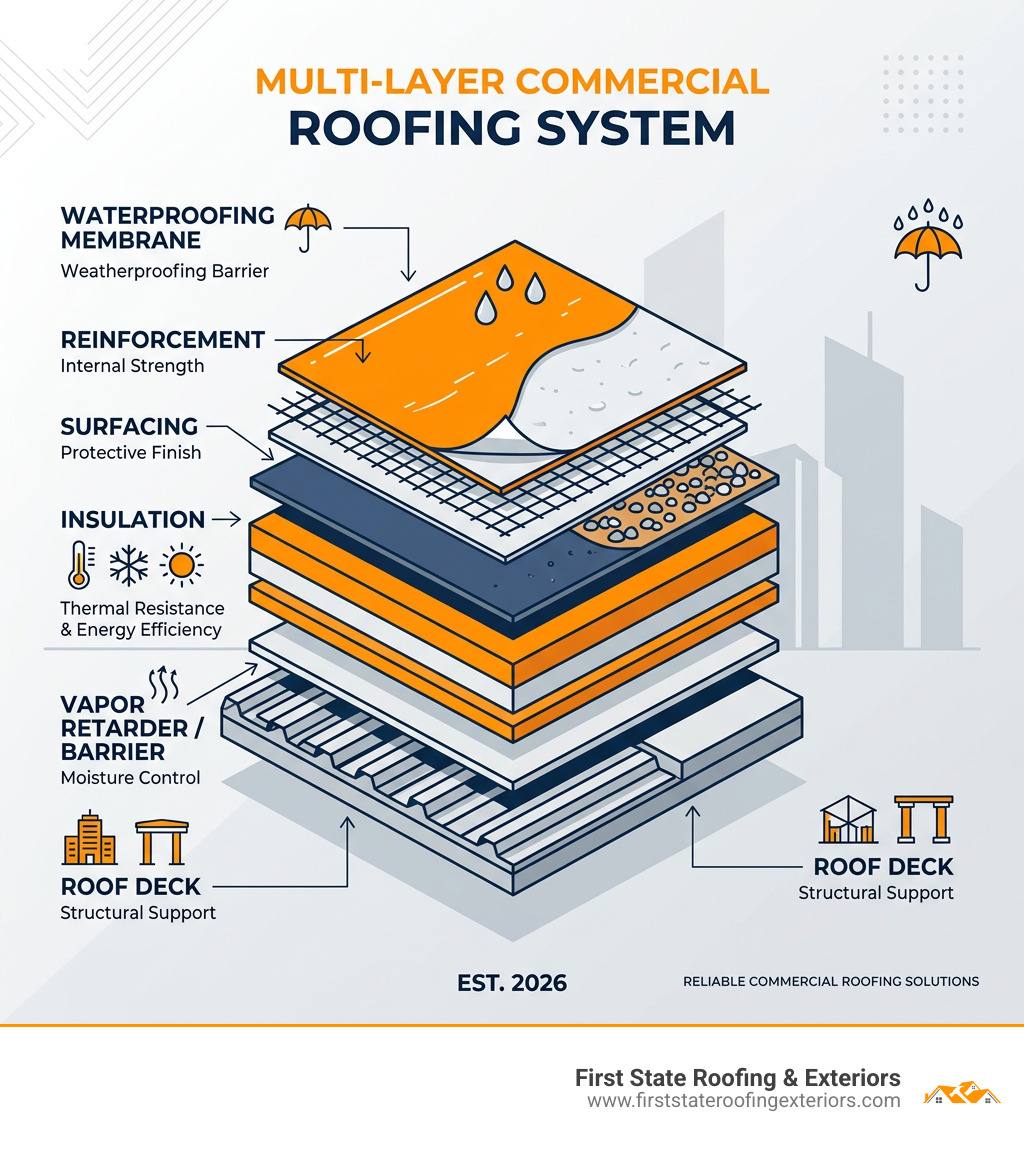
Most flat or low-slope commercial roofs are built from multiple layers — a weatherproofing membrane, reinforcement, and surfacing — each playing a specific role in protecting your building. Understanding those layers helps you make smarter decisions about materials, contractors, and long-term maintenance.
If your Delaware building is aging, showing signs of damage, or simply due for an upgrade, First State Roofing & Exteriors offers free estimates to help you figure out the right path forward. Call (302) 222-4065 to schedule a free inspection.
I’m Richard McCain, Owner and President of First State Roofing & Exteriors, with over 20 years of hands-on experience delivering commercial roofing solutions across Delaware. In this guide, I’ll walk you through everything you need to know — from material types to manufacturer certifications — so you can protect your investment with confidence.
Related content about commercial roofing:
Common Types of Commercial Roofing Systems
Choosing the right commercial roofing system is not a “one-size-fits-all” decision. The architecture of your building, your local climate in Dover or Milford, and your long-term financial goals all play a role. Most low-slope commercial roofs consist of three principal components: a weatherproofing layer, reinforcement for strength, and a surfacing material to protect against UV rays and traffic.
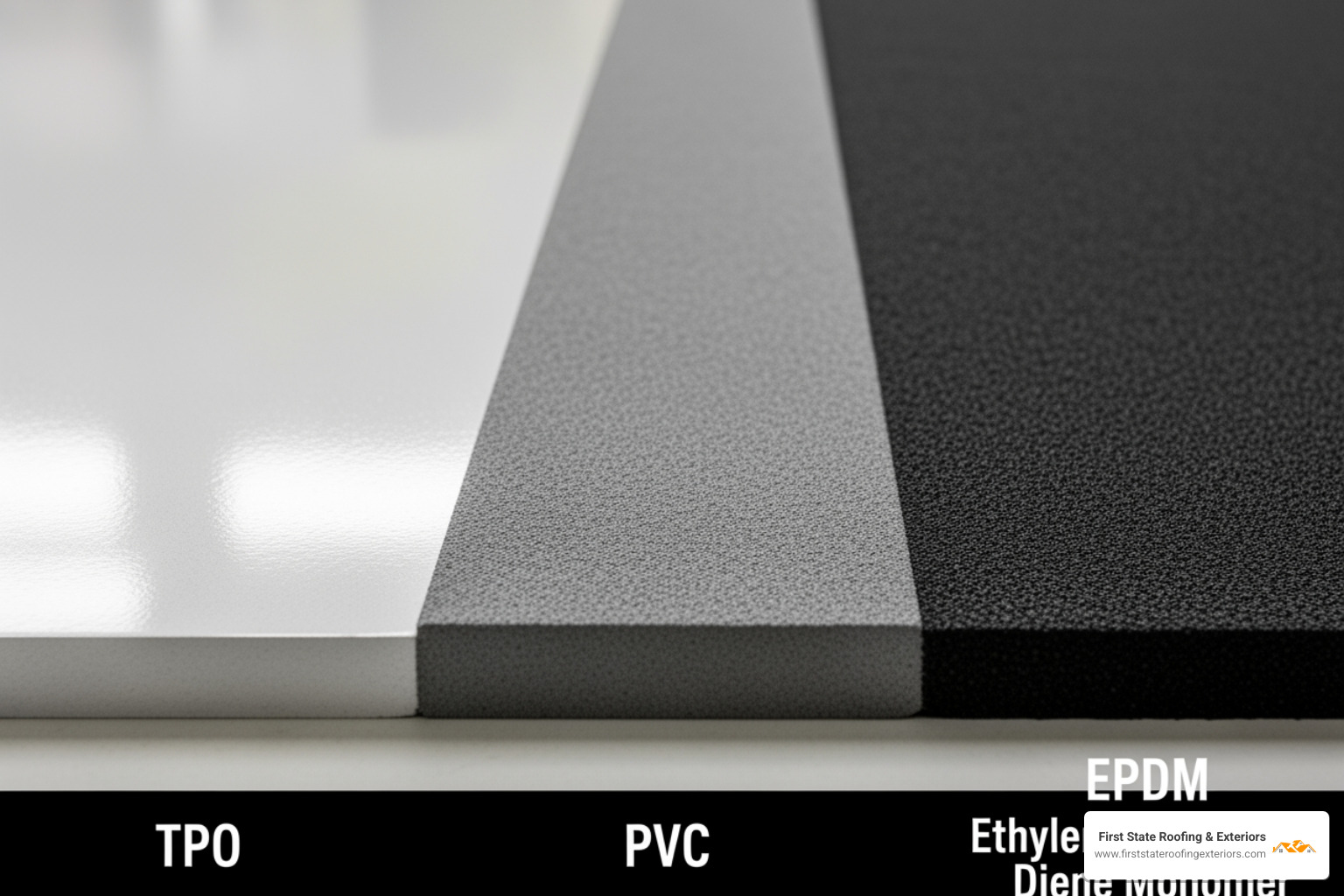
Here are the most prevalent systems we install and maintain:
- TPO (Thermoplastic Polyolefin): This is currently one of the most popular choices for flat roofs. It is a single-ply reflective membrane that provides excellent UV protection and energy efficiency.
- PVC (Polyvinyl Chloride): Known for its extreme durability and resistance to chemicals, grease, and fire. PVC membranes often feature a high-density scrim (reinforcement fabric) that makes them incredibly puncture-resistant.
- EPDM (Ethylene Propylene Diene Terpolymer): Often called “rubber roofing,” EPDM is a durable synthetic rubber membrane. It is particularly effective in colder climates and has been a staple in the industry for decades.
- Metal Roofing: For both low-slope and steep-slope commercial buildings, metal offers unmatched longevity and fire resistance.
- Built-Up Roofing (BUR): The traditional “tar and gravel” roof. It’s built on-site using multiple layers of asphalt-coated felt bonded with hot asphalt.
- Modified Bitumen: An evolution of BUR, these systems use modifiers like APP (plastic-like) or SBS (rubber-like) to enhance the asphalt’s performance and flexibility.
For more detailed technical data, you can explore Types of Commercial Roofing Systems or contact us for expert commercial roofing solutions.
Durability and Cost Comparison Table
| System Type | Average Lifespan | Maintenance Level | Best For |
|---|---|---|---|
| TPO | 20-25 Years | Low | Energy efficiency, large warehouses |
| PVC | 20-30 Years | Low | Restaurants, chemical plants |
| EPDM | 25-30 Years | Moderate | Durability, cold weather |
| Metal | 40-60 Years | Low | Longevity, architectural appeal |
| BUR | 15-20 Years | High | Heavy foot traffic, redundancy |
Benefits of Single-Ply Membranes
Single-ply membranes like TPO, PVC, and EPDM have revolutionized the industry because they are lightweight and relatively fast to install. TPO and PVC are thermoplastic, meaning their seams are heat-welded to create a monolithic, watertight bond that is actually stronger than the membrane itself.
PVC is often the “go-to” for the food service industry because it resists the animal fats and oils exhausted through kitchen vents that would otherwise degrade EPDM or TPO. Meanwhile, TPO is prized for its high solar reflectance, which can significantly lower cooling costs for large facilities. To learn more about how these systems integrate with your building’s exterior, check out our commercial exterior services page.
Advantages of Commercial Metal Roofing
Commercial metal roofing is an investment in “generational” protection. Whether you choose standing seam or corrugated panels, metal roofs are virtually impervious to the heavy winds and rains we see in Delaware. They are also non-combustible, which can sometimes lead to lower insurance premiums for property owners. If you are considering this material, read our Delaware commercial metal roofing contractors tips for a deeper dive into regional installation requirements.
Key Factors in Selecting Commercial Roofing Materials
When we sit down with a business owner in Milford or Dover, we look at several environmental and structural variables before recommending a system. You can find a local commercial roofing complete guide on our site, but here are the heavy hitters:
- Structural Load: Can your building’s deck handle the weight of a heavy Built-Up Roof, or do you need a lightweight TPO membrane?
- Site Access: Some systems require heavy kettles or large rolls of material. If your building is in a dense urban area with limited access, this may limit your choices.
- Chemical Exposure: Does your facility exhaust chemicals, oils, or acids? If so, PVC is likely your only viable option.
- Wind Uplift: Delaware’s coastal proximity means we must account for high wind speeds. Wind-vented systems or high-density fastening patterns may be necessary.
- Energy Goals: If you want to reduce your carbon footprint, “cool roofs” with high solar reflectance are the way to go.
Maximizing the Lifespan of Your Commercial Roof
A commercial roofing system typically lasts between 20 and 30 years, but that number is not guaranteed. It is earned through proper maintenance. Without it, even the best GAF or CertainTeed roof can fail prematurely due to ponding water, clogged drains, or thermal expansion.
We recommend a 20-point inspection at least twice a year — once in the spring and once in the fall. During these inspections, we check for:
- Ponding Water: If water stays on your roof for more than 48 hours, it can lead to structural damage and membrane degradation.
- Drainage Efficiency: Clearing debris from gutters and scuppers is the simplest way to prevent major leaks.
- Thermal Expansion: Roofs “breathe.” They expand in the heat and contract in the cold. We check flashings and seams to ensure they haven’t cracked under the stress.
For more tips on keeping your industrial facility dry, see our industrial roof repair near me guide.
Repair, Restoration, or Full Replacement?
One of the most common questions we get is: “Do I really need a whole new roof?” The answer often lies beneath the surface. We use core cuts — literally taking a small sample slice of the roof — to assess how many layers of roofing are already present and if the underlying insulation is saturated with moisture.
If the structural integrity is sound and the insulation is dry, you might be a candidate for a roof restoration.
- Roof Coatings: Applying a high-quality silicone or acrylic coating can seal minor leaks and extend your roof’s life by 10 to 15 years at a fraction of the cost of a replacement.
- Full Replacement: If there is widespread moisture under the membrane or structural damage, a full tear-off is necessary to protect the building.
For a step-by-step look at the replacement process, read from tear-off to top-off your guide to commercial flat roof replacement.
The Importance of Manufacturer Certifications and Warranties
In the commercial roofing world, the material is only as good as the warranty backing it. We are proud to work with industry leaders like GAF and CertainTeed. Choosing a certified contractor is the only way to access “No Dollar Limit” (NDL) warranties, which cover both materials and workmanship for up to 30 years.
Manufacturers like GAF provide extensive training for every system to ensure that their products are installed to the highest standards. When you see a “Master Elite” or “Integrity” designation, it means the contractor has been vetted for financial stability, insurance coverage, and technical proficiency.
Frequently Asked Questions about Commercial Roofing
How long does a commercial roofing system typically last?
On average, a commercial roofing system serves a building for about 20 to 25 years. However, this varies wildly by material. For instance, a properly maintained EPDM or PVC roof can easily push past the 30-year mark, while a metal roof might last 50 years. The biggest factors affecting lifespan are the quality of the initial installation and the consistency of preventative maintenance. To budget for the future, check out our guide on commercial roof replacement cost what to expect in 2025 and beyond.
What are the most energy-efficient commercial roofing options?
“Cool roofing” is the standard for energy efficiency. TPO and PVC membranes are naturally reflective, bouncing solar heat away from the building. This reduces the “urban heat island effect” and lowers your HVAC system’s workload. Some GAF PVC membranes even offer guarantees up to 30 years while maintaining high solar reflectance. For local business owners, our commercial roofing contractor Dover DE guide explains how these systems perform in the Delaware climate.
When is a roof coating better than a replacement?
A roof coating is better when the underlying structure is healthy but the surface is aging. It is a sustainable, cost-effective way to “renew” your roof without the waste of a full tear-off. Coatings are excellent for leak prevention and can be reapplied every decade to keep the roof in a perpetual state of “good repair.” If you’re dealing with active leaks, see our commercial roof repair Dover DE page for immediate assistance.
Conclusion
Choosing the right commercial roofing system in Delaware requires a balance of technical knowledge and local experience. From the humid summers in Dover to the windy winters in Milford, your roof has to stand up to a lot. At First State Roofing & Exteriors, we bring family-owned integrity and 24/7 availability to every project, ensuring your business stays protected no matter what the forecast says.
Why Delaware businesses trust us:
- Local Expertise: We know the specific building codes and weather patterns of the First State.
- Certified Quality: We use top-tier materials from GAF and CertainTeed.
- Transparency: No hidden fees and honest assessments of whether you need a repair or a replacement.
- Availability: We offer 24/7 emergency services because leaks don’t wait for business hours.
If you’re looking for professional commercial roofers near me, look no further. We are here to help you navigate the complexities of commercial systems with ease and humor.
Ready to protect your building? We provide comprehensive evaluations and free estimates for all commercial properties. Call us today at (302) 222-4065 to schedule your free inspection and take the first step toward a more secure, energy-efficient future for your business.