Why Asbestos Shingle Replacement Is a Health and Safety Priority for Kent and Sussex County, DE Homeowners
Asbestos shingle replacement is one of the most important — and most misunderstood — home improvement projects a Kent and Sussex County, DE homeowner can undertake. If your home was built between the 1920s and the 1980s, there’s a real chance your roof or siding contains asbestos-cement shingles. When left undisturbed, they’re often manageable. But when they crack, crumble, or need repair, the risk to your family’s health becomes serious.
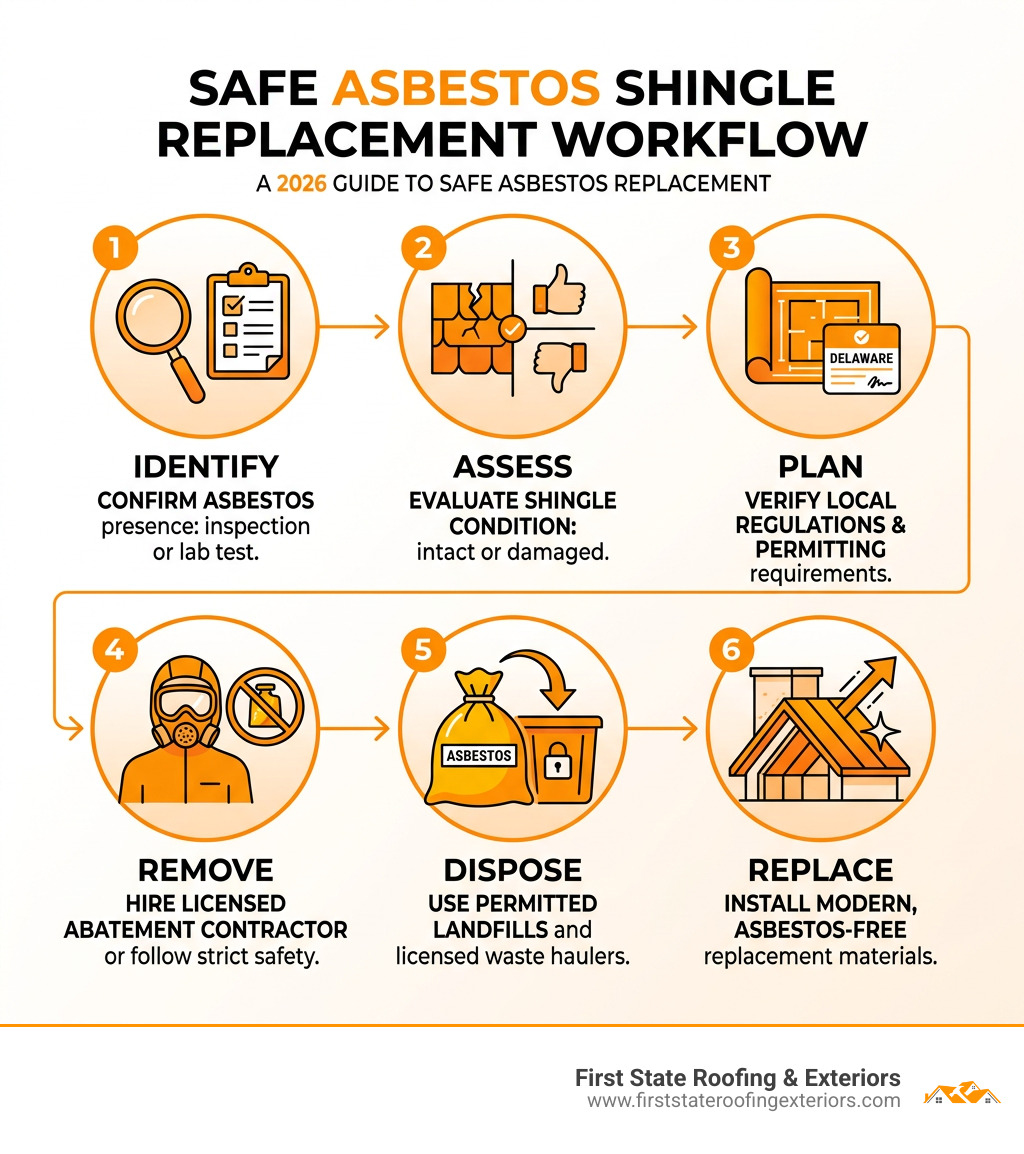
Here’s a quick overview of what asbestos shingle replacement involves:
| Step | What It Means |
|---|---|
| Identify | Confirm asbestos presence through visual inspection or lab testing |
| Assess | Determine if shingles are intact (lower risk) or damaged (higher risk) |
| Plan | Check Kent and Sussex County, DE regulations and permit requirements |
| Remove | Hire a licensed abatement contractor or follow strict DIY safety protocols |
| Dispose | Use permitted landfills and licensed haulers for asbestos waste |
| Replace | Install modern, asbestos-free materials like fiber cement or metal roofing |
Asbestos was used heavily in roofing shingles from the 1920s through the 1960s — and sold well into the 1970s and 1980s — because it was affordable, fire-resistant, and durable. The typical lifespan was around 30 years, though some roofs have held up for 50 years or more. The problem isn’t the material sitting quietly on your roof. It’s what happens when those shingles get disturbed: microscopic fibers become airborne and can cause mesothelioma, lung cancer, and asbestosis decades later.
The good news? With the right approach, asbestos shingle replacement doesn’t have to break the bank. Our professional Kent and Sussex County, DE roofing experts at First State Roofing & Exteriors have guided hundreds of homeowners through this process safely, legally, and affordably.
I’m Richard McCain, Owner and President of First State Roofing & Exteriors, with over 20 years of hands-on experience managing roofing and exterior projects across Kent and Sussex County, DE — including asbestos shingle replacement on aging homes throughout the state. In this guide, I’ll walk you through everything you need to know to handle this the right way.
Simple asbestos shingle replacement glossary:
Understanding the Risks and Identification of Asbestos Shingles
Before you swing a hammer or pull a single shingle, you need to know exactly what you are dealing with. Asbestos-cement shingles, often referred to by the trade name “Transite,” are not 100% asbestos. In fact, laboratory results show that asbestos content typically varies from 5% to as high as 35%. The remainder is usually Portland cement and mineral fibers.
While these shingles are exceptionally durable, they are classified as Category II non-friable materials. “Non-friable” means that under normal conditions, you cannot crush the material into powder with your bare hands. However, as these shingles age—reaching that 30-to-50-year life expectancy limit—they become brittle. If they are sawn, sanded, or broken during a botched asbestos shingle replacement, they release hazardous dust.
How to Identify Asbestos-Containing Materials
You cannot confirm the presence of asbestos just by looking at it, but there are several strong indicators. If your Kent and Sussex County, DE home was built before 1989 and features the following, you should treat the material as asbestos-containing until proven otherwise:
- Dimensions and Shape: Many asbestos shingles were manufactured in 12×24 inch rectangles or hexagonal shapes.
- Texture and Edges: Look for a distinct cement-like texture and “wavy” or “scalloped” bottom edges.
- Physical Characteristics: They are very hard, heavy, and brittle. If you see a broken piece, it often looks like layered gray stone rather than wood or asphalt.
- Age: If the roof was installed between 1905 (when the Ambler Asbestos Shingle & Sheathing Company started U.S. production) and the late 1970s, it almost certainly contains asbestos.
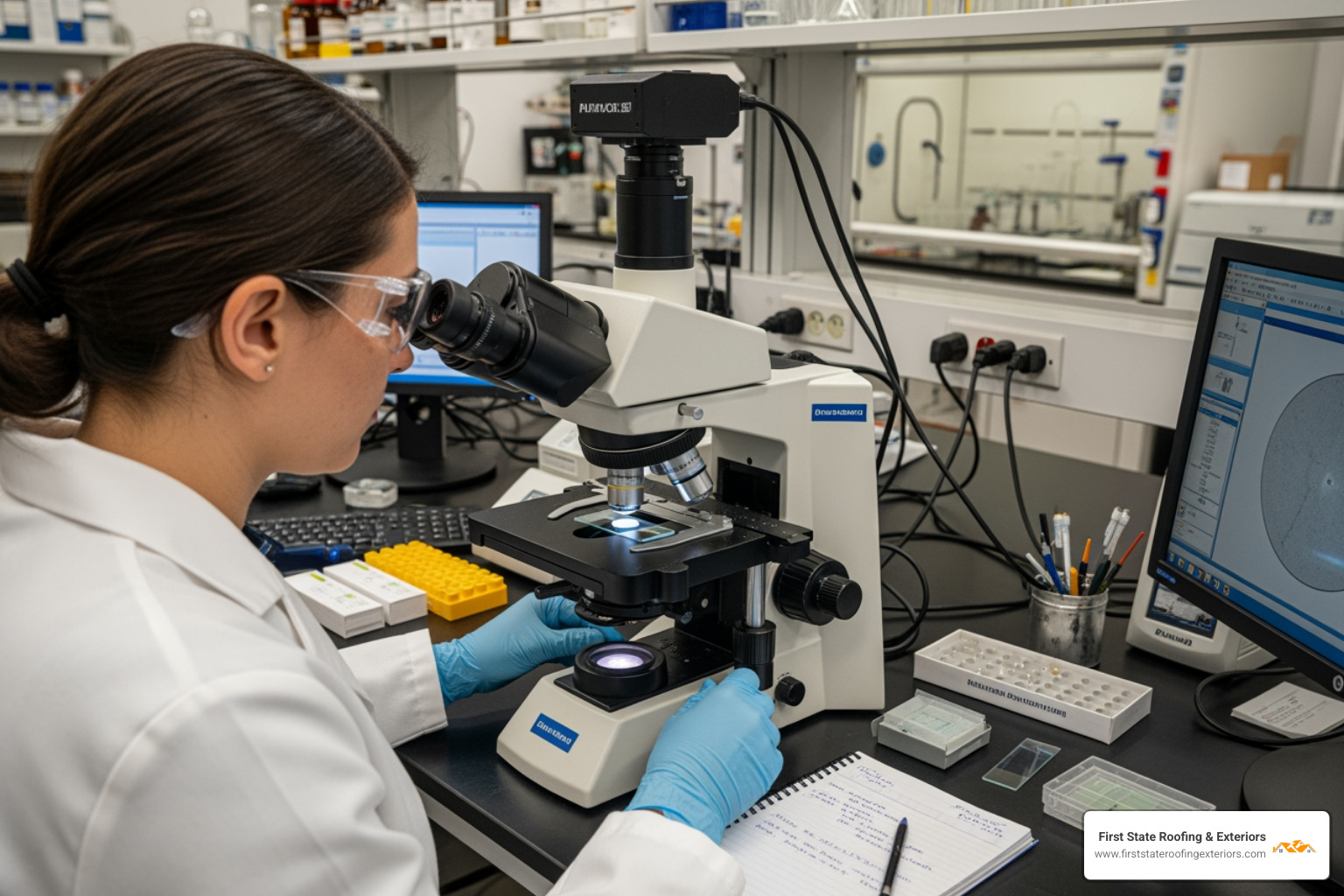
For a definitive answer, we recommend InspectApedia Diagnose & Fix resources or professional laboratory testing. A technician will use polarized light microscopy (PLM) to identify the specific type of asbestos—usually Chrysotile—present in the sample.
Health Hazards of Asbestos Shingle Replacement
The primary danger of asbestos shingle replacement lies in the inhalation of microscopic fibers. According to Regulation (EC) n. 1272/2008, asbestos is a Category 1A carcinogen. Once inhaled, these thin, durable filaments lodge in the lining of the lungs or abdomen.
The “scary” part of asbestos exposure is the latency period. Diseases like mesothelioma, lung cancer, and asbestosis often don’t appear until 10 to 40 years after the initial exposure. This is why “minor” dust created during a DIY removal today can become a life-threatening illness decades from now. To learn more about the history and technical specifications, you can find more information about Asbestos shingles through specialist archives.
Legal Requirements and Safety Protocols for Asbestos Shingle Replacement
In Kent and Sussex County, DE, the Department of Natural Resources and Environmental Control (DNREC) oversees the handling of asbestos. Because asbestos shingle replacement involves hazardous waste, you cannot simply toss these shingles into your weekly trash bin.
Federal OSHA and EPA standards are very strict regarding “friability.” If there is a high probability that the shingles will be crumbled, pulverized, or reduced to powder during removal, the project becomes a regulated abatement. This often happens if the shingles are already in poor condition or if the removal method (like using power tools) creates dust.
Professional Abatement vs. DIY Regulations
Can a homeowner remove their own asbestos shingles in Kent and Sussex County, DE? Technically, DNREC provides Information for Homeowners that allows for some DIY work on owner-occupied single-family homes. However, we strongly advise against it for several reasons:
- Liability: If you accidentally contaminate your neighbor’s yard or the local environment, you could face massive fines.
- Specialized Equipment: Professionals use negative air machines, HEPA-filtered vacuums, and specialized wetting agents that most homeowners can’t access.
- Disposal: You still must follow strict DNREC guidelines for transport and disposal at a permitted facility.
- Insurance: Many standard homeowners’ insurance policies will not cover damages or health claims resulting from DIY asbestos disturbance.
For residents in areas like Milford, checking a roof-replacement-milford-guide can help you understand local permitting nuances.
Step-by-Step Guide to Safe Removal and Disposal
If a professional inspection determines that your shingles must go—perhaps because more than 25% of the roof is damaged—the removal must be methodical. The goal is zero dust.
The Removal Process: Minimizing Fiber Release
Whether you are hiring a pro or following a how-to guide, the “wet method” is the industry standard. Keeping the material damp prevents fibers from taking flight.
- Preparation: Seal all windows and doors. Lay 6-mil poly plastic sheeting at least 10 feet out from the walls to catch any debris.
- PPE: Workers must wear disposable Tyvek coveralls, rubber gloves, and—most importantly—an N100 or P100 respirator. A standard “dust mask” is useless against asbestos.
- Top-Down Strategy: Start at the ridge and work down. This prevents you from walking on and breaking shingles you haven’t removed yet.
- Gentle Extraction: Do not pry or shatter the shingles. Use a shingle ripper or nippers to cut the nails, then carefully slide the shingle out and lower it to the ground. Never throw shingles from the roof into a dumpster.
- Packaging: Place shingles immediately into heavy-duty, leak-tight bags or 6-mil poly-wrapped bundles.
For a deeper dive into these technical steps, see our roof-installation-complete-guide.
Proper Disposal of Asbestos Waste
Asbestos waste is classified as “special waste.” It must be transported by a licensed hauler to a landfill specifically permitted to accept asbestos. In Kent and Sussex County, DE, you must fill out a waste shipment manifest that tracks the material from your roof to its final burial site. Every package must be labeled with a warning: “DANGER – CONTAINS ASBESTOS FIBERS – CANCER AND LUNG DISEASE HAZARD.”
Cost-Effective Asbestos Shingle Replacement Materials
Once the hazardous material is gone, you have a blank canvas. The most popular choice today is asphalt, which represents 80% of the U.S. market. However, because asbestos shingles had a very specific “look,” many Kent and Sussex County, DE homeowners want a replacement that maintains that historic charm.
| Material | Estimated Cost | Lifespan | Best For |
|---|---|---|---|
| Architectural Asphalt | Low-Medium | 25-30 Years | Budget-friendly durability |
| Fiber Cement | Medium | 30-50 Years | Matching the original look |
| Metal Roofing | High | 50+ Years | Longevity and energy efficiency |
| Synthetic Slate | High | 50 Years | High-end historic aesthetics |
Modern Asbestos-Free Replacement Options
If you want to keep the “Transite” look without the “Transite” danger, fiber cement siding and shingles (like GAF WeatherSide) are the perfect solution. They are made of cellulose fiber, sand, and cement—completely asbestos-free. They are rot-resistant, fire-rated, and can be painted any color.
For those interested in high-end alternatives, The TileGuru Blog offers great insights into clay and concrete options that mimic the weight and feel of old-world materials. If you’re leaning toward asphalt for its value, check out our asphalt-roof-replacement-ultimate-guide.
Frequently Asked Questions About Asbestos Shingles
Can I paint or encapsulate asbestos shingles?
Yes, if the shingles are in good structural shape. Using a high-quality latex masonry paint or a specialized fiber-sealing coating can “lock in” the fibers and extend the life of the siding. This is a great short-term management strategy that avoids the high cost of full asbestos shingle replacement. Just remember: never power-wash or scrape the shingles before painting, as this releases dust.
When is removal absolutely necessary?
We generally recommend full removal if more than 25% of the shingles are cracked, worn, or missing. Additionally, if you are planning a structural renovation that requires cutting into the roof deck, or if you are selling a home and the buyer’s inspector flags the roof as a “friable hazard,” replacement becomes unavoidable.
How much does professional removal cost?
In Kent and Sussex County, DE, professional asbestos abatement typically costs between $8 and $15 per square foot, depending on the height of the roof and disposal fees. While this is more expensive than a standard “tear-off,” it ensures your property remains safe and compliant with state law.
Conclusion: Trust the Local Experts at First State Roofing & Exteriors
Replacing asbestos shingles isn’t just about curb appeal; it’s about peace of mind. At First State Roofing & Exteriors, we pride ourselves on being the local Kent and Sussex County, DE experts who handle these complex projects with total integrity and transparency. Whether you are in Dover, Milford, or anywhere else in the First State, we are available 24/7 to help you navigate the challenges of aging exteriors.
Don’t let the “asbestos” label scare you into overpaying or ignoring a growing problem. We offer a range of roof-replacement options that fit your style and your budget.
Ready to secure your home’s future? First State Roofing & Exteriors gives free estimates! Call (302) 222-4065 for a free inspection and let our family protect yours.