Why Finding the Right Local Flat Roof Specialists Matters for Your Property
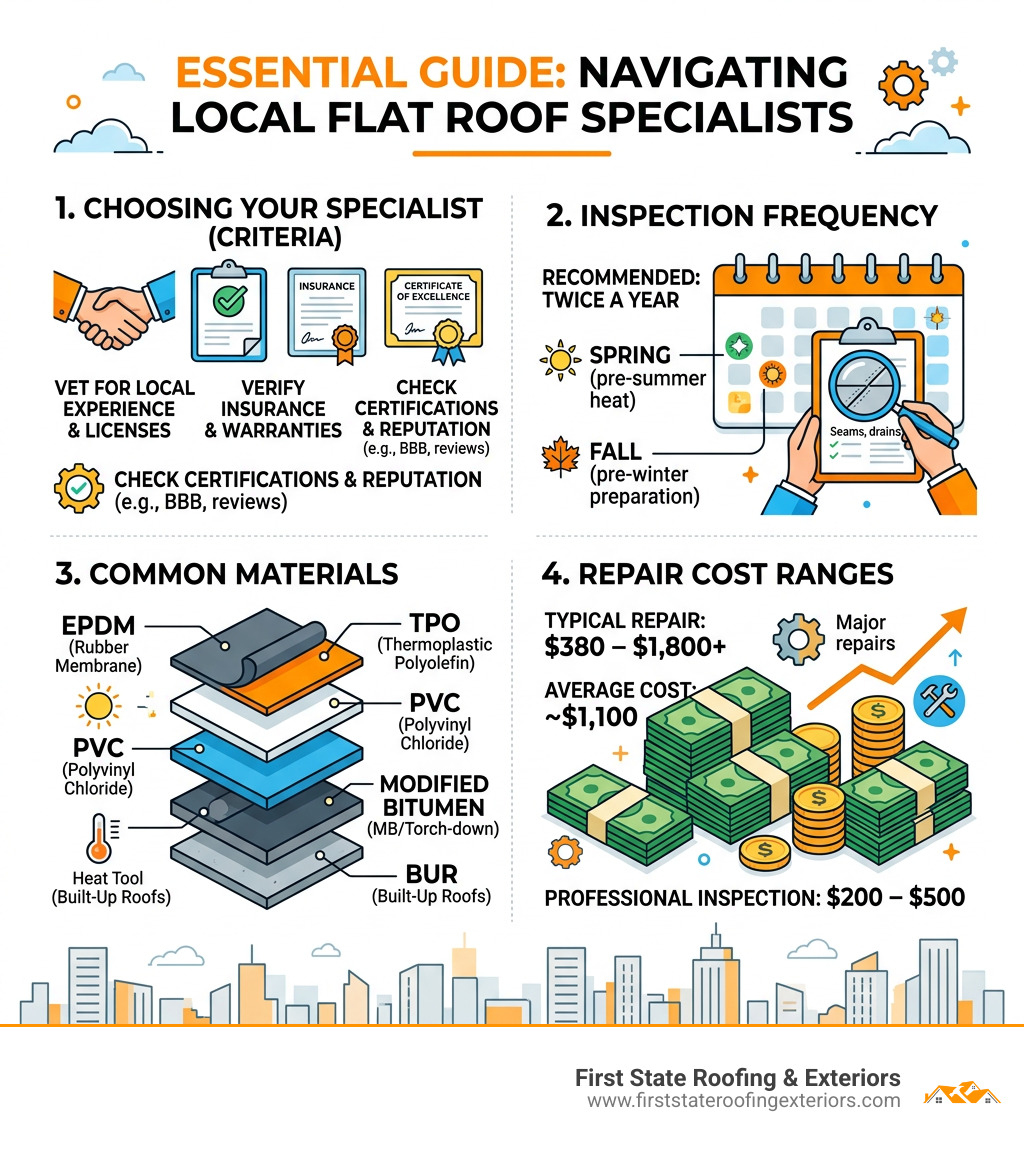
Local flat roof specialists are licensed, experienced contractors who focus on the repair, installation, maintenance, and restoration of low-slope roofing systems for commercial and residential properties. Here is a quick overview of what to look for and expect:
| What to Know | Key Details |
|---|---|
| Who they are | Licensed, insured contractors with flat roof expertise |
| What they do | Repair, replace, restore, inspect, and maintain flat roofs |
| Common materials | EPDM, TPO, PVC, modified bitumen, BUR |
| Typical repair cost | $380 to $1,800, with most homeowners paying around $1,100 |
| How often to inspect | Twice a year — spring and fall |
| What to verify | BBB rating, certifications, insurance, and written warranties |
Flat roofs cover most commercial buildings in the United States — from retail centers and schools to warehouses and apartment complexes. They are efficient, cost-effective to construct, and durable when properly maintained. But they come with a unique set of challenges: ponding water, membrane shrinkage, UV degradation, and storm damage all require a specialist’s eye. Choosing the wrong contractor — or skipping maintenance — can turn a small leak into a very expensive problem.
That is why choosing the right contractor is not just a practical decision. It is a financial one. Our professional roofing services in Delaware are built around exactly this kind of expertise. We offer free estimates and a free inspection; call us at (302) 222-4065.
I’m Richard McCain, Owner and President of First State Roofing & Exteriors, a family-run Delaware contractor with over 20 years of hands-on experience working with local flat roof specialists and managing roofing projects of all scales across the state. In the sections ahead, I’ll walk you through everything you need to know — from materials and maintenance to costs and contractor vetting — so you can make a confident, informed decision for your property.
Simple local flat roof specialists glossary:
Understanding Flat Roofing Systems and Materials
When we talk about flat roofs, we are technically referring to “low-slope” roofs. In commercial architecture, flat roofs are the gold standard for efficiency. They follow the geometric principle that the shortest distance between two points is a straight line, allowing builders to cover massive industrial spaces, shopping malls, and schools with minimal material waste compared to high-pitched residential gables.
However, because gravity isn’t doing the heavy lifting to shed water, these systems rely on sophisticated chemical membranes to stay watertight. Modern engineering has moved past the “tar and gravel” days of the mid-20th century. Today, local flat roof specialists utilize advanced single-ply membranes like EPDM, TPO, and PVC to create seamless barriers against the elements.
| Material | Primary Benefit | Average Lifespan |
|---|---|---|
| EPDM | Extreme durability and weather resistance | Up to 50 Years |
| TPO | Energy efficiency and heat-reflective | 20 – 30 Years |
| PVC | Chemical resistance and strongest seams | 40+ Years |
For many property owners, the choice of material depends on the building’s use. For instance, Duro-Last PVC roofing benefits include custom fabrication, where the membrane is manufactured in a factory to the exact specifications of your building, significantly reducing the number of seams that must be welded on-site.
Popular Materials Used by Local Flat Roof Specialists
If you are considering a new installation or a full replacement, you will likely hear three acronyms repeatedly: EPDM, TPO, and PVC.
EPDM (Ethylene Propylene Diene Terpolymer) is a synthetic rubber membrane that has been a staple in the industry for decades. It is typically black, which helps absorb heat in colder climates, and it is incredibly resilient. Statistics show that EPDM roofing membranes can last up to 50 years, often carrying manufacturer warranties of 30 years. It’s the “old reliable” of the roofing world.
TPO (Thermoplastic Polyolefin) is the rising star of eco-friendly roofing. These white or light-colored membranes are highly reflective, bouncing UV rays away from the building. This can drastically reduce cooling costs during Delaware’s humid summers. TPO features heat-welded seams, which create a physical bond between sheets that is often stronger than the membrane itself. If you’re planning a major project, check out our guide to commercial flat roof replacement to see how TPO stacks up.
PVC (Polyvinyl Chloride) has been on the market for over 40 years. It is similar to TPO in its reflective properties but offers superior resistance to chemicals, oils, and greases. This makes it the preferred choice for restaurants or manufacturing facilities where exhaust vents might release substances that would degrade other rubber-based roofs.
Why Businesses Trust Local Flat Roof Specialists
Commercial roofing is a different beast than residential shingling. Industrial complexes and retail centers require specialized mechanics who understand the nuances of large-scale water management. A minor dip in a 50,000-square-foot roof can lead to “ponding,” where water sits for days, slowly eating away at the membrane.
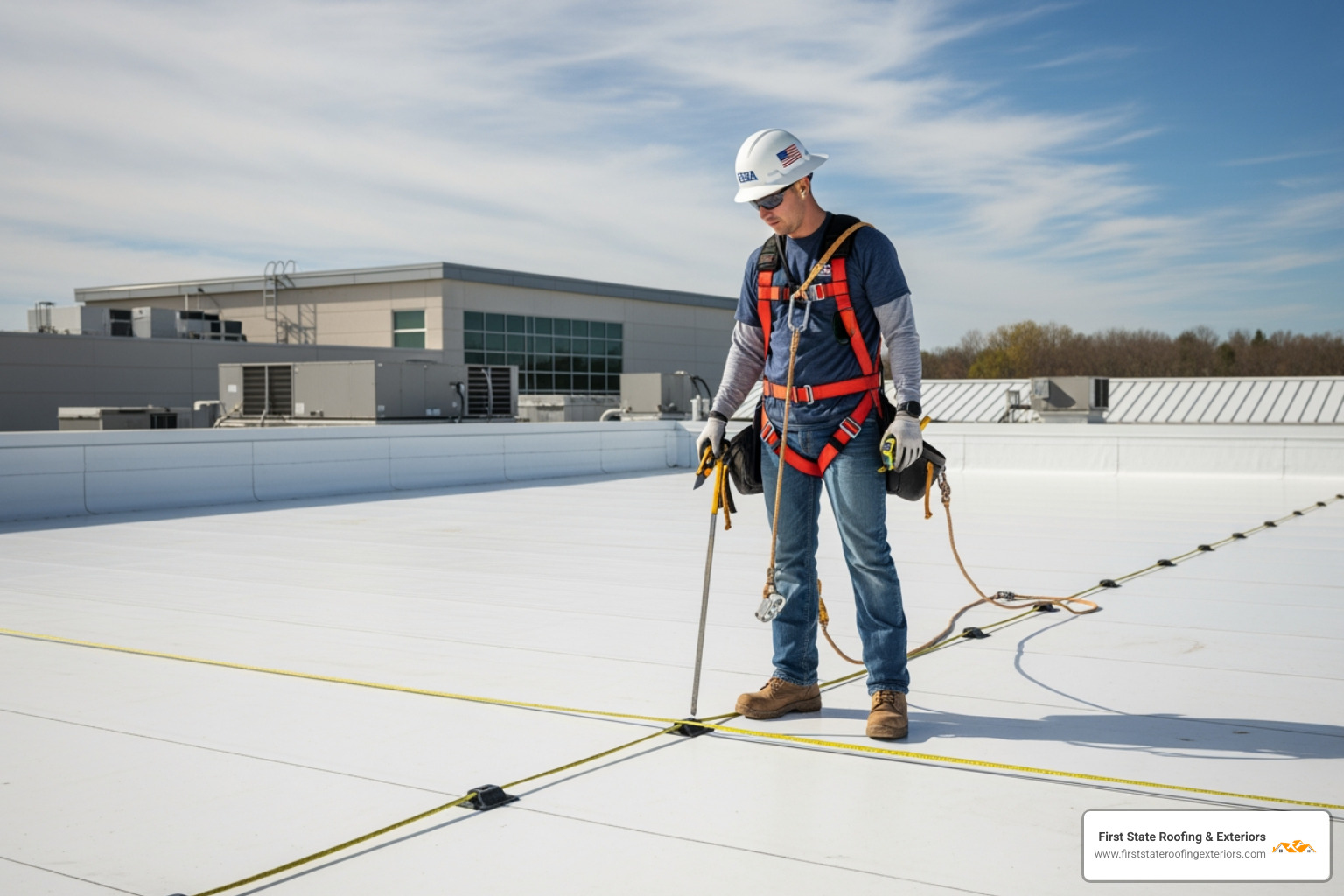
Local flat roof specialists possess the diagnostic tools—such as infrared moisture detection—to find leaks that are invisible to the naked eye. Unlike national chains that might send a different crew every time, local experts understand the specific weather patterns of the Mid-Atlantic. They know how our freeze-thaw cycles impact membrane expansion and contraction. For more on finding the right fit, read about finding flat roof specialists nearby.
Common Challenges and Maintenance Requirements
The biggest enemy of a flat roof is standing water. Industry standards generally follow the “48-hour rule”: if water remains on the roof surface 48 hours after a rainstorm, you have a ponding problem. Ponding water adds immense weight to the structure and accelerates UV degradation, as the water acts like a magnifying glass for the sun’s rays.
Other common issues include:
- Membrane Shrinkage: Over time, EPDM can pull away from the edges of the roof, stressing the flashings.
- UV Degradation: Constant sun exposure can cause older membranes to become brittle and crack.
- Alligatoring: In older built-up roofs (BUR), the bitumen can crack in a pattern resembling alligator skin, signaling the end of its life cycle.
If you are in the Lewes area and noticing these signs, it is vital to contact a professional for flat roof repairs before the underlying insulation becomes saturated.
Identifying Leaks and Storm Damage
Storm damage isn’t always as obvious as a fallen tree. In Delaware, hailstorms can be particularly insidious. While a shingle roof might show missing granules, hail impacts on a flat membrane can puncture the surface or crush the ISO (polyisocyanurate) insulation underneath. Once the insulation is crushed, it creates a “bowl” that invites ponding water.
Wind-lifted seams are another silent killer. High winds can get under the edge of a poorly secured membrane, fluttering it like a bedsheet. This loosens the fasteners and weakens the watertight seal at the perimeter. If you suspect damage after a storm, you can request a professional roof inspection quote to document the issues for insurance purposes.
The Importance of Bi-Annual Inspections
We recommend a “twice-a-year” rule for flat roof inspections: once in the spring and once in the fall.
- Spring Inspection: Checks for damage caused by winter ice expansion and ensures drains are clear for spring showers.
- Fall Inspection: Focuses on removing debris (leaves, branches) that can clog scuppers and drains, leading to massive ponding during winter snowmelts.
Regular maintenance can extend the life of your roof by a decade or more. If you find that your flat roof is simply too high-maintenance for your residential porch or addition, you might even consider a structural change. Our guide on changing a flat roof to a pitched roof explores this long-term solution.
How to Choose Reputable Local Flat Roof Specialists
Not all roofers are created equal. Flat roofing requires a specific skill set that differs from standard shingle installation. When vetting local flat roof specialists, start with their credentials. A reputable contractor should hold an A+ rating with the Better Business Bureau (BBB) and possess manufacturer-specific certifications.
For example, being a GAF-certified contractor means the team has been trained in the latest installation techniques and can offer enhanced warranties that uncertified roofers cannot. You can verify GAF Roofing Contractors in Dover to ensure you are working with the best in the business.
Verifying Insurance and Experience
Never hire a contractor who cannot produce up-to-date certificates for General Liability and Workers’ Compensation insurance. Roofing is high-risk work; if an uninsured worker is injured on your property, you could be held liable.
Furthermore, look for a company with at least 20 years of local experience. A contractor who has survived two decades in Delaware understands our local building codes and how to install a roof that survives our specific climate. If you’re looking for someone near the southern part of the state, check out our Seaford location page for local expertise.
Key Questions to Ask Your Contractor
Before signing a contract, ask these four critical questions:
- Do you use subcontractors? You want to know if the people on your roof actually work for the company you hired.
- What is the written warranty? Distinguish between the manufacturer’s warranty (on materials) and the contractor’s warranty (on labor).
- What is your cleanup protocol? Flat roof tear-offs can be messy. Ensure they use magnetic sweeps to pick up stray fasteners.
- Will you remove the old roof? “Recovering” an old roof (laying new material over old) is sometimes possible, but a full tear-off is usually better for identifying hidden rot.
If you’re dealing with a smaller project, like a porch, you might find that a pitched roof conversion is more cost-effective in the long run than constant flat roof repairs.
The Economics of Flat Roof Repair and Replacement
Budgeting for roofing work can be stressful, but knowing the averages helps. Typical flat roof repairs cost between $380 and $1,800, with most property owners spending approximately $1,100.
It is important to understand where your money goes. In the roofing industry, labor generally makes up about 60% of the overall project cost, averaging roughly $2 per square foot. This is because flat roofing is labor-intensive; every seam must be meticulously cleaned and welded or glued to ensure a 100% watertight seal.
Restoration vs. Full Replacement
If your roof membrane is aging but the underlying structure is still sound, you might not need a full replacement. Roof restoration is a growing trend among local flat roof specialists. This involves applying a fluid-applied coating system (like silicone or acrylic) over the existing roof.
The benefits of restoration are significant:
- Cost Savings: It can be up to 50% cheaper than a full tear-off.
- Energy Efficiency: Highly reflective coatings can reduce a building’s energy consumption by up to 20% on average.
- Sustainability: It keeps old roofing materials out of Delaware landfills.
- Tax Benefits: Restoration is often classified as a maintenance expense rather than a capital improvement, which can be advantageous for business owners.
However, if the insulation is wet or the decking is rotting, a full roof replacement is the only safe option.
Frequently Asked Questions about Flat Roofing
How long does a flat roof typically last?
The lifespan depends heavily on the material and maintenance. EPDM membranes are the champions of longevity, often lasting up to 50 years. PVC systems have a proven 40-year track record. TPO typically lasts 20 to 30 years. However, these numbers assume the roof is inspected twice a year and small leaks are patched immediately. Neglect can cut these lifespans in half.
What are the most common causes of flat roof leaks?
The number one cause is ponding water due to a lack of proper slope or clogged drains. Other common culprits include:
- Structural Movement: As a building settles, it can stress the membrane seams.
- Biological Growth: Algae and moss can trap moisture against the membrane.
- Debris Accumulation: Leaves and dirt can act as an abrasive, wearing down the protective top layer of the roof.
Is a flat roof restoration better than a replacement?
Restoration is better if the “bones” of the roof are good. If your roof is leaking in dozens of places and the insulation feels “spongy” when you walk on it, restoration will likely fail. However, if the roof is just nearing the end of its warranty and is still dry underneath, a fluid-applied coating provides a seamless, waterproof seal that can add 10 to 20 years to the roof’s life.
Conclusion
Navigating flat roofing doesn’t have to be a headache. By understanding your material options—whether it’s the 50-year durability of EPDM or the energy-saving reflections of TPO—and committing to a bi-annual inspection schedule, you can protect your investment for decades.
At First State Roofing & Exteriors, we pride ourselves on being the local flat roof specialists Delaware trusts. As a family-owned company, we bring integrity, transparency, and a 24/7 commitment to every project, whether it’s a small repair in Milford or a massive commercial replacement in Dover. We don’t just treat your roof like a checklist; we treat it like the essential shield it is.
Don’t wait for the next big storm to find out if your roof is up to the task. We offer free estimates and a free inspection—call us today at (302) 222-4065.