
Hear from Our Customers
When your property sits in the Leipsic River basin — on flat, low-lying land bordered by tidal marsh to the east — a flat roof isn’t just a construction choice. It’s a system that either manages water or lets it win.
After a proper flat roof installation or replacement, you stop chasing the same leak after every storm. You stop wondering whether that standing water is going to find its way in. You get a sealed, drained, properly sloped membrane that handles what this area throws at it year-round.
That matters more in Whitehall Crossroads than in most places. The land here is documented as mostly flat and devoted to agricultural use — which means drainage doesn’t happen by gravity alone. Whether you’re dealing with a farmstead outbuilding, a barn, a residence with a flat-roofed addition, or an equipment structure, the roofing system has to be engineered to move water, not just cover the surface.
TPO, EPDM, and modified bitumen each handle this differently, and the right choice depends on your specific building, your budget, and how long you want it to last. The proximity to Bombay Hook National Wildlife Refuge also means this area carries higher ambient humidity than inland Kent County communities. That moisture doesn’t just affect the membrane — it affects seams, flashing, and any weak point in the system.
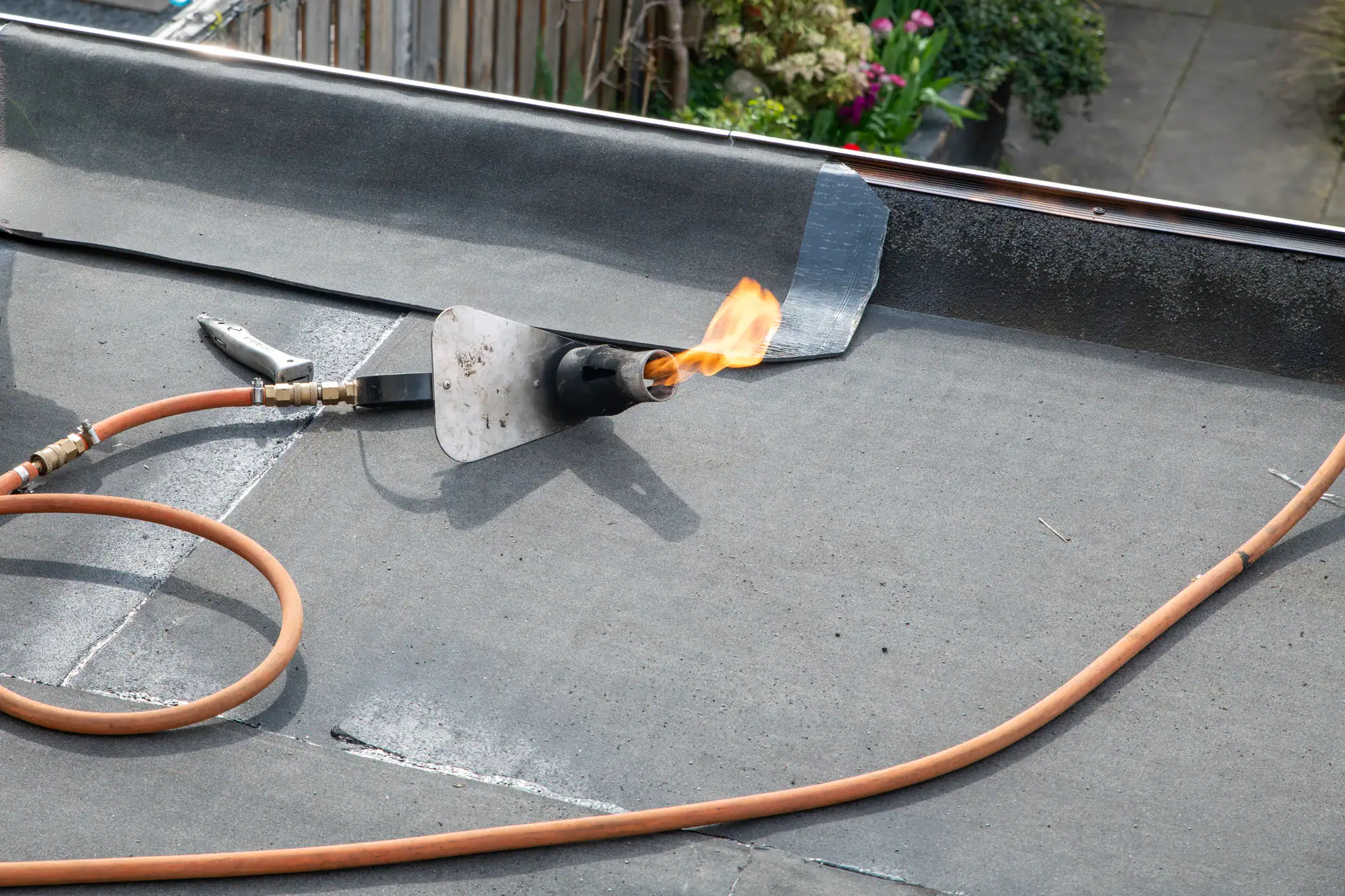
A roof installed correctly here, with properly heat-welded or fully adhered seams and complete perimeter flashing, is a different product than one that just looks fine on install day. That’s the difference between a roof that performs for 20-plus years and one that needs attention in five.
First State Roofing & Exteriors Co. is based in Smyrna — about 8 to 10 miles up Smyrna Leipsic Road from Whitehall Crossroads. That’s the same DE-9 corridor that runs straight through the heart of this community. When we say we’re local to this area, that’s not a service-area map talking. It’s a real contractor who has worked on properties throughout northeastern Kent County for over two decades, including the kind of rural farmsteads and agricultural structures that define Whitehall Crossroads and the surrounding Raymond Neck.
We handle both residential and commercial flat roofing, which matters here because most properties in the Whitehall Crossroads area aren’t just a house. There’s often a barn, a storage building, or an outbuilding that needs the same level of attention. We’re BBB accredited, carry a 5.0 out of 5 rating across 63-plus verified reviews, and we don’t subcontract — the crew you meet is the crew that does the work.
Every project is backed by full licensing and insurance, and we’re registered to pull permits in Kent County, including for unincorporated areas like Whitehall Crossroads that fall under Kent County Levy Court jurisdiction.
It starts with a free estimate and a real inspection — not a drive-by quote. On properties in the Whitehall Crossroads area, that means we’re looking at the full picture: the existing membrane condition, the deck structure underneath, how the drainage is set up, and whether the current slope is moving water or letting it sit.
On older agricultural buildings or historic outbuildings in the Raymond Neck area, the deck assessment matters even more because the framing may be original timber that needs evaluation before anything else happens.
Once we know what we’re working with, we walk you through the material options that actually make sense for your building. For large-footprint structures like barns or equipment sheds, TPO is often the right call — it reflects up to 84 percent of solar load, which keeps interior temperatures manageable in Delaware summers, and the heat-welded seams create a watertight bond that holds up against the moisture exposure this area sees.
For residential buildings or smaller structures, EPDM is a proven performer with a 20 to 30 year lifespan. Modified bitumen works well on existing torch-down systems that need a repair or an upgrade.
Because Whitehall Crossroads is unincorporated Kent County, any replacement that involves more than 25 percent of the roof sheathing or a change in roof material type requires a building permit through Kent County Levy Court. We handle that process — applications go through the mygovernmentonline.org portal, and we’re fully registered to pull permits in this jurisdiction. You don’t have to figure that out yourself.
From inspection through installation to final cleanup, we manage the project from start to finish with our own crew.

Ready to get started?
The flat roofing systems we install and repair cover the full range of what properties in the Whitehall Crossroads area typically need. TPO membrane roofing is the most in-demand option for commercial and agricultural structures right now — it’s energy efficient, durable, and the heat-welded seams are significantly stronger than glued or taped alternatives.
For a large barn or equipment building on a working farm in Duck Creek Hundred, that seam strength matters when a nor’easter rolls through or a tropical system pushes up the Delaware Bay.
EPDM rubber roofing is the go-to for residential buildings and smaller structures where flexibility and longevity are the priority. It handles Delaware’s freeze-thaw cycles well, which is relevant here given the proximity to the Leipsic River basin and the moisture that comes with it. Modified bitumen — sometimes called torch-down roofing — is common on older structures throughout this area and can be repaired or fully replaced depending on the condition of the existing system.
PVC roofing membrane is also available for commercial applications where chemical resistance or specific drainage requirements are a factor. Beyond the membrane itself, every job includes proper flashing at all penetrations and perimeters, a drainage assessment, and a full deck inspection before anything goes down.
We also assist with insurance claims for storm damage — if a weather event has affected your roof and you’re navigating a claim, we help document the damage and work with your adjuster so the scope of repair is accurate. Financing is available if you need to spread the cost of a larger replacement. And if you have a situation that can’t wait, we offer emergency roof repair for active leaks.

Yes, and it’s one of the most important things to get right on a flat roof in this area. The land around Whitehall Crossroads sits in the Leipsic River basin — it’s low-lying, mostly flat agricultural terrain with no natural grade to carry water away from structures. That means a flat roof here can’t rely on the surrounding landscape to help with drainage. It has to be engineered correctly on its own, with proper internal slope built into the installation so water moves toward drains or scuppers rather than pooling in the middle of the membrane.
Ponding water — water that stands on a flat roof for more than 48 hours after a rain event — is the number one cause of premature flat roof failure. It accelerates membrane degradation, promotes mold and algae growth, adds structural weight load, and in winter it freezes, expands, and works into any weak point in the system. In a location like Whitehall Crossroads, where Delaware’s roughly 45 inches of annual rainfall lands on flat terrain with limited natural runoff, getting the drainage design right during installation isn’t optional. It’s what separates a roof that lasts 20-plus years from one that’s failing in five.
For large-footprint agricultural structures — barns, equipment sheds, grain storage buildings — TPO membrane roofing is typically the strongest choice. The heat-welded seams create a continuous watertight bond across the entire roof surface, which holds up well against the wind uplift that comes with nor’easters and late-summer storms in this part of Kent County. TPO also reflects up to 84 percent of solar load, which helps keep interior temperatures down in Delaware summers — relevant for any structure storing equipment, feed, or livestock that doesn’t have active climate control.
EPDM rubber roofing is a solid alternative for smaller agricultural outbuildings or structures where the budget is a factor. It’s flexible, handles freeze-thaw cycling well, and has a documented lifespan of 20 to 30 years with proper maintenance. Modified bitumen is common on older farm structures throughout the Duck Creek Hundred area and can often be repaired rather than fully replaced if the deck is sound and the existing system hasn’t failed completely.
The right call depends on the size of the building, the condition of the existing roof, and what you need the system to do — which is exactly what we assess during the free estimate.
It depends on the scope of the work. In unincorporated Kent County — which includes Whitehall Crossroads — a building permit is required when the replacement involves more than 25 percent of the roof sheathing or when you’re changing the roof material type. So if you’re switching from modified bitumen to TPO, or if the deck inspection reveals enough damaged sheathing to warrant significant replacement, a permit is required.
Applications are submitted through the mygovernmentonline.org portal, and the permit authority is Kent County Levy Court’s Inspections and Enforcement division. This is worth understanding before you hire anyone. Contractors who aren’t registered to pull permits in Kent County can’t legally perform permitted work in this jurisdiction — and a roofing job done without a required permit can create complications when you sell the property or file an insurance claim.
First State Roofing & Exteriors Co. is fully registered and handles the permit process as part of the job. You don’t have to navigate that yourself. If the scope of your project requires a permit, we pull it before work begins.
The honest answer is that you usually can’t tell from the ground, and even a surface inspection can miss what’s happening underneath. A flat roof can look intact from outside while the membrane has lost its elasticity, the seams have started separating, or the deck underneath has absorbed enough moisture to begin softening.
On older agricultural structures and historic outbuildings in the Whitehall Crossroads area — some of which date back to the 1800s — the deck condition is often the deciding factor. A membrane in decent shape sitting on compromised timber framing is not a roof worth repairing.
The general markers that point toward replacement rather than repair are age, the extent of ponding, and how many times the same areas have been patched. If a TPO or EPDM membrane is past 15 to 20 years, if water is consistently pooling in multiple locations, or if you’ve had the same leak addressed more than once without resolution, a full replacement is almost always the better financial decision over time. Repeated repairs on a failing system add up fast and don’t address the underlying problem.
A proper inspection — which we provide at no cost — gives you a clear picture of what you’re actually dealing with before you commit to anything.
Yes, and it’s one of the more valuable things we do for property owners in this area. The Whitehall Crossroads community sits closer to the Delaware Bay than most of Kent County, which means nor’easters and late-summer weather systems hit harder here. When a storm damages a flat roof — whether it’s wind uplift at the membrane perimeter, debris impact, or water intrusion through compromised flashing — the insurance claim process can get complicated quickly, especially on agricultural properties with multiple structures.
We help you document the damage thoroughly, work with your adjuster, and make sure the scope of the claim reflects what actually needs to be done — not just a surface patch that leaves the underlying problem unresolved. Insurance adjusters aren’t always familiar with flat roof systems, and claims that aren’t properly documented can result in settlements that don’t cover a complete repair.
Having a contractor involved from the start who can speak to the specific failure mode and the correct repair scope makes a real difference in how the claim gets resolved. There’s no additional charge for this assistance — it’s part of how we handle storm damage work.
Lifespan depends heavily on the material, the quality of the original installation, and how the roof has been maintained — but the local environment here does affect how systems age. EPDM rubber roofing typically lasts 20 to 30 years. TPO membrane runs 15 to 25 years. Modified bitumen systems generally fall in the 15 to 20 year range.
In a high-humidity, wetland-adjacent environment like the Leipsic River basin, a system that was installed with compromised seams or inadequate drainage will age faster than those numbers suggest. The biggest factor that shortens flat roof lifespan in this area is deferred maintenance — specifically, letting ponding water go unaddressed and skipping annual inspections.
A small seam separation or a partially clogged drain that gets ignored through a Delaware winter will cause significantly more damage than the original issue. Annual inspections, keeping drains clear, and addressing minor repairs before they become major ones are the practical steps that get you to the high end of those lifespan ranges. If you’re not sure how old your current system is or when it was last inspected, a free estimate from First State Roofing & Exteriors Co. is the right starting point.
Other Services we provide in Whitehall Crossroads