
Hear from Our Customers
When your flat roof is done right, you stop thinking about it. No water stains creeping across your ceiling after a heavy rain, no soft spots forming over the back addition, no wondering whether that pooling water is going to become a much bigger problem by spring. That’s the outcome — not just a new membrane, but actual peace of mind.
For homeowners in The Blades, that peace of mind matters more than it does in most places. The town sits on the south bank of the Nanticoke River, in terrain that was historically sandy and marshy. Water doesn’t drain away quickly here. Ambient humidity runs high year-round. Those conditions put real stress on flat roof membranes, especially around seams, penetrations, and drainage outlets — which is exactly where most flat roofs fail first.
The older housing stock in The Blades adds another layer to the picture. Many homes have flat or low-slope sections — rear additions, attached garages, porch roofs — that were built decades ago and haven’t been touched since. If you’ve been in your home for ten or fifteen years and haven’t looked at that section of the roof, there’s a good chance it’s overdue. A properly installed membrane system, matched to what your building actually needs, is what keeps a manageable situation from turning into a structural repair.
We’ve been doing this work in Delaware for over 22 years. That’s not a number for its own sake — it means our team has worked through Delaware’s storm seasons, its freeze-thaw winters, and its humid summers long enough to know what holds up and what doesn’t. That experience covers Sussex County, including The Blades and the Seaford area along the Nanticoke River, where the environment is genuinely different from what you’d find inland.
Every project is handled by our own certified crew. There’s no outsourcing, no subcontracting to someone you’ve never met. The people who show up are the people accountable for the work — and in a close-knit community like The Blades, where neighbors talk and reputations travel fast, that accountability matters.
We’re BBB Accredited, consistently rated 5 stars across 63-plus verified reviews, and licensed and insured throughout. Free estimates are available with no pressure attached.
It starts with a free estimate and a real look at what’s going on. We get eyes on the existing membrane, check the deck condition underneath, assess drainage, and identify any areas where water has been sitting or working its way in. In The Blades, that drainage assessment carries extra weight — low-lying terrain and saturated soil mean that a flat roof without properly designed drainage will have standing water on it regularly, and standing water is the single fastest way to shorten the life of any membrane system.
Once the scope is clear, the existing material comes off. A full tear-off isn’t always required, but it’s the only way to know what the deck underneath actually looks like. If there’s rot, soft spots, or structural damage from years of moisture intrusion — which is common in older homes near the river — that gets addressed before anything new goes on. Skipping that step is how cheap jobs become expensive problems.
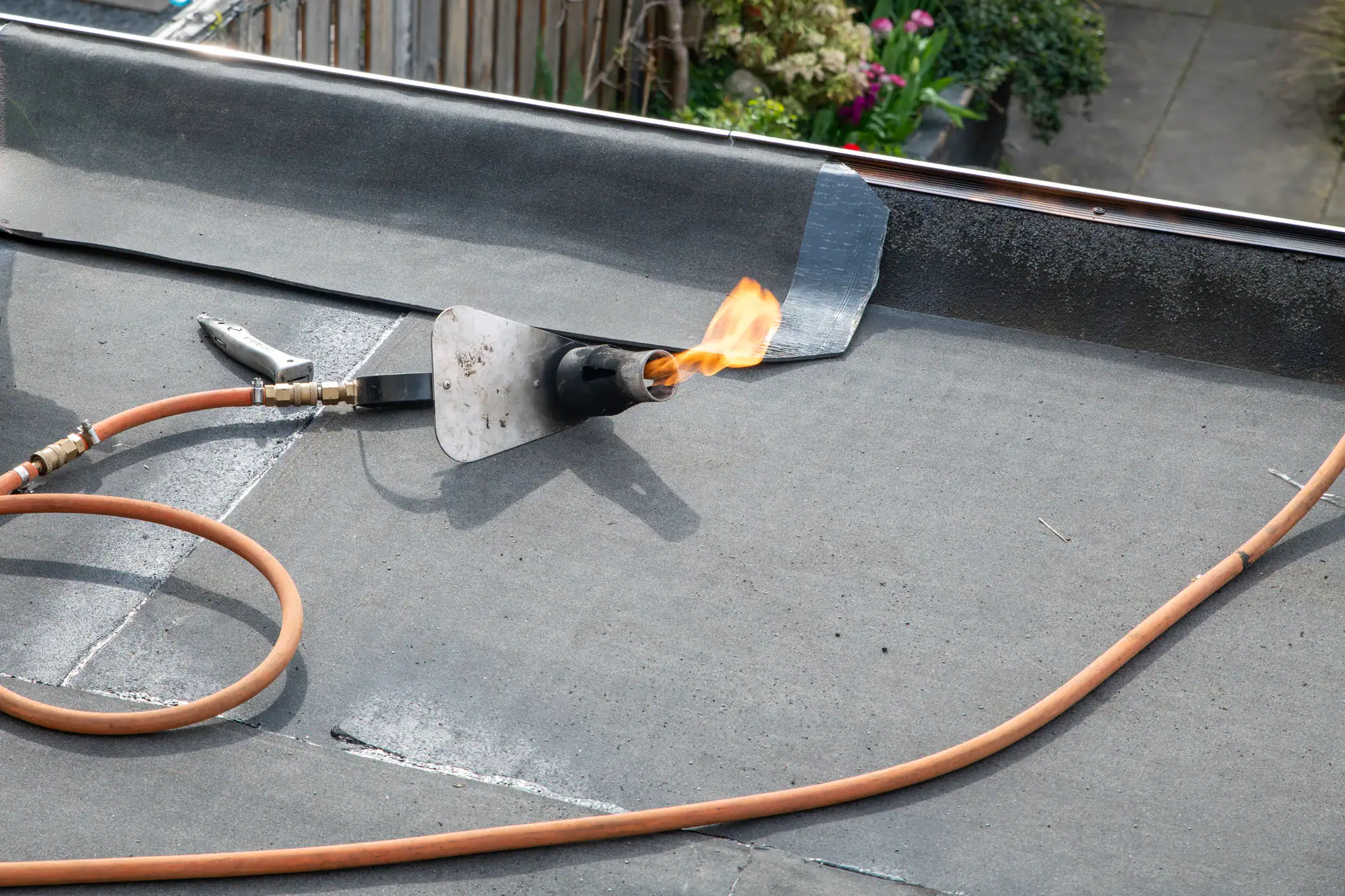
Then comes the membrane installation itself: the right insulation layer, the membrane matched to your building and your budget — whether that’s TPO, EPDM rubber roofing, or modified bitumen — and proper flashing at every penetration and edge. Roofing work in The Blades falls under Sussex County’s building code jurisdiction, so permits are part of the process when required. We handle that side of it. When the job is done, the site is cleaned up and the work is backed by both a workmanship warranty and the manufacturer’s material warranty.

Ready to get started?
Not every flat roof material makes the same sense in every location. In The Blades, where humidity is elevated, drainage is slower than in inland communities, and freeze-thaw cycling puts stress on seams through the winter, material selection is a real decision — not just a price comparison.
TPO roofing membrane is a strong option for commercial properties along the US Route 13 corridor on the eastern edge of town. Its heat-welded seams create a watertight bond that holds up well in wet environments, and its high solar reflectance can meaningfully reduce cooling costs during Delaware’s humid summers — a real consideration for any flat-roofed commercial structure. EPDM rubber roofing material is a proven choice for residential applications: flexible enough to handle freeze-thaw movement, with a lifespan that can reach 20 to 30 years when installed correctly and maintained. Modified bitumen, sometimes called torch down roofing, remains a practical option for certain residential flat sections, particularly where a two-ply APP system is appropriate for the slope and exposure.
For properties in The Blades dealing with storm damage, we provide insurance claims assistance — helping homeowners document the damage, work through the adjuster process, and make sure the repair scope reflects what actually happened to the roof, not what’s easiest to approve. Financing is available for larger projects, and emergency roof repair is an option when a situation can’t wait for a scheduled appointment.

Yes, and it’s worth taking seriously sooner rather than later. The industry standard threshold is water standing on a flat roof for more than 48 hours after rainfall — at that point, it’s no longer just a drainage inconvenience, it’s actively working against the membrane. Standing water accelerates surface degradation, puts added structural load on the deck, promotes mold and algae growth, and can void manufacturer warranties on the membrane itself.
In The Blades specifically, this matters more than it would in a higher, drier location. The town sits on historically sandy and marshy terrain along the south bank of the Nanticoke River. Drainage is slower here. Ground saturation during heavy rain events is a real factor. If your roof’s drainage outlets are clogged or the roof deck has settled and created low spots, ponding water will be a recurring issue — not a one-time event. The fix might be as straightforward as clearing clogged drains and adding tapered insulation to redirect flow, or it might indicate a more significant drainage design problem that needs to be addressed during a full replacement. Either way, we can provide an honest assessment before it becomes a ceiling repair.
The short answer is that it depends on your building, your budget, and what your roof is actually dealing with day to day. TPO roofing membrane is a single-ply system with heat-welded seams — it’s energy-efficient, reflects a significant portion of solar heat load, and has become the most widely used flat roof membrane in commercial applications. If you have a commercial property along the US Route 13 corridor near The Blades, TPO is worth serious consideration.
EPDM, often called rubber roofing material, has been around longer and has a massive installed base worldwide. It’s flexible, which makes it particularly resilient during Delaware’s freeze-thaw cycles, and a properly installed EPDM system can last 20 to 30 years. It tends to be a strong fit for residential flat sections — additions, garage roofs, porch coverings — where long-term durability matters more than energy efficiency. Modified bitumen, or torch down roofing, is a multi-layer system that works well in certain residential applications and is a common existing material on older homes in The Blades. When it’s time to replace a mod-bit system, the question is whether to replace in kind or upgrade to TPO or EPDM — and the right answer depends on the slope, the drainage design, and how the building is used. A free estimate from us includes an honest recommendation on which system fits your specific situation.
The honest answer is that you usually can’t tell from the ground, and even a visual inspection from the roof surface doesn’t always tell the full story. A membrane can look intact on top while the deck underneath has sustained significant moisture damage — especially in older homes where a flat section has been quietly dealing with slow leaks for years. That’s a common scenario in The Blades, where the housing stock includes a lot of older construction and where the riverfront humidity environment accelerates moisture-related deterioration.
The factors that push a roof toward replacement rather than repair are age, the condition of the deck, and the extent of membrane failure. If the membrane is more than 15 to 20 years old, has multiple areas of failure, or if the deck has soft spots or rot, a repair is usually throwing good money at a problem that’s going to come back. If the membrane is relatively young and the failure is isolated — a single seam separation, a flashing failure at a penetration — repair is often the right call. The only way to know for certain is a proper inspection that includes checking the deck, not just the surface. We provide free estimates that include that full assessment.
It depends on the cause. Homeowner’s insurance typically covers sudden, storm-related damage — wind, hail, a tree limb coming through — but generally does not cover damage that results from deferred maintenance or gradual deterioration. In The Blades, where the area sits along the Nanticoke River and DE 20 through town is designated as a secondary hurricane evacuation route, storm-related roof damage is a real and recurring event. When a storm causes damage to a flat roof membrane, the claims process can be complicated by the fact that adjusters don’t always assess flat roofs the same way they do pitched roofs, and the full scope of damage isn’t always visible from a surface inspection.
We provide insurance claims assistance as part of our service. That means helping you document the damage thoroughly, working alongside your adjuster, and making sure the repair or replacement scope reflects what actually happened — not what’s easiest to approve on the first pass. If you’ve had a storm event and you’re not sure whether the damage is covered or how to start the process, a free estimate is a good first step.
For a typical residential flat roof section — a rear addition, a garage, a porch roof — the installation itself usually takes one to three days once materials are on site and the job is scheduled. A larger commercial flat roof will take longer depending on square footage and system complexity. The timeline from your initial estimate to the start of work depends on scheduling, material lead times, and weather. In Delaware, fall tends to be the most popular time for roof replacements as homeowners prepare before winter, which can affect scheduling windows during that season.
The disruption is generally manageable. Our crew works on the exterior of the structure, so interior access is rarely needed unless there’s deck damage that requires repair from below. We use our own certified crew — no subcontractors — which means the team is consistent from start to finish and there are no coordination gaps that drag a job out longer than it should take. Cleanup is part of the job, not an afterthought.
Because the environment here is genuinely different from what you’d find in a drier, inland community, and those differences affect how a flat roof should be designed, what material makes the most sense, and what drainage approach will actually work long-term. The Blades sits on the south bank of the Nanticoke River in terrain that was historically sandy and marshy. That means slower drainage, higher ambient humidity, and a water table that’s closer to the surface than in higher-elevation parts of Sussex County. A contractor who doesn’t know this area may install a technically correct roof that still develops ponding problems because the drainage design didn’t account for local conditions.
There’s also the practical reality that Blades residents can face access challenges during severe flood events — Seaford’s own flood zone documentation specifically notes that the bridge at the Blades Causeway can become difficult during extreme conditions. That makes the relationship you have with your contractor before a storm more valuable than the one you try to build after one. We’ve been serving Sussex County for over 22 years, cover this area as part of our regular service territory, and offer emergency roof repair when a situation can’t wait. Knowing your contractor already knows your property is a different kind of peace of mind.
Other Services we provide in The Blades