
Hear from Our Customers
Over half the homes in the Hazlettville area were built after 2000, which means a lot of garages, additions, and rear extensions had flat or low-slope membranes installed somewhere between 2001 and 2010. Those systems are now squarely in their replacement window. TPO and modified bitumen roofs from that era have lifespans of 15 to 25 years. If yours has never been replaced, you’re not being paranoid by wondering about it. You’re being realistic.
What makes Hazlettville’s situation different from a typical suburban neighborhood is the terrain. This area sits on flat Kent County land with minimal elevation change, surrounded by active farmland. There’s no natural slope helping water move off your roof. Every flat surface on your property — your main roof, your detached garage, your workshop — depends entirely on its drainage system to do that job.
When a scupper clogs with crop dust, pollen, or leaf fall from field windbreaks, water doesn’t just slow down. It sits. And water that sits for more than 48 hours starts doing real damage to whatever membrane is underneath it. A properly installed flat roof with a drainage system designed for Hazlettville’s flat terrain is a completely different animal than a patched-up original membrane limping through another Delaware winter. You get a dry interior, lower energy bills thanks to TPO’s solar reflectance, and the peace of mind that comes from knowing the job was done right — not just done.
First State Roofing & Exteriors Co. is based in Smyrna — about 10 to 12 miles up the road from Hazlettville via Westville Road. We’re not a national franchise that shows up after a storm and disappears. We’ve been working across Kent County since before most of the homes along Hazlettville Road were built, and we’ve watched how Delaware’s climate treats flat roofs over time.
Every project we take on is handled by our own certified crew — no subcontractors, no handoffs to a team you’ve never met. The people who show up to do the work are the same people accountable for the result. That matters on a rural property where you’re trusting someone to be on your land, on your roof, and in your space.
We’re BBB accredited, fully licensed and insured, and carry a 5.0 rating from over 63 verified reviews. We offer free estimates and financing options for larger projects, and we’re available for emergency repairs when weather doesn’t wait for a convenient schedule.
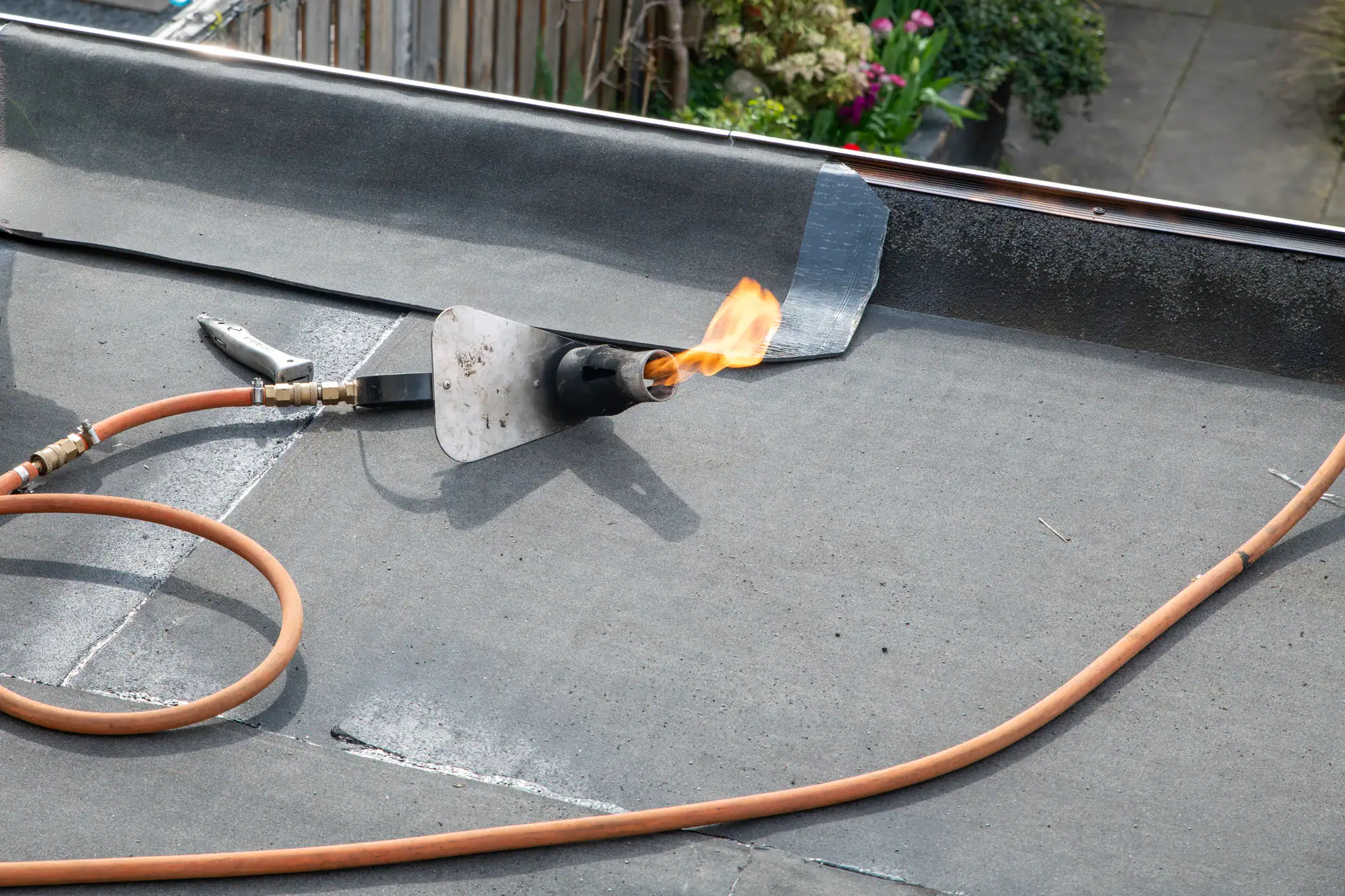
It starts with a free inspection and estimate. We come out to your property, get on the roof, and look at what you actually have — not just the surface, but the drainage system, the flashing at every penetration and edge, and the condition of the deck underneath.
On rural Hazlettville-area properties, we pay particular attention to drain and scupper condition because agricultural debris accumulation is a real factor here. A clogged drain on flat terrain doesn’t drain slowly — it doesn’t drain at all. From there, we walk you through what we found in plain language. If you need a full replacement, we’ll tell you which membrane system makes sense for your building, your budget, and the way your property is positioned.
If it’s a repair, we’ll scope that honestly too. Because Hazlettville is in unincorporated Kent County, roofing permits are handled through Kent County Levy Court — required when you’re changing material type or replacing more than 25 percent of the roof sheathing. We handle that paperwork through the county’s online portal so you don’t have to navigate it yourself.
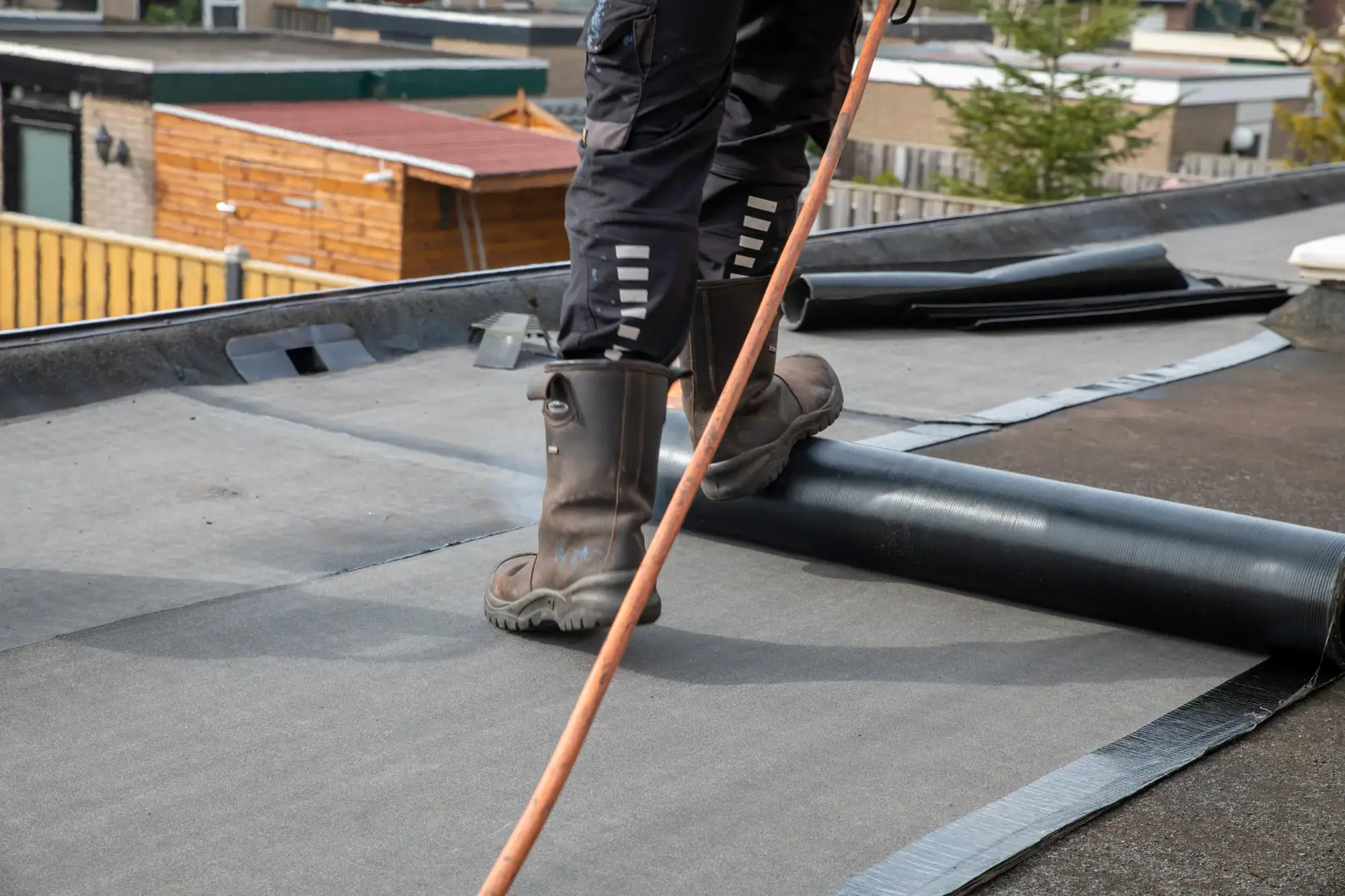
Installation follows a complete process: tear-off of the existing membrane, deck inspection and repair where needed, insulation layer, new membrane installation with properly heat-welded or adhered seams, and thorough flashing at every edge and penetration. We clean up completely before we leave — no debris in your driveway, no nails in the grass.

Ready to get started?
Not every flat roof material is the right call for every situation, and the choice matters more than most people realize. For Hazlettville-area properties, we work with TPO, EPDM rubber roofing, modified bitumen (torch-down), and PVC membranes — and we’ll give you a straight answer on which one fits your building and your climate exposure.
TPO is the most popular choice for good reason. It reflects up to 84 percent of solar load, which keeps interior temperatures lower during Kent County’s humid summers and reduces HVAC strain. It’s installed with heat-welded seams that hold up well through Delaware’s freeze-thaw cycling, and it’s the go-to modern replacement when an aging modified bitumen system from the early 2000s reaches end of life.
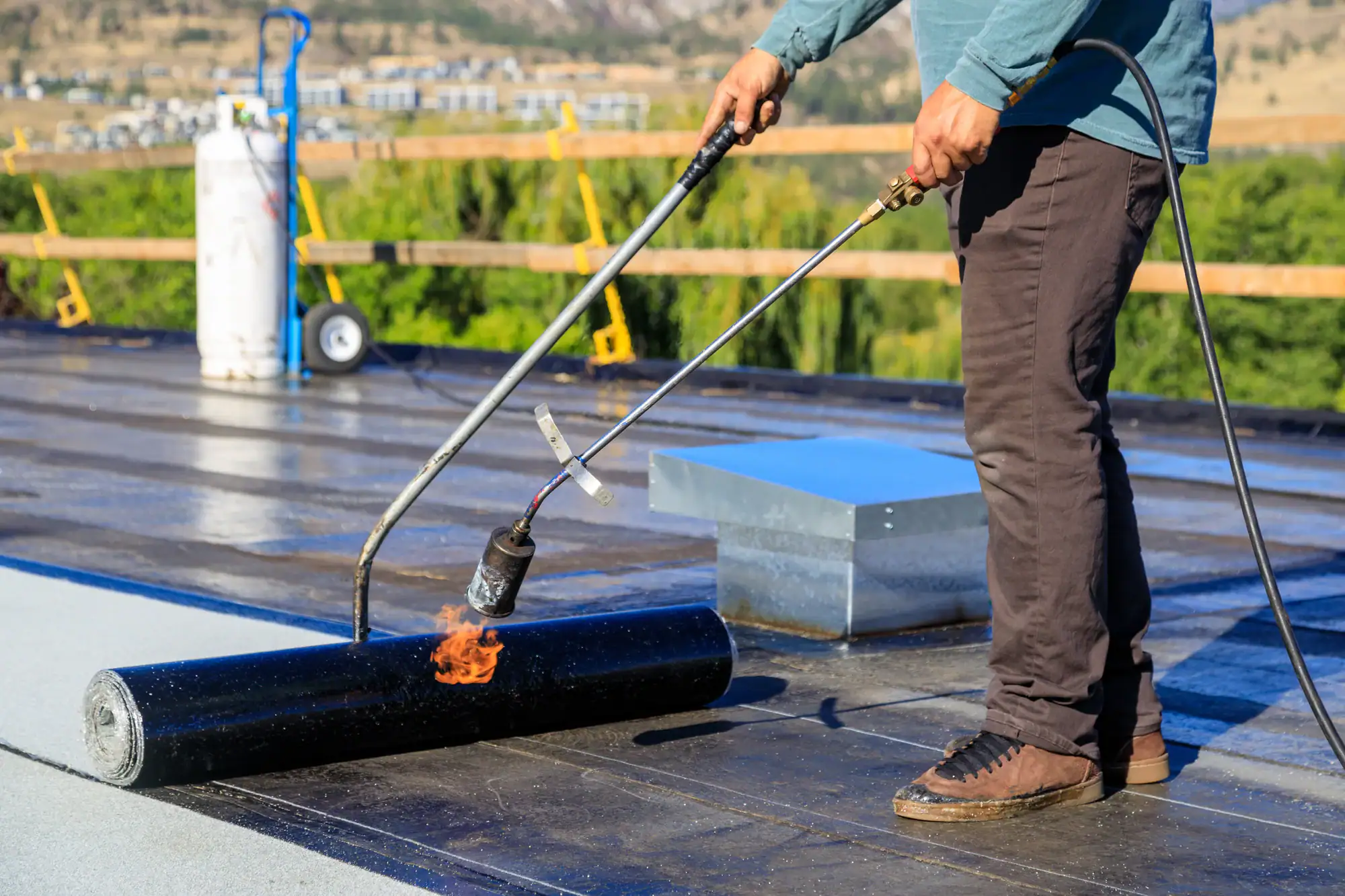
EPDM rubber roofing has been around for decades and earns its reputation for flexibility and longevity — it handles thermal movement well, which matters during the temperature swings between a 77-degree June and a 35-degree January in this area. Modified bitumen (torch-down) is still a solid option in the right application, though older systems on Hazlettville-area properties are often showing mineral surface wear and seam fatigue after 20-plus years.
We also handle flat roof waterproofing, full drainage system assessment, flashing repairs, and emergency repairs when a membrane fails mid-storm. For properties with multiple flat roof sections — a house addition plus a detached garage or workshop — we can assess and address everything in one project. We work with both residential and commercial clients, and we assist with insurance claims for storm damage so you’re not navigating that process alone.

Because Hazlettville is an unincorporated community, it falls under Kent County Levy Court jurisdiction — not a city building department. Kent County requires a roofing permit when you’re replacing more than 25 percent of the roof sheathing or when you’re changing the roof material type, such as switching from modified bitumen to TPO. Permits are applied for online through the Kent County MyGovernmentOnline portal, and the county’s Building Inspections office handles review and inspections.
This is actually simpler than dealing with an incorporated town that layers its own local requirements on top of county code. There’s one set of rules — Kent County’s adopted International Building Code and International Residential Code — and we know them well. When you hire First State Roofing & Exteriors Co., we handle the permit application and coordinate the required inspections so the job is documented correctly and you’re not left with unpermitted work on your property.
The honest answer is that you usually can’t tell from the ground, and even a visual inspection from a ladder only tells part of the story. The real question is what’s happening at the seams, at the flashing, and underneath the membrane where the deck sits.
Surface granule loss on a modified bitumen roof is visible and tells you the membrane is aging. Seam separation, blistering, or membrane shrinkage are signs the system is past its repair window. But water staining on your ceiling — especially in a garage or addition — often means the damage is further along than the surface suggests. For Hazlettville-area homes built in the early 2000s, the math is straightforward: a modified bitumen or TPO system installed 20 to 25 years ago is at or past its expected lifespan. A repair might buy you another season, but if the membrane is broadly fatigued, you’re paying for a patch on a system that’s going to need full replacement within a year or two anyway. A free inspection from First State Roofing & Exteriors Co. gives you an honest read on where things actually stand — no pressure to replace if repair is the right call.
Ponding water — water that’s still sitting on your roof more than 48 hours after rain — is one of the most common flat roof problems in this area, and Hazlettville’s geography makes it worse than average. The land here is essentially flat, sitting at around 62 feet of elevation with no meaningful topographic gradient. That means your flat roof has no natural assist from gravity. Every drop of water that lands on it has to exit through a designed drainage point — a scupper, an interior drain, or a gutter system. When those get clogged, the water has nowhere to go.
The agricultural surroundings compound this. Pollen, crop dust, and leaf fall from field windbreaks along Hazlettville Road accumulate on flat roofs and block drains faster than in suburban or urban environments. Most homeowners don’t notice until they see a water stain or spot standing water after a storm. By then, the membrane has already been under sustained water pressure.
Over time, ponding water accelerates membrane degradation, promotes mold and algae growth, adds structural load, and can void manufacturer warranties. Keeping drains clear and ensuring your drainage system is properly designed for your roof’s geometry is the most important maintenance step for any flat roof in Hazlettville.
TPO and EPDM are both single-ply membrane systems, but they perform differently and suit different situations. TPO is a thermoplastic membrane installed with heat-welded seams — the seams are literally fused together, which makes them very strong and resistant to water infiltration. It has high solar reflectance, which is meaningful in Delaware’s humid summers when rooftop temperatures can drive HVAC costs up significantly. TPO is currently the most widely used flat roofing membrane in the commercial market and is the most common modern replacement for aging modified bitumen systems.
EPDM is a synthetic rubber membrane that has been in use for decades — there’s more than 20 billion square feet of it installed worldwide, which tells you something about its track record. It handles thermal movement exceptionally well, which matters in Kent County where temperatures swing from the mid-30s in January to the upper 80s in summer. EPDM is flexible enough to absorb that expansion and contraction without seam stress, making it a strong choice for detached garages and outbuildings where temperature swings are more extreme than in conditioned spaces. The right choice between the two depends on your building, your budget, and how the roof is used — and that’s exactly what a free inspection helps determine.
Lifespan varies by material and how well the roof is maintained, but here are the realistic ranges: EPDM rubber roofing typically lasts 20 to 30 years, TPO runs 15 to 25 years, and modified bitumen (torch-down) generally lasts 15 to 20 years. Those numbers assume correct installation, functioning drainage, and at least basic annual maintenance — clearing drains, checking flashing, and catching small issues before they become large ones.
Delaware’s climate puts specific stress on flat roofs that can shorten those ranges if the system isn’t right for the conditions. The freeze-thaw cycling through Kent County winters is hard on modified bitumen mineral surfaces and on any membrane with compromised seams. The ~45 inches of annual rainfall Delaware receives means drainage performance is tested repeatedly throughout the year. A properly installed membrane from First State Roofing & Exteriors Co. — with drainage designed for the flat terrain of Hazlettville — should reach the upper end of its expected lifespan rather than the lower end.
Homeowner’s insurance typically covers sudden, storm-related damage — wind, hail, falling debris — but generally does not cover damage from deferred maintenance or normal wear and tear. For Hazlettville-area homeowners, that distinction matters because flat roofs that have been quietly deteriorating for years can look like storm damage on the surface, but an adjuster may scope the claim narrowly if the underlying membrane was already compromised.
This is where having a contractor who assists with insurance claims makes a real difference. First State Roofing & Exteriors Co. works with homeowners to document damage accurately, communicate with adjusters, and make sure the claim scope reflects the actual condition of the roof — not a minimized patch estimate that leaves you exposed six months later. Kent County sits squarely in the Mid-Atlantic storm corridor, and wind and hail events are a recurring reality here. If you’ve had a significant storm come through and you’re not sure whether you have a claim worth filing, a free inspection is the right first step — it gives you an honest picture before you involve your insurance company.
Other Services we provide in Hazlettville