
Hear from Our Customers
When a flat roof is done right, you stop thinking about it. No ceiling stains after a hard rain, no water pooling near your foundation, no emergency calls in the middle of a Kent County thunderstorm. That’s what the job is supposed to deliver — and it’s what we’ve been delivering across this county for over 22 years.
Frederica sits on low-lying Atlantic Coastal Plain terrain along the Murderkill River. The USGS monitors river levels right here, 0.5 miles east of town, and that’s not a coincidence — water management is a genuine, day-to-day reality in this area. A flat roof without proper drainage slope and functioning outlets isn’t just an inconvenience here; it’s a liability. Standing water that lingers more than 48 hours starts breaking down membrane materials, adds structural load, and can void manufacturer warranties. The right installation accounts for that from the start.
The same goes for storm exposure. Kent County emergency management documents hurricanes, severe thunderstorms, and tornadoes as real local hazards — and the National Weather Service confirmed an EF-1 tornado with 100 mph winds touched down near Frederica specifically. When your flat roof is installed by a crew that understands this environment, you’re not just getting a new membrane. You’re getting a roof that was specified for what Delaware actually delivers.
We’re based in Smyrna — about 15 to 20 miles from Frederica via Route 1 — and have been serving Kent County homeowners and commercial property owners for more than 22 years. That’s not a national call center routing jobs to whoever’s available. It’s a locally rooted team that has worked through the same weather patterns, the same soil conditions, and the same seasonal cycles that affect every property in Frederica and the surrounding area.
Every project is handled start to finish by our own certified crew. No subcontracting, no unknown third parties showing up at your door. For residents who commute to Dover or Milford and can’t be home to supervise, that direct accountability matters. The team you speak with is the team doing the work.
With a 5.0 out of 5 rating from 63-plus verified reviews and BBB Accreditation, the track record is public and easy to check. Customers consistently call out professionalism, clean worksites, and clear communication — which is exactly what you want from a contractor working on a building near the Murderkill River corridor where drainage details aren’t optional.
It starts with a free estimate. Someone from our team comes out, looks at the actual condition of your roof, checks the membrane, inspects the deck underneath, and gives you a clear written scope of work. No vague verbal quotes. If there’s storm damage involved — which is a real possibility in a county with Frederica’s documented severe weather history — we can also help you document it properly for an insurance claim so you’re not left negotiating a lowball patch estimate on your own.
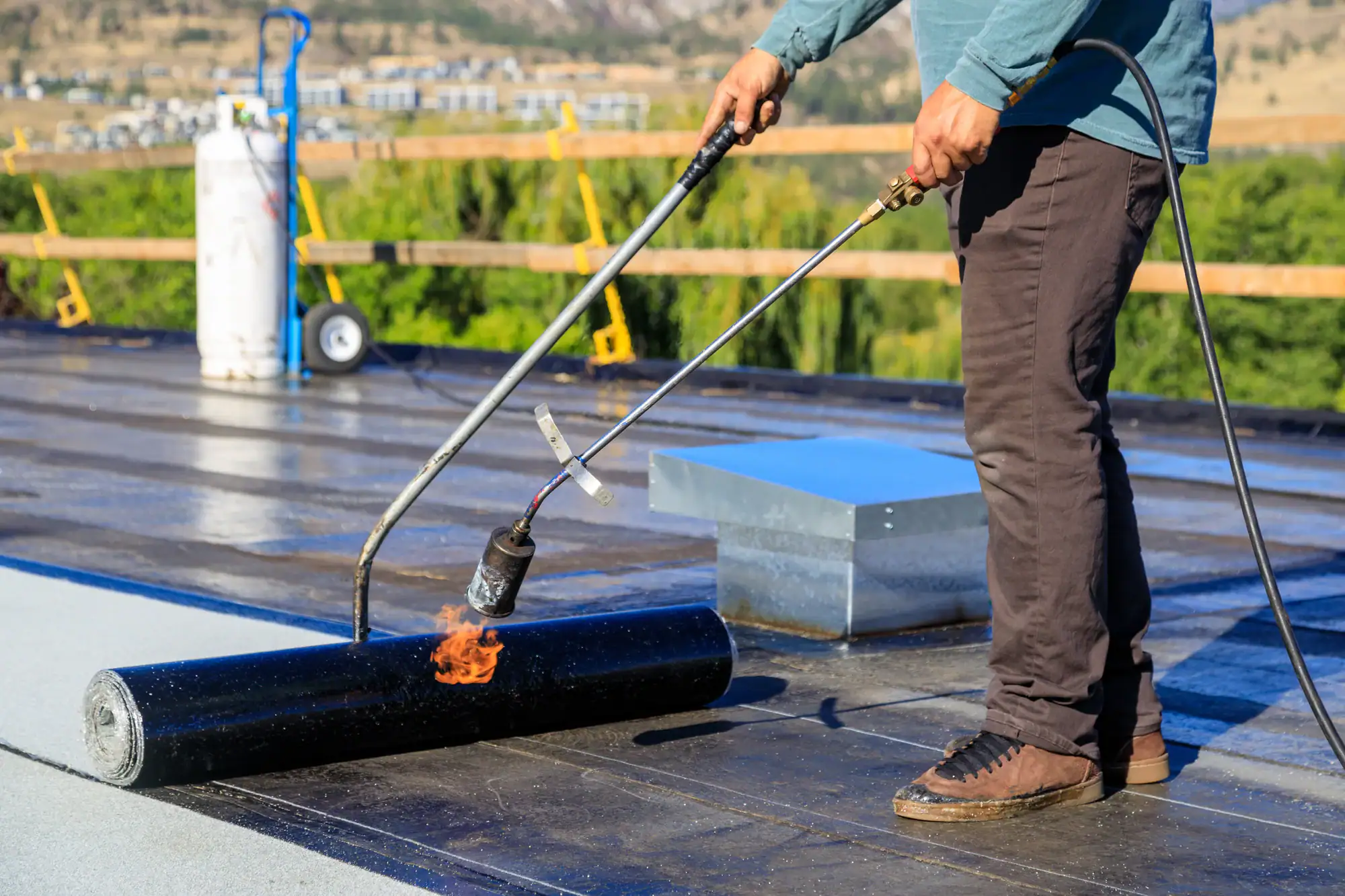
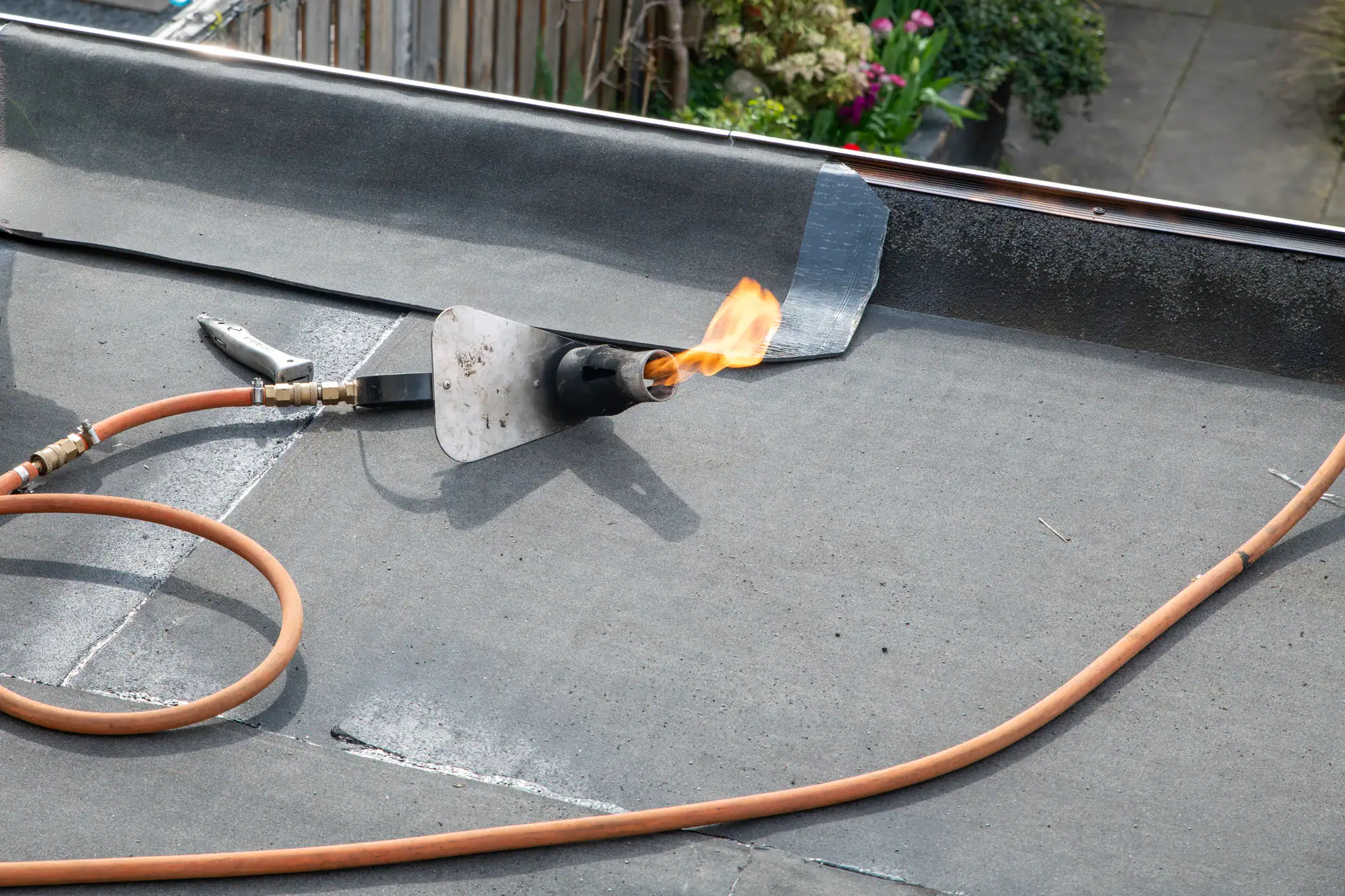
Once the scope is agreed on, our crew handles the full tear-off of the existing membrane, inspects the deck for any soft spots or water damage that needs to be addressed before the new system goes down, and installs the appropriate insulation layer. The membrane — whether that’s TPO, EPDM, modified bitumen, or PVC — is then installed with proper attention to seam integrity and flashing at every penetration and perimeter edge. Drainage slope is verified, not assumed. In Frederica’s low-lying terrain, that step isn’t a formality.
Kent County requires a building permit when a roofing project involves replacing more than 25 percent of the roof sheathing or changing the roof material type. We’re familiar with that process and handle the compliance side so it doesn’t become your problem to figure out.

Ready to get started?
Not every flat roof is the same, and not every membrane is the right choice for every building. We work with the full range of flat and low-slope roofing systems — TPO, EPDM rubber roofing, modified bitumen (torch-down), and PVC — and the recommendation depends on your building’s specific situation, not a one-size-fits-all default.
For the commercial properties along Frederica’s Route 1 corridor — near the DE Turf Sports Complex at 4000 Bay Road and the hotels and retail development that have followed — TPO is typically the right call. It reflects up to 84 percent of solar load, which matters for HVAC costs on large commercial footprints, and its heat-welded seams hold up well under the humidity and freeze-thaw cycling that Delaware’s Mid-Atlantic climate delivers. For older residential low-slope roofs and established commercial buildings on US Route 113 or Frederica Road, modified bitumen or EPDM may be the better fit depending on the existing system and budget.
EPDM rubber roofing has more than 20 billion square feet installed worldwide and a lifespan of 20 to 30 years when properly maintained — it’s a proven system for a reason. Modified bitumen torch-down systems remain a reliable choice for buildings where the existing substrate and drainage setup support them. Whatever the right system is for your property, the goal is the same: a roof that handles what Frederica’s weather delivers, drains correctly given the area’s flat terrain, and doesn’t need your attention again for decades. Financing is available if upfront cost is a concern, and the free estimate gives you a clear number to work with before you commit to anything.

The terrain in and around Frederica — low-elevation Atlantic Coastal Plain, with the Murderkill River running through the area — means drainage design has to be treated as a primary concern, not an afterthought. Standing water that sits on a flat roof for more than 48 hours is the industry-defined threshold for concern, and on flat land with limited natural runoff, that threshold gets tested more often here than in areas with more elevation change.
For most residential and light commercial applications in Frederica, TPO and EPDM are the two most commonly recommended membrane systems. TPO’s heat-welded seams create a watertight bond that holds up well under repeated wet-dry cycling, and its reflective surface helps manage heat load during Delaware’s humid summers. EPDM is extremely flexible, which makes it resistant to the seam stress that freeze-thaw cycling can cause during winter months. Modified bitumen torch-down is a solid choice for older buildings where the existing system is already torch-applied and the substrate is in good condition. The right answer depends on your specific roof — which is exactly why the free estimate and inspection process matters before any material decision gets made.
This is one of the most common questions, and the honest answer is that you usually can’t tell from the inside. A water stain on your ceiling tells you water got in — it doesn’t tell you where the membrane failed, how far the water traveled along the deck before showing up, or whether the deck itself has been compromised. In Frederica’s climate, where heavy rainfall events are common and the terrain doesn’t drain aggressively, small membrane failures tend to compound faster than they would in drier regions.
The general rule of thumb is that if the membrane is under 10 years old and the damage is isolated to a specific area — a failed seam, a cracked flashing detail, a puncture — a targeted repair often makes sense. If the membrane is approaching or past its expected lifespan, if there are multiple failure points, or if the deck underneath shows signs of moisture damage, a full replacement is usually the more cost-effective path. Patching an aging membrane repeatedly tends to cost more over time than replacing it once correctly. A proper inspection, which we provide as part of the free estimate process, is the only way to get a reliable answer to this question for your specific roof.
It’s a fair question. The National Weather Service confirmed an EF-1 tornado with 100 mph winds touched down near Frederica — documented damage at Carpenter Bridge Road and Fork Landing Road — and Kent County emergency management lists tornadoes, hurricanes, and severe thunderstorms as real local hazards. Wind uplift is a legitimate design consideration for flat roofs in this area.
The most important factor for wind resistance on a flat roof isn’t which membrane you choose — it’s how it’s attached and how the perimeter flashing is detailed. Mechanically fastened TPO systems, for example, provide strong uplift resistance when installed to manufacturer specifications. Fully adhered systems eliminate the fastener pattern but require proper substrate prep to bond correctly. In either case, the perimeter edge and corners are where flat roofs fail in high-wind events — and those details require experienced installation, not just the right material. We handle flashing and edge detailing as part of every installation, not as an optional upgrade.
Yes, and this is worth understanding before you call your insurance company on your own. The claims process for flat roof storm damage can get complicated quickly — adjusters may assess visible surface damage without accounting for what’s happening underneath the membrane, and a lowball estimate that covers a surface patch often leaves underlying deck damage unaddressed. That leads to the same problem returning within a season or two.
We help property owners document damage thoroughly, work through the scope with adjusters, and make sure the approved repair or replacement actually addresses what caused the failure — not just what’s visible from the outside. Given Frederica’s documented exposure to severe weather events, this isn’t a niche situation. It’s something property owners in this area deal with on a real and recurring basis. If you’ve had a recent storm event and you’re not sure whether to file a claim or pay out of pocket, starting with a free inspection gives you the information you need to make that call.
Lifespan depends heavily on the material, the quality of the original installation, and how consistently the roof gets maintained. In Delaware’s Mid-Atlantic climate — roughly 45 inches of annual rainfall, humid summers, and freeze-thaw cycling in winter — here’s what you can reasonably expect from each system when properly installed and maintained: EPDM rubber roofing typically lasts 20 to 30 years. TPO membranes generally run 15 to 25 years. Modified bitumen torch-down systems typically fall in the 15 to 20 year range. PVC membranes are comparable to TPO at 20 to 25 years.
The word “maintained” matters. A flat roof that gets inspected annually, has its drainage outlets cleared regularly, and gets minor repairs addressed promptly will consistently reach the upper end of those ranges. One that gets ignored until there’s a visible leak will often fall short of even the lower end. For Frederica specifically, the combination of low-lying terrain and seasonal storm exposure means annual inspections aren’t just a best practice — they’re the difference between catching a minor drainage issue and dealing with a deck replacement.
The most important thing is to verify that the contractor is genuinely local, licensed, insured, and doing the work themselves — not subcontracting it to a crew you’ve never met. After any significant storm event in Kent County, out-of-area contractors show up quickly and often pressure property owners to sign before a proper assessment has been done. That pattern is well documented, and Frederica is not immune to it.
Before you sign anything, confirm that the contractor carries comprehensive liability insurance and that their crew is employed directly by the company — not dispatched through a subcontractor network. Ask for a written scope of work, not a verbal estimate. If the job involves replacing more than 25 percent of the roof sheathing or switching membrane systems, a Kent County building permit is required — a legitimate contractor will know this and handle it. We’re BBB Accredited, hold a 5.0 out of 5 rating from 63-plus verified reviews, have been working in Kent County for over 22 years, and operate with a strict no-subcontracting policy. Those aren’t claims you have to take at face value — they’re publicly verifiable before you ever make a call.
Other Services we provide in Frederica