
Hear from Our Customers
A flat roof that’s doing its job is one you never have to think about. No water stains on the ceiling after a hard rain. No standing water sitting on the membrane for days. No wondering whether that soft spot near the parapet is something serious or something catastrophic. When the work is done right, you just get to move on with your day.
That matters more in Clayton than it might somewhere else. The town sits in a flat stretch of northern Kent County near Duck Creek, and that combination — low topography, a nearby waterway, and Delaware’s 45-plus inches of annual rainfall — means water has nowhere to go in a hurry. Flat roofs in Clayton don’t just deal with rain; they deal with rain that lingers. A properly installed membrane system with thoughtful drainage design is what separates a roof that ages well from one that starts failing quietly and expensively.
For Clayton’s commercial property owners, especially those with buildings in or near the Downtown Development District corridor on Main Street, a sound flat roof is also a prerequisite for any meaningful renovation investment. You can’t build up from a bad foundation, and you can’t renovate around a failing roof. Getting the membrane right first is what makes everything else possible.
We’ve been doing roofing work in Kent County for over two decades. Our team is based in Smyrna, which puts us directly east of Clayton on DE Route 6 — the same road that runs straight through Clayton’s Main Street. That proximity isn’t just a convenience. It means we know how northern Kent County’s flat terrain and seasonal weather patterns behave, and we’ve been working through those conditions long enough to know what flat roof systems actually hold up here versus what just sounds good on paper.
Every project is handled by our own crew — no subcontractors, no unfamiliar faces showing up at your property. We carry a 5.0 out of 5 rating across 63-plus verified reviews, hold BBB Accreditation, and are fully licensed and insured. For Clayton homeowners and commercial property owners who’ve been burned by contractors who overpromised and underdelivered, that track record is worth paying attention to.
It starts with a free estimate. Someone from our team comes out to your property, gets on the roof, and looks at what’s actually there — the membrane condition, the drainage situation, the deck underneath. We’re not guessing from the ground. If there’s storm damage involved, we’ll document it in a way that supports an insurance claim, so you’re not navigating that process alone.
From there, you get a clear, written estimate that explains the scope of work and the material recommendation. Whether that’s a TPO membrane for a commercial building in Clayton’s Downtown Development District, an EPDM rubber system for a residential addition, or a modified bitumen replacement on an older structure, the recommendation is based on your specific building — not a default answer. For work within Clayton’s incorporated limits, we pull permits through the town’s own building permit process, not the county. We handle that coordination so it doesn’t fall on you.
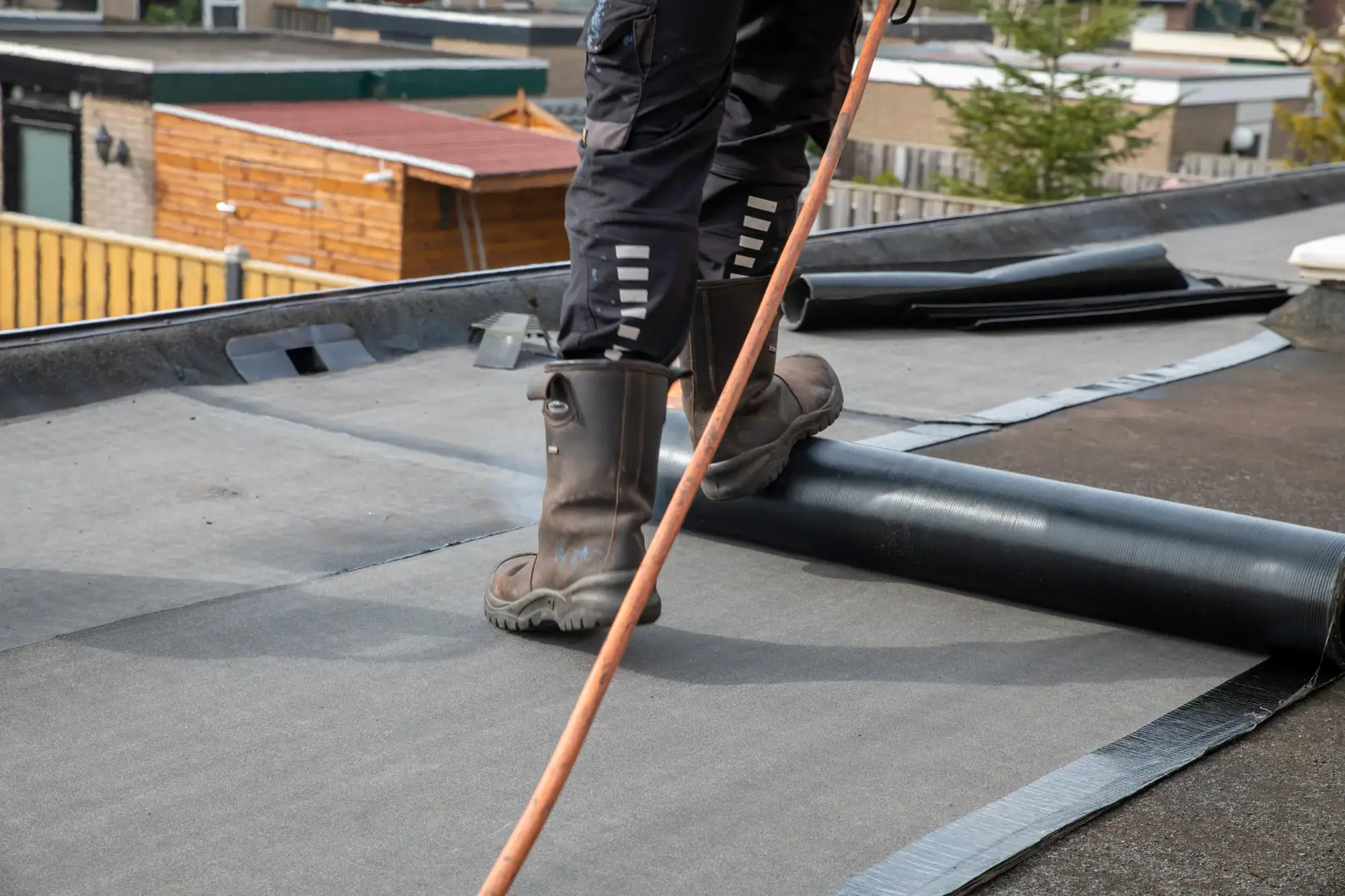
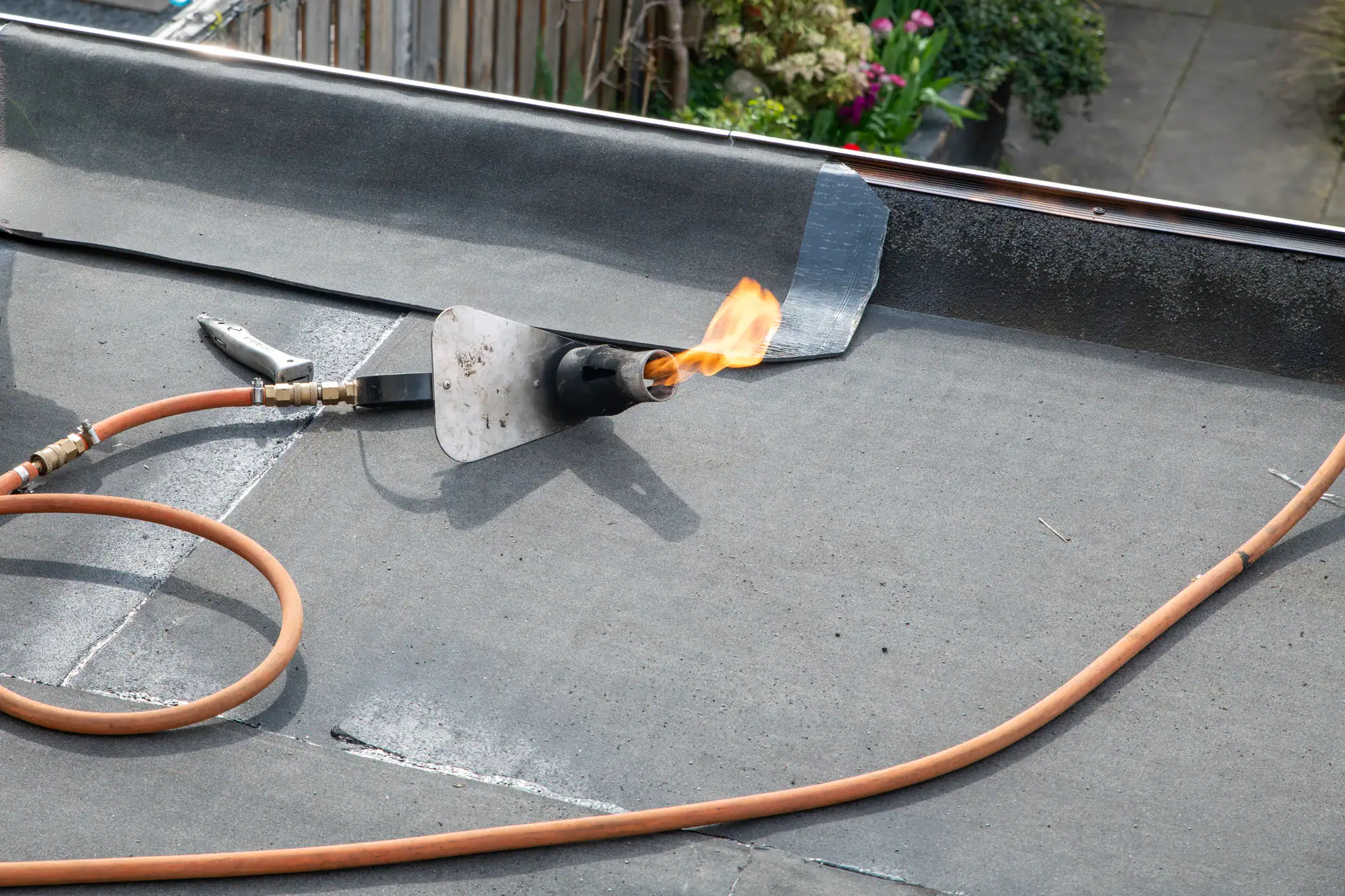
Once the job starts, the existing membrane comes off, the deck gets inspected and repaired where needed, insulation is addressed, and the new membrane goes down with properly heat-welded or adhered seams and flashing at every penetration and edge. When the job is done, the site is cleaned up completely. No nails in the driveway, no debris left behind.

Ready to get started?
Not every flat roof is the same, and the material that makes sense for a 1960s commercial building on Main Street is not necessarily the right call for a newer residential garage addition on the edge of town. We work with the full range of flat roofing systems — TPO, EPDM, modified bitumen, and PVC — and the recommendation you get will be based on your building’s age, use, drainage setup, and exposure.
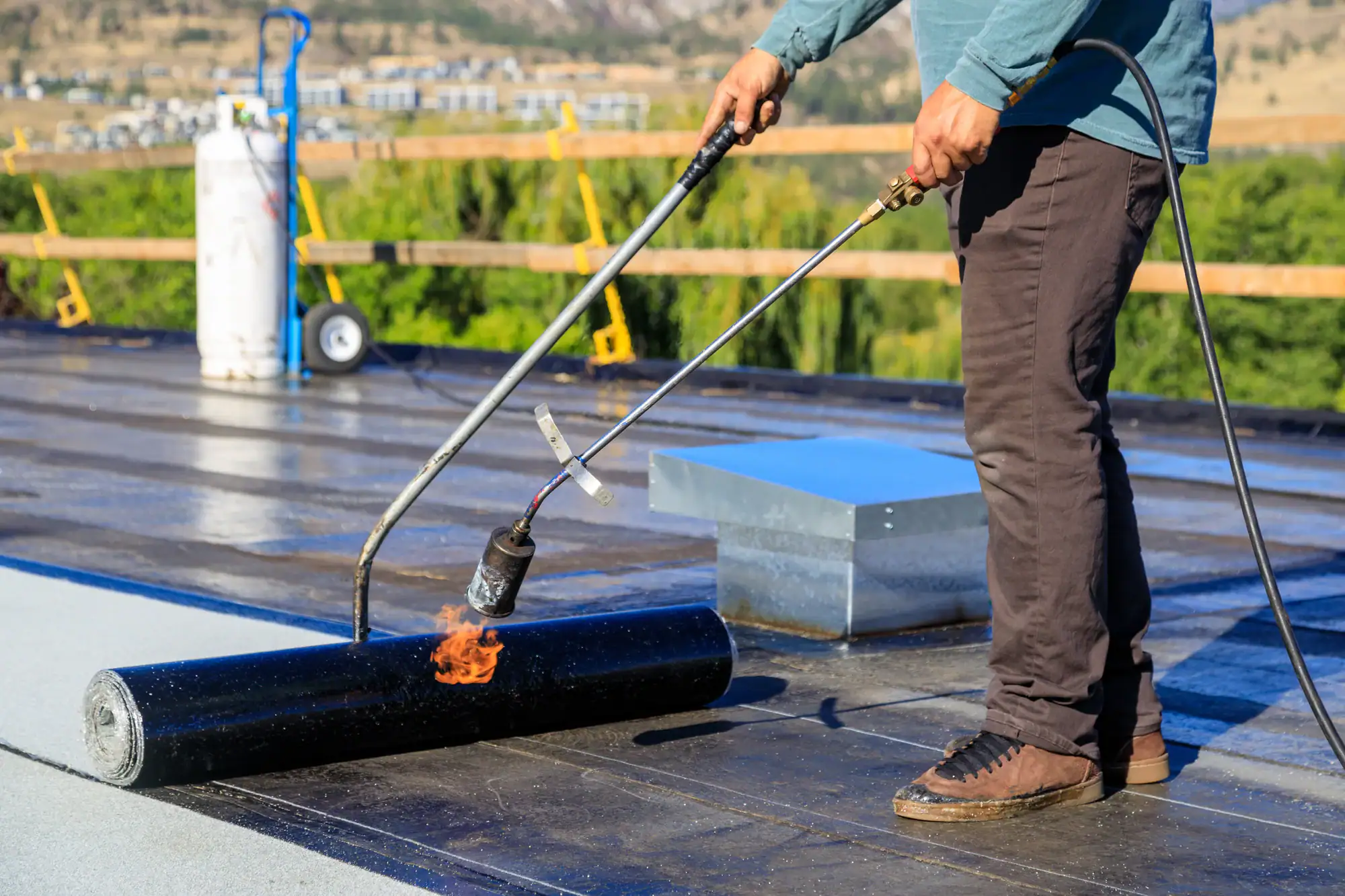
TPO roofing membrane is the most common choice for commercial flat roofs right now, and for good reason. It reflects a significant portion of solar load, which keeps cooling costs down during Delaware’s humid summers, and the heat-welded seams create a watertight bond that holds up well under the kind of repetitive rain cycles Clayton sees. EPDM rubber roofing is the go-to for residential applications and situations where flexibility through freeze-thaw cycling matters most — it’s been the proven standard for decades and can last 20 to 30 years when installed correctly. Modified bitumen, sometimes called torch-down roofing, is still a solid option for certain older structures and low-slope applications, though it requires careful attention to seam integrity in climates with significant temperature swings.
Beyond the membrane itself, roof waterproofing comes down to drainage design, flashing quality, and how well the system handles ponding water. In Clayton’s flat landscape near Duck Creek, getting the drainage right isn’t optional — it’s the whole job. We also handle siding, gutters, windows, and skylights, so if your flat roof project connects to broader exterior work, that can be coordinated under one contractor rather than juggled across multiple.

The honest answer is that you usually can’t tell from the ground, and even a basic visual inspection from a ladder won’t give you the full picture. The membrane surface might look intact while the seams have separated, or the deck underneath might have soft spots from water that got in months ago and never dried out. A proper assessment means getting on the roof and checking the membrane condition, the seams, the flashing at the edges and around any penetrations, and the drainage outlets.
In Clayton specifically, the flat topography near Duck Creek means water doesn’t always drain away from structures quickly after a heavy rain. If your roof has been holding standing water for more than 48 hours after a storm, that’s the industry threshold for concern — and it’s a sign that drainage is either blocked or poorly designed. Repairs can address isolated membrane damage, failed seams, or clogged drains. But if the membrane is aged, brittle, or showing widespread cracking, and especially if the deck underneath has taken on moisture damage, a full replacement is usually the more cost-effective path over a five-to-ten year horizon. We’ll give you a clear answer based on what’s actually on your roof.
EPDM rubber roofing consistently delivers the longest lifespan in Mid-Atlantic climates like Delaware’s, typically running 20 to 30 years when installed correctly. The reason it performs well here comes down to flexibility. Delaware’s winters bring freeze-thaw cycles that stress rigid materials — temperatures drop, the membrane contracts, and seams that weren’t properly adhered start to open up. EPDM stays flexible through that cycling in a way that older modified bitumen systems sometimes don’t, especially as they age and the mineral surface erodes.
TPO roofing membrane is the stronger choice when energy efficiency is a priority, particularly for commercial buildings. It reflects a high percentage of solar load, which matters during Clayton’s humid summers when cooling costs climb. TPO also uses heat-welded seams rather than adhesive, which creates a more durable bond at the joints — the most common failure point on any flat roof. Modified bitumen, or torch-down roofing, is still a reliable option for certain applications, but its lifespan of 15 to 20 years is shorter than either EPDM or TPO. The right answer depends on your building’s specific situation, and that’s exactly what our estimate process is designed to figure out.
Yes, if your property is within Clayton’s incorporated town limits, permits for roofing work go through the Town of Clayton’s own building permit process — not Kent County’s. Clayton maintains its own municipal permitting requirements, and roofing work that involves replacing or changing the roof material or system typically triggers a permit requirement. For properties in the unincorporated areas surrounding Clayton that fall under Kent County jurisdiction, the county’s building code applies, which generally requires a permit when replacing more than 25 percent of the roof sheathing or changing the roof material.
This distinction matters because the process and timeline can differ depending on which jurisdiction your property falls under. We handle permit coordination as part of the project — you don’t have to figure out which office to call or what documentation is required. Delaware follows International Building Code and International Residential Code standards at the local level, and the installation work is done to meet those standards. The permit process exists to protect you as the property owner, and skipping it can create problems when you sell or file an insurance claim.
Yes, and this is one of the more practical things we bring to the table. Delaware’s spring and summer storm season can bring damaging winds and heavy rain to the Clayton area, and when that results in flat roof damage, the insurance process can feel like a second problem on top of the first one. Adjusters are looking for documentation, and if the damage isn’t scoped and presented correctly, the settlement offer often reflects a patch rather than the repair or replacement the roof actually needs.
We help Clayton property owners document the damage thoroughly — photos, written assessments, and a clear scope of work that gives the adjuster an accurate picture of what happened and what it will take to fix it. We work with you through the claims process rather than handing you a quote and leaving you to figure out the rest. This is especially relevant for older commercial buildings in Clayton’s Downtown Development District corridor, where storm damage to a flat roof can affect not just the building but any active renovation investment tied to the DDD rebate program. Getting the insurance piece right protects that investment.
It depends on how long it’s sitting there. Some water on a flat roof immediately after a heavy rain is normal — the roof is designed to drain, not to shed water the way a pitched roof does. The concern starts when water is still standing 48 hours after the rain stopped. At that point, you’re past the drainage window, and the water is doing real work against your membrane.
In Clayton, this matters more than in some other areas because the town’s flat terrain near Duck Creek doesn’t give water a lot of natural encouragement to move. If your drainage outlets are partially clogged or your roof has developed any low spots from structural settling, water will find those areas and sit. Over time, standing water accelerates membrane degradation, adds structural load to the deck, promotes mold and algae growth, and in winter, it freezes — expanding in the membrane and forcing seams apart. It can also void manufacturer warranties on newer membranes if it’s a recurring condition. If you’re noticing ponding water after storms, it’s worth having someone look at the drainage design, not just the membrane surface.
Older commercial buildings along Clayton’s Main Street corridor — many of which predate modern roofing membranes — tend to present a specific set of challenges. The decks are often wood or older concrete that may have absorbed moisture over decades. The drainage systems were designed for a different era and may not move water efficiently by today’s standards. And the existing membrane, if it hasn’t been replaced recently, is likely a modified bitumen or built-up system that’s reached or exceeded its useful life.
For these buildings, the assessment phase is especially important. Before recommending a membrane, we look at the deck condition, the drainage layout, and any penetrations — HVAC units, vents, skylights — that need to be properly flashed. If the deck has taken on moisture damage, that has to be addressed before the new membrane goes down, or you’re just covering up a problem. For property owners in Clayton’s Downtown Development District who are undertaking qualifying improvements and looking at state rebates of up to 20 percent on capital costs, a flat roof replacement done correctly from the deck up is the kind of investment the DDD program is designed to support. Getting it right the first time is what makes that investment hold its value.
Other Services we provide in Clayton