How Long Does Roof Replacement Take? Here’s What Delaware Homeowners Need to Know
Determining how long does roof replacement take is a primary concern for homeowners planning a renovation. For most residential properties in Delaware, a professional Delaware roofing company can complete a full tear-off and installation in 1 to 3 days. While the timeline varies based on the complexity of the structure, the majority of asphalt shingle projects are finished within a 48-hour window.
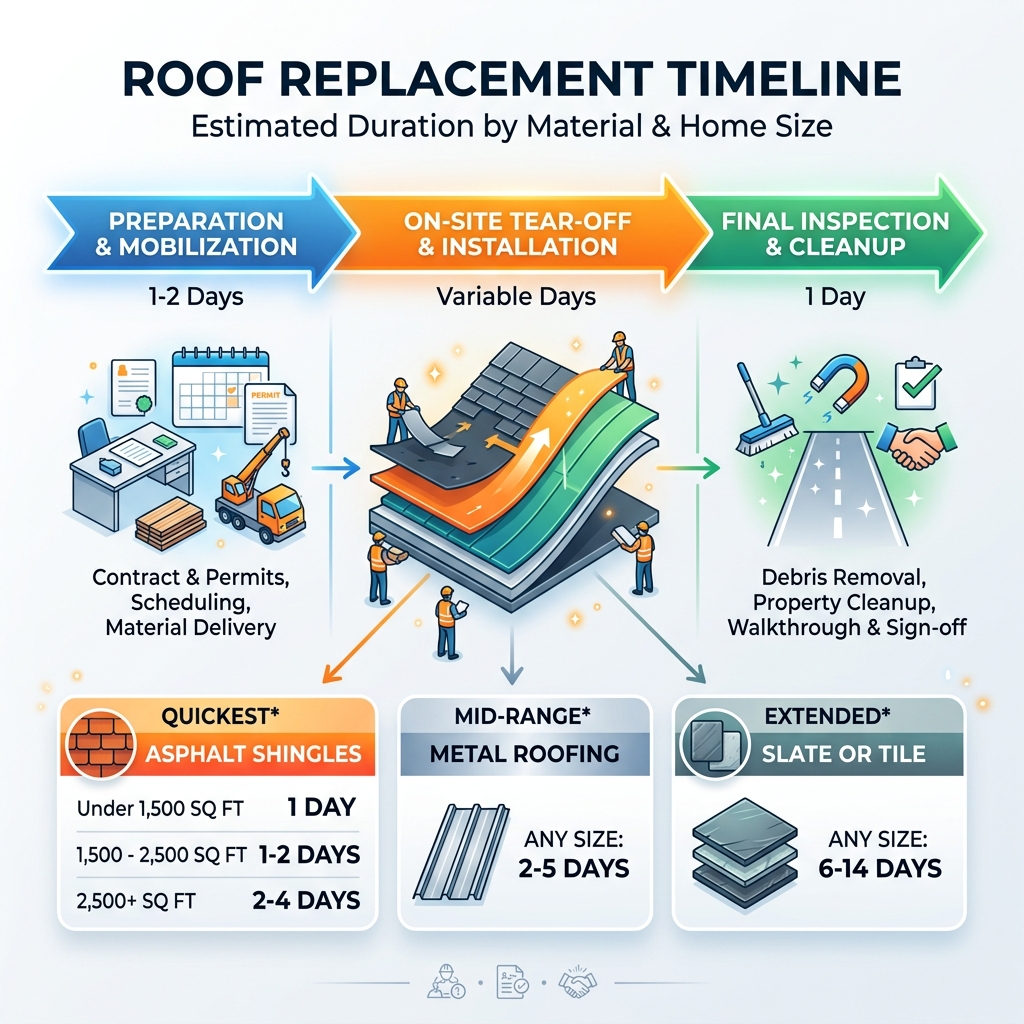
| Home Size | Typical Material | Time to Complete |
|---|---|---|
| Under 1,500 sq ft | Asphalt shingles | 1 day |
| 1,500 – 2,500 sq ft | Asphalt shingles | 1-2 days |
| 2,500+ sq ft | Asphalt shingles | 2-4 days |
| Any size | Slate or tile | 6-14 days |
| Any size | Metal roofing | 2-5 days |
Most residential roof replacements are completed within 1-3 days once work begins. Complex roofs, premium materials, or unexpected deck damage can push that to a week or more.
Several factors shape the final timeline — roof size, pitch, material type, crew experience, weather, and hidden damage discovered during tear-off. We’ll walk through each one clearly so you know exactly what to expect before the first nail goes in.
I’m Richard McCain, Owner and President of First State Roofing & Exteriors, and with over 20 years of hands-on experience managing residential and commercial roofing projects across Delaware, I’ve seen how every variable — from a steep pitch to an unexpected rainstorm — can shift the answer to how long does roof replacement take. In the sections below, I’ll give you a realistic, no-fluff breakdown of what drives your timeline and how to keep your project on track.
Related content about how long does roof replacement take:
Typical Timelines: How Long Does Roof Replacement Take?
When we talk about “average” timelines, we are usually referring to a standard North American single-family home, which typically measures around 2,200 to 2,500 square feet. For a home of this size using asphalt shingles, the actual installation phase is surprisingly fast. Most professional crews can strip and reroof a standard home in just one to two days.
However, the clock doesn’t start and stop with the banging of hammers. The total project timeline—from your first phone call to the final inspection—usually spans one to three weeks. This includes the time needed for an on-site estimate, material ordering, and scheduling around the Delaware weather.
The material you choose is the single biggest “time-shifter” in the process. While asphalt is the king of speed, premium materials require specialized techniques. For a deeper dive into why asphalt is such a popular choice for quick turnarounds, check out our Asphalt Roof Replacement Ultimate Guide.
Material Installation Comparison
| Material Type | Installation Time | Why It Takes This Long |
|---|---|---|
| Asphalt Shingles | 1-3 Days | Lightweight and easy to nail down in a non-linear workflow. |
| Metal Roofing | 2-5 Days | Requires precise alignment and specialized fasteners for expansion. |
| Wood Shakes | 3-8 Days | Labor-intensive; each shake often requires individual placement. |
| Synthetic Slate | 3-5 Days | Faster than natural slate but requires more care than asphalt. |
| Natural Slate | 6-14 Days | Extremely heavy; requires structural checks and slow, careful handling. |
| Concrete/Clay Tile | 8-12 Days | Heavy and fragile; requires specialized flashing and slow installation. |
7 Critical Factors Influencing Your Project Duration
If you’ve ever wondered why your neighbor’s roof took one day while yours is scheduled for three, it usually comes down to these seven variables. Understanding these will help you get a more accurate estimate of how long does roof replacement take for your specific property.
1. Roof Size (Measured in “Squares”)
In the roofing industry, we measure size in “squares.” One square equals 100 square feet of roof surface. Naturally, a 1,500-square-foot roof will be finished much faster than a 4,000-square-foot estate. As a general rule, for every additional 1,000 square feet of roof, you should expect to add about half a day to a full day of labor.
2. Roof Pitch (Steepness)
Pitch refers to the angle of your roof. A “walkable” roof (lower pitch) allows the crew to move quickly and stage materials easily. Once a roof exceeds a 7:12 or 8:12 pitch, it is considered “steep.” On steep roofs, workers must use specialized safety harnesses and scaffolding, which naturally slows down the pace of work. Think of it like the difference between walking across a flat parking lot versus climbing a ladder; the latter requires much more caution and time.
3. Complexity and Design Features
A simple “up-and-over” gable roof is the fastest to replace. However, complexity adds hours. Every time a roof has a valley (where two roof planes meet), a dormer, a chimney, or a skylight, the crew must stop to cut shingles and install specialized flashing. These penetrations are the most common spots for leaks, so we never rush this part of the job.
4. Accessibility
Can we park our dump trailers right next to the roof line? Or do we have to carry old shingles across a manicured lawn and over a fence? If your home has tight property lines, extensive landscaping, or a long, narrow driveway, it takes longer to move materials up and debris down.
5. Weather Conditions
In Delaware, Mother Nature is the ultimate project manager. We cannot install shingles in the rain, as moisture trapped under the underlayment leads to rot. Extreme heat can also slow us down, as shingles can become too soft to walk on without scuffing. If a storm hits mid-project, we “dry-in” the roof with synthetic underlayment to keep your home safe until the sun returns.
6. Hidden Damage (The “Deck Rot” Factor)
We don’t truly know the condition of your roof until the old shingles are gone. If we find rotted plywood or a sagging roof deck, we must stop and perform carpentry repairs. Replacing a few sheets of plywood might only add two hours, but a full re-sheathing can add an entire day to the project. For more on how we handle these surprises, see our Roofing Installation Complete Guide.
7. Crew Experience and Size
A “two-man-and-a-truck” operation will always take longer than a professional, coordinated crew. At First State Roofing & Exteriors, we scale our workforce to the size of the job. For a 3,000-square-foot home, we might send a crew of six to eight specialists to ensure the job is “dried-in” and secured before the end of day one.
Step-by-Step: The Anatomy of a 48-Hour Roof Replacement
To help you visualize the process, here is what a typical two-day asphalt shingle replacement looks like.

Day 1: The “Demo” and “Dry-In”
- Property Protection: We begin by draping heavy-duty tarps over your landscaping, decks, and windows. We may use plywood to protect AC units.
- Tear-Off Phase: The crew removes the old shingles and underlayment down to the bare wood deck. This is the loudest and messiest part of the job.
- Deck Inspection: Once bare, we inspect the wood for rot or soft spots.
- Dry-In: We install the drip edge, ice and water shields in the valleys, and synthetic underlayment across the entire deck. By the end of day one, your home is water-tight, even if the shingles aren’t all on yet.
Day 2: Installation and Cleanup
- Shingle Installation: The crew begins laying the new shingles, starting from the eaves and working toward the peaks.
- Flashing and Ventilation: We install new flashing around chimneys and vents, and set the ridge vents at the peaks to ensure your attic breathes properly.
- Final Cleanup: We perform a “magnetic sweep” of your yard to catch stray nails and remove all debris.
- Final Inspection: A supervisor walks the roof to ensure every shingle is laid to manufacturer specifications.
If you are curious about the costs associated with this multi-step process, our guide on the Average Cost to Tear Off and Replace Roof provides a transparent breakdown.
Preparing Your Home to Minimize Delays
You play a vital role in determining how long does roof replacement take. A prepared job site allows our crew to start immediately and work without interruption.
- Vehicle Relocation: Please move your cars out of the driveway and away from the house the night before. This gives us room for our dump trailers and prevents any fallen debris from scratching your vehicle.
- Attic Preparation: The vibration from hammers can knock dust or small debris loose in your attic. Cover any valuable items stored there with old sheets or plastic.
- Pet and Child Safety: The noise can be stressful for pets, and the falling debris makes the yard a “no-go” zone for children. Plan to keep them indoors or away from the house during work hours.
- Clear the Perimeter: Move patio furniture, potted plants, and grills away from the house. If you have a locked gate, please ensure we have access to the backyard.
- HOA and Permits: While we typically handle the building permits in Delaware, ensure you have notified your Homeowners Association (HOA) if they require approval for shingle colors.
For a full checklist on getting your property ready, visit our Roofing Services Roof Replacement page.
Frequently Asked Questions About Roof Timelines
Can you stay in your home during a roof replacement?
Yes, you can absolutely stay in your home, but you should be prepared for a very noisy experience. There will be constant hammering, the sound of shingles sliding down the roof, and occasional vibrations that can be felt throughout the house. If you work from home or have sensitive pets or infants, we often recommend spending the day at a library or a friend’s house. We maintain a strict safety zone around the house, so you’ll need to use designated entry and exit points.
How long does roof replacement take for commercial buildings?
Commercial roofs are a different beast. Because they often involve large, flat surfaces and complex systems like TPO or EPDM, the timeline usually ranges from one to five weeks. The scale of the building and the need to keep the business operational during the install are the primary factors here. We work closely with Delaware business owners to schedule work in phases, ensuring minimal disruption to your customers and staff.
How long does roof replacement take in Delaware weather?
Delaware’s climate presents unique challenges. In the spring, frequent rain showers can cause “stop-and-go” schedules. In the winter, we have to watch for frost; asphalt shingles require a certain temperature to “seal” properly. If it’s too cold, we may need to use specialized hand-sealing techniques, which adds a bit of time. Generally, the most efficient months for a quick replacement in areas like Seaford, DE or Milford are late spring and early fall.
Conclusion
At First State Roofing & Exteriors, we know that your time is valuable. While the answer to how long does roof replacement take depends on the unique characteristics of your home, our goal is always to provide a “one-and-done” experience that combines speed with uncompromising quality. As a family-owned Delaware company, we treat your home like our own, ensuring that when we leave, the only sign we were there is your beautiful, durable new roof.
Don’t let a deteriorating roof cause more damage to your home. We provide free estimates and invite you to call First State Roofing & Exteriors at (302) 222-4065 for a free inspection today. We are available 24/7 to help you protect your most important investment.
For more information on the entire process, browse our Roof Replacement Complete Guide.