
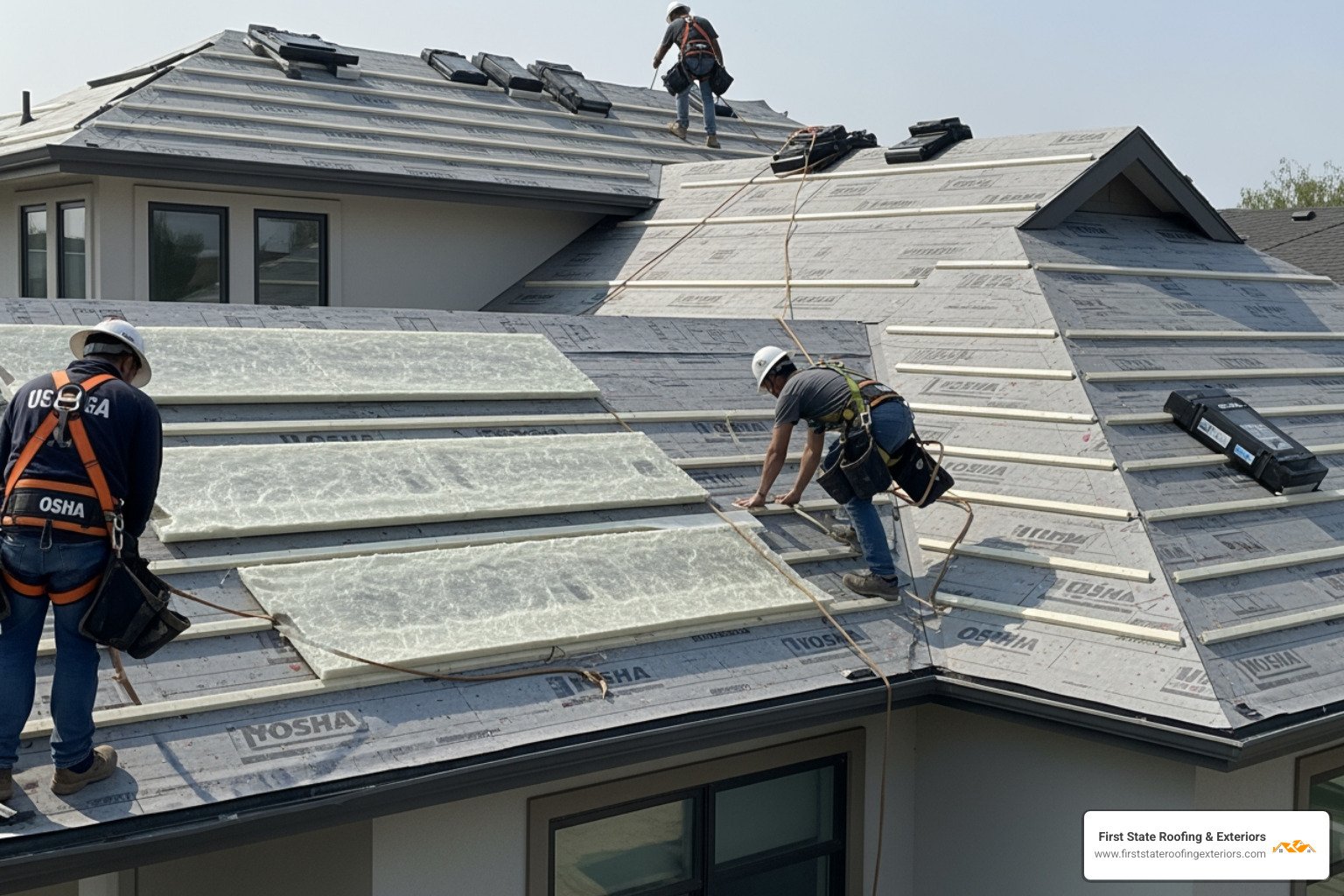
Most homeowners hire a roofing contractor two or three times in their lives. That’s not enough experience to know what you don’t know — and the roofing industry has no shortage of contractors who count on exactly that. In Kent County, where nor’easters roll in off the Delaware Bay and summer storms can strip a roof in minutes, the stakes are real. The right contractor protects your home for decades. The wrong one leaves you with a failed roof, a voided warranty, and nobody picking up the phone. These 10 questions give you a framework that cuts through the noise before you ever put pen to paper.
What to Ask About Credentials and Legitimacy
Before anything else — materials, timelines, price — you need to know who you’re actually dealing with. In Delaware, a roofing contractor is required to hold a Contractor Registration Certificate through the Delaware Department of Labor, submit an OSHA safety plan, and carry workers’ compensation insurance for any employees. A general business license is not the same thing. It’s a tax registration, nothing more. It tells you nothing about a contractor’s qualifications, training, or accountability.
Ask any contractor you’re considering to show you their registration and insurance certificates. A reputable contractor hands those over without hesitation. If there’s resistance, that’s your answer.
Are You Licensed, Registered, and Insured — and Can You Prove It?
This sounds basic, but the way a contractor responds tells you a lot. There’s a meaningful difference between a contractor who says “yes, we’re licensed and insured” and one who hands you a certificate of insurance on the spot and tells you exactly how to verify our Delaware contractor registration with the Division of Revenue.
Workers’ compensation coverage matters more than most homeowners realize. If a crew member is injured on your property and the contractor doesn’t carry workers’ comp, you could be held liable. That’s not a hypothetical — it’s a real exposure that comes up more often than it should. General liability insurance protects against property damage during the job. Both coverages should be current, not expired, and the certificates should name your address.
Manufacturer certifications are a separate but equally important layer. A contractor who holds GAF Master Elite certification, for example, has been vetted by GAF directly — our licensing, customer satisfaction history, financial stability, and work quality all reviewed before that designation is granted. It’s a status held by fewer than 2% of roofing contractors in the country. That’s not marketing language. That’s a third-party validation that the contractor has cleared a bar most haven’t.
When you’re comparing contractors in Kent County, ask each one specifically: what certifications do you hold, who issued them, and what did it take to earn them? The answers will tell you a great deal about who you’re working with.
Will Your Own Crew Be Doing the Work, or Are You Subcontracting It?
This is one of the most important questions to ask a roofing contractor, and one of the most frequently skipped. Many contractors sell the job themselves and then hand it off to a subcontracted crew — people you’ve never met, who may or may not carry their own insurance, and who have no direct relationship with the company whose name is on the contract.
The problem isn’t subcontracting itself — it’s the lack of transparency around it. When the crew showing up Monday morning is a different company entirely, the accountability chain gets murky fast. If something goes wrong during installation, who’s responsible? If the subcontractor’s worker is injured on your property and they don’t carry workers’ comp, you’re exposed again.
Ask directly: are the people doing the work your employees? If the answer is no, ask whether the subcontractors carry their own insurance and whether you can verify it. A contractor who manages the entire project with their own team — from tear-off to final inspection — removes that ambiguity entirely. You know who’s on your roof, who they answer to, and who’s accountable if something doesn’t go right.
In a market like Kent County, where storm damage can create a sudden rush of roofing work and contractors scramble to keep up with demand, the subcontracting question becomes even more relevant. Surge periods are exactly when corners get cut and unfamiliar crews get brought in. Know what you’re agreeing to before you sign.
Questions to Ask About Warranties, Permits, and What Happens After the Job
The questions above help you vet who the contractor is. These next ones help you understand what you’re actually buying — and what protection you have once the crew packs up and leaves.
A roof replacement is a long-term investment. The work itself might take one to three days. The warranty is supposed to last decades. Those two things need to align, and it’s your job to make sure they do before you sign anything.
What Does the Warranty Actually Cover — Materials, Workmanship, or Both?
Most homeowners assume “warranty” means the roof is covered. The reality is more specific, and the distinction matters a great deal.
There are two separate warranties on any roofing job. The manufacturer’s material warranty covers defects in the shingles or membrane itself — if the product fails due to a manufacturing issue. The workmanship warranty covers the installation — if the roof leaks or fails because of how it was installed. These are entirely different protections, issued by different parties, and they don’t automatically come together.
Here’s why this matters: most roofing failures aren’t caused by defective materials. They’re caused by improper installation — flashing that wasn’t sealed correctly, underlayment that was rushed, ridge caps that weren’t fastened properly. The workmanship warranty is the one that actually protects you against the most common failure modes. And standard workmanship warranties from non-certified contractors often last just one year.
By contrast, a contractor with GAF Master Elite certification can offer the GAF Golden Pledge® Limited Warranty — 50 years of material coverage and 25 years of workmanship coverage. That warranty also includes a 40-point factory inspection of the completed roof. It’s the most comprehensive residential roofing warranty available, and it’s only accessible through contractors who’ve earned that certification.
Ask every contractor you meet with: what does your workmanship warranty cover, how long does it last, and who backs it? Then ask what it would take to qualify for the manufacturer’s strongest warranty. The answers will tell you immediately whether you’re talking to someone who can actually deliver long-term protection or someone offering the minimum.
Will You Pull the Permit — and Can You Help With My Insurance Claim?
Two questions that often get overlooked, but both carry real consequences.
On permits: roof replacements require a permit in most Delaware jurisdictions, including Kent County. A contractor who suggests skipping the permit to save time or money is waving a red flag. Unpermitted work can void your homeowner’s insurance coverage, create legal complications when you sell the home, and leave you without the required inspections that confirm the work was done correctly. We handle the permit process as a standard part of the job — not as an optional add-on.
On insurance claims: this one is especially relevant in Kent County, DE. Delaware’s coastal geography puts the area in the path of Atlantic storm systems, nor’easters, and hurricane remnants that periodically cause significant roof damage. After a major storm, the insurance claim process can feel overwhelming — especially when you’re also trying to find a contractor, manage temporary repairs, and keep your household running. Ask any contractor you’re considering whether they work directly with insurance providers and what that process looks like in practice.
There’s also a specific thing to watch out for here: an Assignment of Benefits agreement. Some contractors will ask you to sign an AoB at the outset, which transfers control of your insurance claim to them. This is a fraud vector that removes your oversight from the process. A contractor who asks you to sign one before any work has been assessed or agreed upon is not protecting your interests.
One more thing worth asking: what’s your down payment policy? Industry guidance is clear — a deposit should not exceed 20% of the projected total. Any contractor asking for 50% or more upfront before work begins is a significant warning sign. Legitimate contractors don’t need that kind of cash in hand before a shingle has been touched.
Choose a Roofing Contractor in Kent County, DE With Confidence
The right contractor answers every one of these questions clearly, without hesitation, and without making you feel like you’re being difficult for asking. That confidence isn’t arrogance — it’s what accountability looks like when a contractor has nothing to hide.
Kent County homeowners deal with more than the average share of roofing stress. The rainfall here runs above the national average, coastal storms bring real wind and water damage, and the post-storm period brings its own wave of out-of-state contractors who won’t be around to honor a warranty. Knowing the right questions to ask is how you protect yourself before any of that becomes your problem.
If you’re in the process of comparing contractors right now, we’d be glad to walk through any of these questions with you directly. First State Roofing & Exteriors Co. offers free roof estimates with no pressure and no obligation — just a straightforward conversation about what your roof needs and what it would take to get it done right.